

Disclosure: This post contains affiliate links. If you purchase through them, I may earn a small commission at no extra cost to you. I only recommend things I’d genuinely use.
It doesn’t announce itself with a dramatic breakdown. It creeps in quietly — the Sunday dread, the lessons you keep pushing to “tomorrow,” the moment you snap at your kid over something tiny and then sit in the bathroom wondering what is wrong with you.
Homeschool mom burnout is real, it’s common, and it looks nothing like what you thought it would when you started this. The moms who experience it aren’t the ones who didn’t love this enough. They’re usually the ones who loved it too much — who gave everything, planned everything, and forgot to keep anything for themselves.
Here’s what’s actually happening, why it happens to the most dedicated homeschool moms, and what recovery looks like — practically, not just in theory.
What Homeschool Mom Burnout Actually Looks Like
Burnout isn’t just being tired. Every mom is tired. Burnout is when the tiredness doesn’t go away after rest — when you wake up already depleted, and the day hasn’t even started.
Some signs that what you’re feeling is burnout, not just a rough week:
- You feel resentful toward homeschooling — or toward your kids — in ways that feel foreign and guilt-inducing
- You’ve stopped planning because planning feels pointless
- You’re going through the motions but not actually present during lessons
- The curriculum you loved feels like a burden
- You find yourself fantasizing about putting your kids in school — not because it’s the right choice, but just to have a day where you’re not responsible for everything
- You cry more than usual, or you’ve stopped feeling much of anything
- You’ve started to question whether you’re actually good at this
If several of those landed, you’re not broken. You’re burned out. And those are different things.
Why Homeschool Moms Burn Out (The Real Reasons)
Understanding the cause matters because “just take care of yourself” is useless advice when you don’t know what’s actually draining you.
You’re doing two full-time jobs simultaneously
You are the teacher, the curriculum coordinator, the schedule keeper, the classroom manager, the social planner, and the mom. These roles don’t take turns — they all show up at once, often in the same hour. Traditional teachers get to go home. You don’t.
The bar you set is unmeetable
Homeschool moms tend to be high-achieving, intentional people. The same drive that made you choose this path also makes you hold yourself to standards that no human could consistently meet. When the day goes sideways, it doesn’t feel like a normal bad day — it feels like evidence that you’re failing. If this resonates, you might also recognize yourself in what to do when your homeschool day falls apart.
There’s no separation between work and life
When your home is your school, there’s no leaving work at work. The math books are on the table. The unfinished project is on the counter. The child who pushed back on every lesson today is at dinner with you. The role never fully turns off.
You’re isolated in a way that’s hard to explain
Even if you have a homeschool community, the specific texture of your struggle — the burnout, the doubt, the days where nothing worked — isn’t easy to share. There’s an unspoken pressure to project confidence and intentionality, because you chose this path and you feel like you should be defending it.
How to Actually Recover from Homeschool Burnout
Recovery from burnout isn’t a single action. It’s a series of small decisions that accumulate. Here’s what actually helps — starting with what helps fastest.
Step 1: Stop and name it
You can’t fix what you’re pretending isn’t happening. Say it out loud, or write it down: I am burned out. Not “stressed,” not “in a slump” — burned out. That word matters because it removes the shame. Burnout is a physiological response to chronic stress, not a character flaw.
Step 2: Take a real break — not a partial one
A real break means school stops for a few days. Not “lighter school” — an actual stop. Pull out the audiobooks, the documentaries, the independent reading. Let things be unstructured for a week. The learning gap you’re afraid of creating is smaller than the damage of continuing on fumes.
Use the time to sleep more, move your body, and do something that has nothing to do with your children’s education. A lot of moms find journaling helps — something like a guided journal for moms gives you a place to process without it turning into another to-do list.
Step 3: Audit what’s actually on your plate
Get a piece of paper and list everything you’re managing. Every subject, every extracurricular, every co-op, every curriculum you’re trying to integrate. Then ask: what would happen if this one thing stopped?
You’ll find things on that list that can be dropped entirely, delegated, or replaced with something simpler. Burnout thrives in overcomplication. Simplifying the school load is not giving up — it’s strategic. If your schedule itself is the problem, it might be worth rebuilding it from scratch with a homeschool schedule that actually works — simpler than what most people think they need.
Step 4: Build structure that protects you, not just your kids
Most homeschool schedules are built entirely around children’s needs. The mom appears in the schedule as a function — teacher, planner, cook — never as a person with needs of her own.
When you rebuild after burnout, put your non-negotiables in first: the quiet hour, the solo walk, the time where you are not available for questions. A family weekly routine that includes space for the adults in it is more sustainable than one that doesn’t. One small tool that genuinely helps: a visual timer on the table means kids know exactly when “quiet time” ends without asking you every four minutes.
Step 5: Lower the bar — temporarily and intentionally
During recovery, “good enough” is the goal. Three core subjects done calmly beats five subjects done miserably. A short focused morning beats a long dragging afternoon. Give yourself permission to do less and do it better.
This isn’t a permanent downgrade. It’s a healing phase. You can expand again once you’ve stabilized.
What to Do When Your Kids Are Part of the Problem
Sometimes burnout isn’t caused by the load — it’s caused by the emotional weight of a specific child who is resistant, defiant, or struggling. This is harder to talk about because it feels like you’re blaming your kid.
But if one child’s behavior is a consistent source of daily friction, that needs its own conversation — separate from the burnout conversation. A few things that help:
- Separate the child from the schooling. What would your relationship with this child look like if you weren’t also their teacher? Sometimes kids need a break from being taught by the person they most want to just be loved by.
- Look at the emotional regulation piece. Kids who are emotionally dysregulated make teaching extremely hard. Emotional regulation activities done outside of lesson time can reduce friction significantly. And if big feelings are tipping over into daily meltdowns, having a dedicated calm-down corner gives your child somewhere to go before it escalates.
- Get outside support. A learning co-op, a tutor for one subject, an online class — outsourcing even one subject gives both of you a break from the dynamic.
How to Prevent Burnout the Second Time Around
Once you’ve burned out once, you know the early warning signs. The goal going forward isn’t to never feel tired — it’s to catch the drift early, before it becomes a crisis.
A few prevention habits that make a real difference:
- Plan shorter school weeks on purpose. Build a 4-day school week as your standard, not as a reward. That fifth day absorbs life without derailing the schedule.
- Do a monthly reset. Once a month, step back and ask: what’s working, what isn’t, what can be cut? Catching drift early prevents avalanche.
- Keep your curriculum simple. The most elaborate plan is not the best plan. The best plan is the one you can sustain through a bad month. Books like Simplicity Parenting are worth a read during recovery — the principles translate directly to homeschool.
- Use tools that reduce your daily cognitive load. Visual routine cards, printed schedules, chore systems — anything that reduces the number of decisions you make before 10am is protecting your energy. Morning routine cards are a small change with an outsized impact on how the day starts.
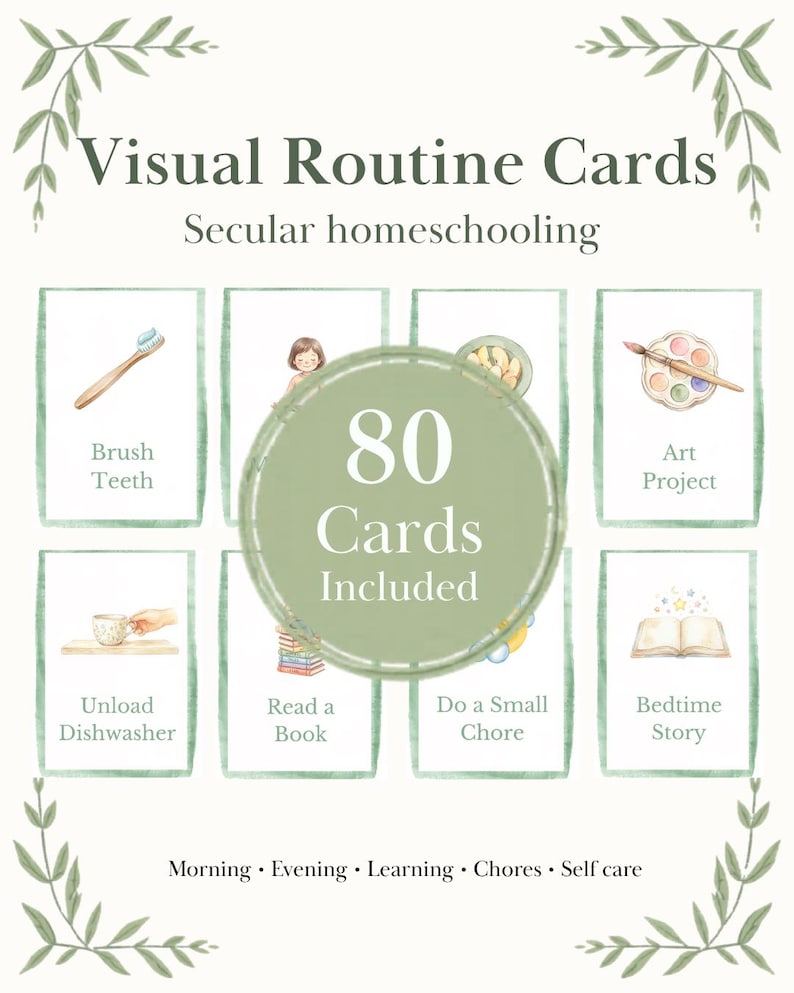
Visual Routine Cards for Kids (80 Cards)
Printable cards that hand the routine back to your child — morning, afternoon, evening, and chores. When kids can follow the routine independently, you get to stop being the reminder system.
- 80 illustrated cards across 4 routine categories
- Print once, use for years
- Designed for ages 3–10
You Don’t Have to Earn the Right to Rest
The most important thing to understand about homeschool mom burnout is this: it doesn’t mean you made the wrong choice. It means you’ve been running on a system that wasn’t built to sustain you.
The choice to homeschool was right. The way you’ve been doing it — without margins, without recovery time, without giving yourself the same patience you give your kids — that’s what needs to change.
Start small. Take the break. Simplify the plan. Put yourself back into the structure. A calmer, more rested version of you is a better teacher than the exhausted version who pushes through.
And if the mornings are where things tend to unravel first, it might help to start there — with a simple homeschool morning routine that doesn’t require you to orchestrate everything from scratch every single day.