This post contains affiliate links. If you buy through them, RaisingCuriousKids may earn a small commission at no extra cost to you. We only suggest things we’d put in our own home.
Your child is melting down over a sock seam, and you’re crouched on the floor trying to talk them out of a feeling that has no words yet. You’ve heard a calm-down corner is supposed to help. You’ve also seen the ones on Pinterest that look like tiny spas and wondered who has the time.
Here’s the part nobody says out loud. A calm-down corner doesn’t work because it’s pretty. It works because it gives a big feeling somewhere to go, and gives your child a few concrete things to do once they get there.
This is the simple version. A corner you can build this week, with tools that earn their spot, set up so your child can use it without you narrating every step.
What a calm-down corner actually is (and what it isn’t)
A calm-down corner is a small, predictable spot your child goes to when feelings get too big to handle in the moment. It’s not a time-out. It’s not a punishment. It’s a place to regulate, not a place to be sent.
The difference matters more than the decor. A time-out says “go away until you’re better.” A calm-down corner says “here’s a place that helps you get there, and I’ll be nearby.” Same corner, opposite message.
You also don’t need a whole room. A floor cushion in the corner of the living room counts. The goal is consistency, so your child knows exactly where to go before the storm hits.
The 4 things every calm-down corner needs
Skip the Pinterest extras. After the basics, more stuff usually means more distraction. These four cover what a dysregulated nervous system actually needs.
1. A soft, defined space
Kids regulate faster when their body feels contained. A floor cushion, a beanbag, or a small pop-up tent gives a clear boundary that says “this is the spot.”
Define it visually so it reads as separate from the play area. A small rug or a pouf is enough.
2. Something for the body to do
Big feelings live in the body before they reach words. A sensory tool gives that energy a safe outlet so the thinking brain can come back online.
A weighted lap pad, a few fidgets, or a stress ball all work. You’re looking for calming input, not a toy.
3. A way to name the feeling
This is the step most corners skip, and it’s the one that does the real work. A child who can point to “I feel frustrated” calms faster than one stuck in a wordless flood.
You don’t need to teach a vocabulary lesson mid-meltdown. You need a visual your child can point to when talking feels impossible, which is exactly what a feelings chart gives you. A feelings picture book like The Color Monster helps on calm days, but in the moment you want something faster to reach for.
This is exactly what our Feelings & Calm-Down Cards do. Sixteen feelings cards let your child point to what they’re feeling without having to find the word, and eight calm-down cards give them a concrete next move, like “take five slow breaths” or “squeeze and release.”
4. A calm-down strategy they can do alone
The whole point is independence over time. Pair the feeling with one repeatable action so the corner runs without you.
A visual timer helps here. A child who can see two minutes shrinking on a dial settles better than one told a vague “calm down.”
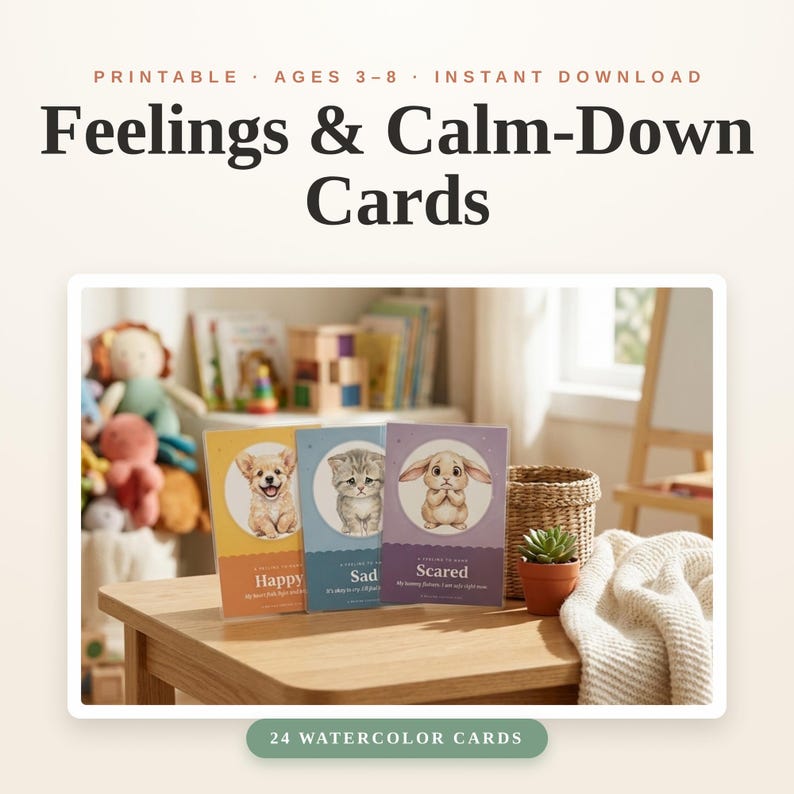
The printable that runs your calm-down corner
Feelings & Calm-Down Cards: 24 cards (16 feelings plus 8 calm-down strategies). Print, laminate, done. Launch sale $7.49.
Want the whole system? The Calm & Routine Bundle pairs them with Visual Routine Cards and Screen-Free Activity Cards (134 cards) for $19.99.
Want the calm-corner setup and a simple weekly rhythm in one place? Grab the free planner and we’ll send the printable straight to your inbox.
How to introduce the corner (so it’s not a punishment)
Introduce it on a good day, never mid-meltdown. Build it together, let your child name it, and do a calm practice run when everyone is regulated.
Practice the steps when nothing is wrong. Point to a feeling card, do the breathing, set the timer. A rehearsed routine is one a child can reach for when the real wave hits.
Then model it yourself. “I’m feeling overwhelmed, I’m going to take three breaths in our corner.” Kids copy what they see far more than what they’re told.
What to do when they refuse to use it
They will refuse, especially early on. That’s not failure, it’s normal. Don’t force it, and never drag a child to the corner, or you’ve turned it back into a punishment.
Instead, offer it as a choice. “Do you want to go to your calm spot, or sit with me for a minute?” Either answer is a win, because both are regulation.
Sometimes co-regulation comes first. Sit nearby, stay calm, and let your presence be the tool until they’re ready to use the corner on their own.
Keep it working past week one
The novelty fades fast. Refresh one element every few weeks, a new fidget or a rotated set of cards, so the corner stays inviting.
Tie it into the rest of your day too. A calm morning routine and a calm-down corner reinforce each other, and so do the emotional regulation activities you practice on ordinary days — the corner works best when it’s part of a toolkit, not a standalone fix.
Build it once, and let it carry the hard moments
A calm-down corner isn’t about raising a child who never falls apart. It’s about giving them a place to go and a few things to do when they do, so the falling-apart gets shorter and the bouncing-back gets easier.
Start with the four basics this week. Add the feeling cards and one calming strategy, practice on a good day, and let the corner do the work you’ve been doing on the floor at 7am.
When you’re ready, the Feelings & Calm-Down Cards take the guesswork out of the hardest step, naming the feeling, so your child can get there with less help from you each time.