The best learning doesn’t announce itself. It sneaks in through the back door, while your child is building something, arguing about something, or trying to figure out why something works the way it does. These 20 activities are designed for exactly that. Each one teaches something real. None of them feel like a lesson.
This post contains affiliate links. As an Amazon Associate I earn from qualifying purchases, at no extra cost to you.
1. The Estimation Jar
Fill a clear jar with small objects, dried beans, pennies, marbles. Ask your child to estimate how many are inside, then count together. Estimation is a genuine math skill, and this makes it a daily ritual.
2. Story Stones
Collect smooth stones from outside. Paint simple images on each one, a house, a boat, a wolf, a moon, a key. Your child pulls out five at random and invents a story that includes all of them. The constraints make the creativity stronger, not weaker.
3. Kitchen Science: Density Tower
Layer different liquids in a clear glass: honey, dish soap, colored water, vegetable oil, rubbing alcohol. Because each has a different density, they sit in separate layers. Drop small objects in and watch where they settle. This is physics.
4. The Nature Journal
Give your child a notebook specifically for recording what they observe outside. Not just what they see, what questions they have. The habit of noticing and asking is more valuable than any answer. Find it on Amazon.
5. Map Your Neighborhood
Go for a walk with paper and pencil. Your child’s job: draw a map of your street from memory after you return. Then compare to a real map. Geography and spatial reasoning, disguised as a walk.
6. Cooking With Math
Give your child a recipe and ask them to double it. Or halve it. Then actually make it. Fractions become concrete when they have to be measured in a real kitchen for a real result someone will eat.
7. The 20 Questions Taxonomy Game
One person thinks of any living thing. The other asks yes/no questions to identify it: Is it a mammal? Does it live in water? This quietly teaches biological classification and logical deduction at the same time.
8. Shadow Tracing
On a sunny day, trace the shadow of an object on the ground. Mark the time. Come back an hour later and trace it again. Watch how it moves. This is how ancient humans tracked time.
9. Build a Rube Goldberg Machine
Challenge your child to build a machine that performs a simple task using at least five steps. Use cardboard tubes, dominoes, ramps, books, toy cars, building bricks, whatever you have. Engineering thinking at its most joyful. Find it on Amazon.
10. Letter Writing
Find a pen pal, a grandparent, a cousin, a friend from another city. Real writing for a real audience does more for writing development than any worksheet.
Want to keep all these activities organized?
Grab the free Weekly Homeschool Planner, one page to plan your whole week without the overwhelm.
11. The Dissection
Buy a flower and take it apart together. Identify the petals, sepals, stamen, pistil, pollen. Draw each part. Label it. Most children find this genuinely fascinating when they’re doing it with their hands.
12. Audiobook + Drawing
Put on a good audiobook and let your child draw or build with bricks while they listen. The combination of listening and making produces deep comprehension and rich mental images. Find it on Amazon.
13. Museum at Home
Ask your child to pick ten objects that are meaningful to them and create a museum exhibit. Each object needs a label: what it is, where it came from, and why it matters. Give a tour to a family member.
14. The Newspaper Hunt
Give your child a real newspaper or print out news articles. Ask them to find: one story that made them feel something, one number they found surprising, one word they didn’t know. Media literacy starts here.
15. Blindfolded Taste Test
Prepare five foods with similar textures but different tastes. Blindfold your child and have them identify each by taste alone. This is sensory science and a surprisingly memorable experiment.
16. The Debate
Pick a low-stakes topic: should bedtime be earlier or later? Is a hot dog a sandwich? Assign sides and debate. Then switch sides. Argumentation and perspective-taking, wrapped in something funny.
17. Time Capsule
Help your child fill a box with things that represent this moment: a drawing, a list of current favorites, a photo, a letter to their future self. Seal it. Decide together when it should be opened.
18. Build a Solar System to Scale
This requires outdoor space, because the distances are humbling. Use online calculators to find scaled distances, mark them with stakes. By the time you reach Neptune, you’ll understand in your body why space is mostly empty.
19. Interview Someone
Teach your child to conduct an interview. Help them prepare five questions for a family member or neighbor. Record or write down the answers. This is oral history and human connection.
20. The Backwards Day
Once in a while: do everything in reverse order. Read aloud first. Math last. The novelty alone wakes up attention in a way that familiar structure can’t.
Want these ideas ready to grab?
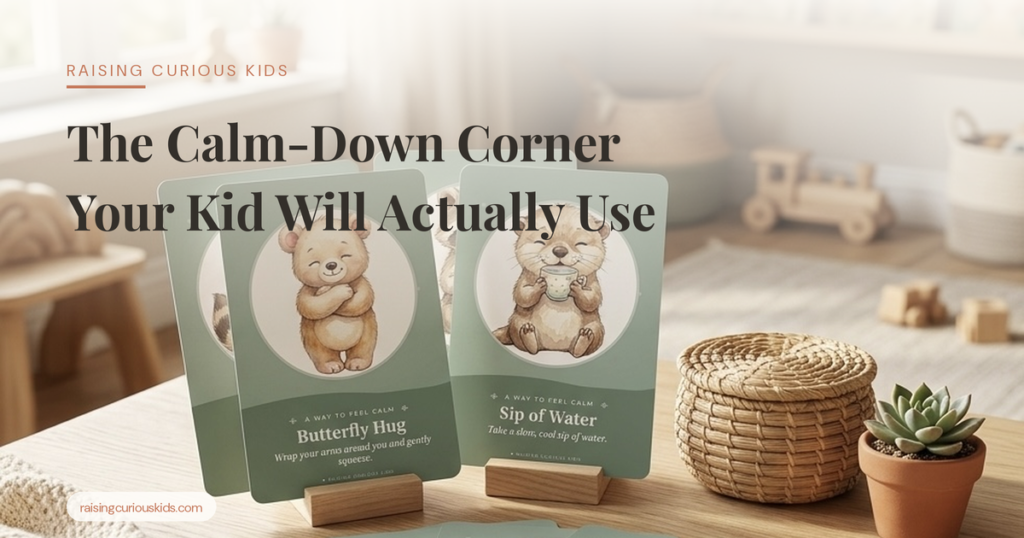
Our Screen-Free Activity Cards turn ideas like these into a deck your kids can pull from on their own, 30 cards across four categories: Independent Play, Outdoor and Active, Creative and Hands-On, and Together Time. No screens, no prep.
15 Screen-Free Indoor Activities for Kids