
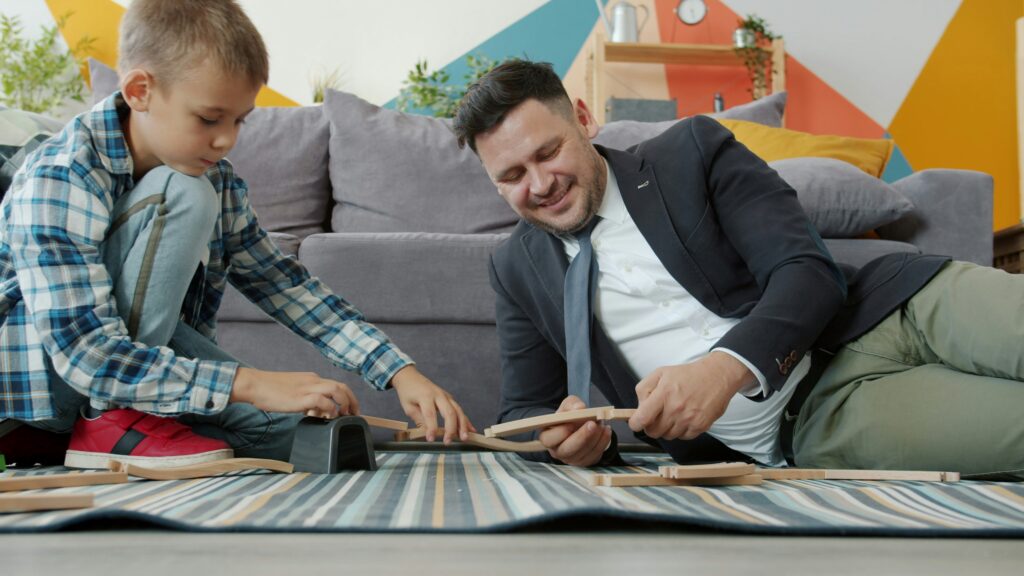
It’s raining. The toys have been played with. The TV has been watched. And somewhere in the house, a child is announcing, for the third time today, that they’re bored.
Screen-free doesn’t have to mean boring. It just means the fun has to come from somewhere else. Here are 15 activities that actually work, for kids, and for the adults who need five minutes of peace while they happen.
This post contains affiliate links. As an Amazon Associate I earn from qualifying purchases, at no extra cost to you.
1. Cardboard Box City
Give your child a large cardboard box, some smaller ones, tape, and markers. The assignment: build a city. Roads, buildings, parks, a hospital, a fire station. This can occupy an entire afternoon and continue for days. The city grows. Residents appear. Stories develop.
2. Blind Drawing Challenge
Sit back to back. One person describes an object or scene in detail. The other draws it without looking. Compare results. The gap between what was described and what was drawn is always funny, and always sparks a conversation about communication and perspective.
3. Indoor Obstacle Course
Chairs, pillows, blankets, masking tape on the floor. Build a course with a beginning, middle, and end. Time runs. Add challenges: crawl under the table, hop on one foot between the tape lines, spin three times before the finish. Change it every round.
4. The Sorting Game
Give younger children a collection of mixed objects, buttons, pasta shapes, coins, small toys, and ask them to sort however they want. The rule: they have to be able to explain their sorting logic. This is early math and classification thinking, disguised as play.
5. Puppet Show
Old socks, googly eyes, felt scraps, and a couch cushion turned on its side. Your child writes the script, makes the puppets, builds the stage, and performs the show. This is literacy, creativity, and performance wrapped into one activity that might last all morning. Find it on Amazon.
6. Kitchen Chemistry
Baking soda and vinegar is the classic for a reason, the reaction is immediate and satisfying. Add food coloring to the vinegar for extra drama. Move to exploring what else fizzes (citrus juice works), what doesn’t, and why. Write down predictions before each experiment.
7. Story Dice
Write six words or draw six simple pictures on separate pieces of paper, fold them, put them in a cup. Your child draws three and has to tell a story that includes all three elements. No wrong answers. The stranger the combination, the better the story.
8. Indoor Nature Museum
Go on a collection walk, around the house, in the garden, or out a window if the weather allows. Collect leaves, rocks, feathers, interesting objects. Come inside and arrange them into a museum. Each item gets a label. A curator’s note explains the collection.
Want to keep all these activities organized?
Grab the free Weekly Homeschool Planner, one page to plan your whole week without the overwhelm.
9. Marble Run
If you don’t have a marble run kit, improvise with cardboard tubes, books propped at angles, empty cereal boxes, and tape. The goal: get the marble from the top of the structure to the bottom using at least four separate runs. Engineering and problem-solving, no kit required. Find it on Amazon.
10. The Memory Tray
Place 15 objects on a tray. Give your child 60 seconds to memorize what’s there. Cover the tray. Remove one object without being seen. Uncover, which one is missing? This is a classic for a reason. Add difficulty by removing two objects, or by rearranging what remains.
11. Watercolor + Salt
Paint a wet wash of watercolor across paper. While it’s still wet, sprinkle table salt over the surface. Watch what happens as it dries. The salt absorbs the pigment and creates a crystalline, galaxy-like texture that looks far more sophisticated than the effort required. Find it on Amazon.
12. Build a Rube Goldberg Machine
Set a simple goal: ring a bell, drop a ball into a cup, knock over a block. Now build a machine that accomplishes it using at least five steps. Every step has to trigger the next one. Use whatever’s around the house. Expect it to take longer than expected. That’s the point.
13. Map Drawing
Ask your child to draw a map, of their bedroom, the house, the street, or an imaginary place. Include a legend. Mark important locations. Add a compass rose. Then ask them to navigate someone else through it using only the map and verbal directions.
14. Listening Walk (Inside Version)
Set a timer for three minutes. Sit completely still. Write down every sound you can hear. Compare lists. Count how many sounds there are in a quiet house. This is a mindfulness exercise, a science activity, and a writing prompt all in one.
15. The Interview Project
Your child is a journalist. They choose someone in the house to interview, a parent, a sibling, even a stuffed animal with a fictional biography. They prepare five questions in advance, conduct the interview, and write up a short article about what they learned.
Want the activities ready to grab?
Our Screen-Free Activity Cards put 30 of these ideas into a deck your kids can pull from on their own, across four categories: Independent Play, Outdoor and Active, Creative and Hands-On, and Together Time. The next bored afternoon answers itself.
20 Fun Learning Activities for Kids
Grab your free homeschool planner and bring some calm to your week. Get the free planner.