
You have decided to homeschool in Illinois, and now you are up late reading conflicting forum posts, trying to work out which form you file and which office you report to. Here is the part that lets you breathe: there is no form, and there is no office.
Illinois is one of the least regulated states in the country for homeschooling. No registration. No notice to anyone. No testing, no reporting, no annual paperwork of any kind.
That freedom comes from a specific place in the law, and it is worth understanding so you can homeschool with confidence instead of a nagging sense that you skipped a step. Here is exactly how it works.
Is Homeschooling Legal in Illinois?
Yes, and it has been settled since 1950. In People v. Levisen, the Illinois Supreme Court ruled that a home can qualify as a private school when the child is taught the subjects covered in the public schools. Illinois treats your homeschool as a private school, and private schools here are not licensed or monitored by the state.
That one ruling is the reason Illinois paperwork is close to nonexistent. You are not asking permission. You are running a private school of one, which the law already allows.
The rule lives in the compulsory attendance statute, Section 26-1 of the Illinois School Code. It exempts children who attend a private school where they are taught the branches of education taught to children of the same age and grade in the public schools, in the English language.
What Illinois Actually Requires
The list is short, and every item is something most families are already doing:
- Teach the core subjects. Cover the branches of education taught in the public schools, which in practice means language arts, math, science, and social studies, with attention to health and the fine arts.
- Teach in English. Instruction in the required subjects has to be in English. You can absolutely teach a second language on top of that.
- Actually educate. The instruction has to be real and in good faith, not the label used to keep a child out of school.
That is the whole list. No minimum number of days or hours. No mandated curriculum. No teaching degree. No test, and no report to anyone. Compulsory attendance in Illinois runs from age 6 to 17, so once your child reaches that age you are simply expected to be teaching the required subjects at home.
How to Actually Start
How you begin depends on one thing: whether your child is currently enrolled in public school.
If your child has never been enrolled
You just start. Choose your materials, cover the subjects, and begin. There is no one to notify first.
If your child is currently enrolled
Withdraw before you begin, or the school can keep counting your child absent and, in a worst case, refer the family for truancy. Send the district a short written letter stating that you are withdrawing your child to educate them in a private school at home, with the date. Send it in a way you can prove was received, like certified mail or tracked email, and keep a copy.
New to all of this? Our walkthrough on how to start homeschooling covers choosing curriculum and finding your rhythm in the first few weeks.
Do You Have to Keep Records in Illinois?
No. Illinois does not require you to keep attendance, grades, or samples of work. But a light record is still one of the smartest habits you can build, for reasons that have nothing to do with the state.
Records make the next thing easier: joining a co-op, applying to college, transferring back into public school, or answering a district that contacts you by mistake. A simple attendance log and a folder of work per year is plenty. Many families keep the current year within reach using a wall-mounted file organizer, so nothing important disappears into a backpack.
This post contains affiliate links. As an Amazon Associate I earn from qualifying purchases, at no extra cost to you.
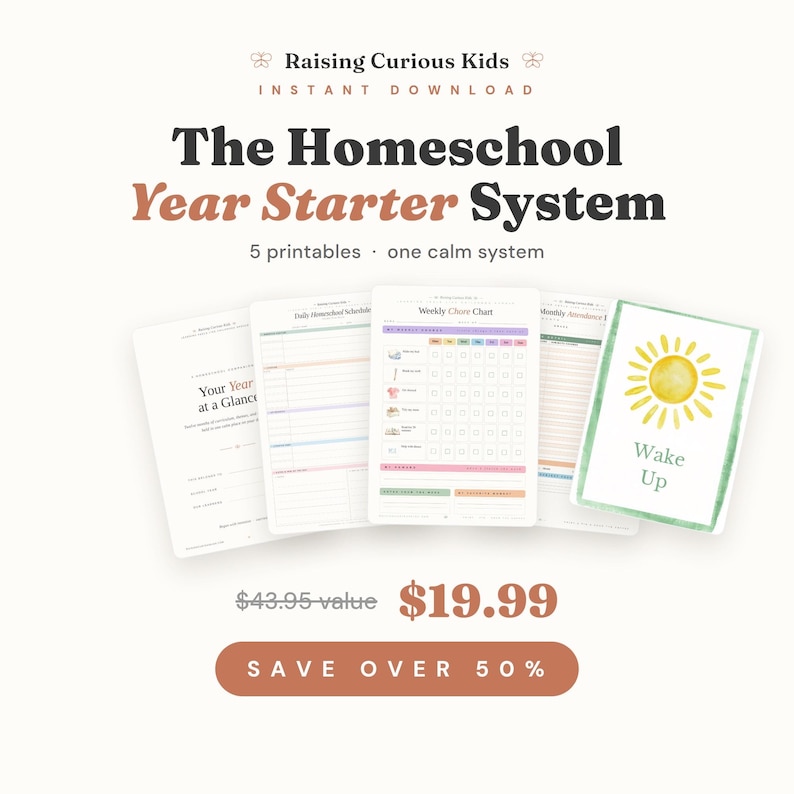
Everything for the Year, Records Included
The Attendance Tracker is one of five printables in our Homeschool Year Starter System: Year at a Glance, Daily Schedule, Attendance Tracker, Chore Chart, and 80 Routine Cards. A clean, print-and-go record for the whole year, plus the tools to plan and run it. Secular, no spreadsheet required.
$19.99 $43.95
Get the Year Starter System on Etsy →One Bill Worth Watching: The Homeschool Act
There is one piece of recent news every Illinois family should know about, because it comes up constantly in local groups. In 2025, a bill called the Homeschool Act (House Bill 2827) proposed requiring parents to file an annual notification form with their regional office of education, with truancy consequences for families who did not.
The bill moved through committee and a second reading, drew record public opposition, and then stalled before a floor vote. It did not become law. As of this writing, nothing has changed: Illinois still requires no notice and no registration.
What that means for you is simple. Homeschool under the current rules, which ask nothing of you, and check the official state source once a year or if you hear a similar bill is moving. Proposals like this can return in a future session, and the reliable way to know where things actually stand is the state’s own site, not a screenshot in a group chat.
Illinois Homeschool Law: Common Questions
Do I have to notify anyone that I am homeschooling?
No. If your child was never enrolled, you tell no one. If you are withdrawing a child from public school, you send that district a withdrawal letter, which ends enrollment but is not a registration with the state.
Does my child have to take a standardized test?
No. Illinois requires no testing for homeschoolers. You can test for your own information if you find it useful, but nothing is submitted to anyone.
Do I need a college degree or a teaching license?
No. Illinois sets no parent qualification. You teach the required subjects in English, and that is the standard.
Can my homeschooler take a class or play a sport at the public school?
Access to public school classes and sports is decided at the local district level in Illinois and varies widely, so the honest answer is to ask your district directly. Many families also plug into homeschool co-ops and sports leagues built for exactly this.
Other States and the Big Picture
Illinois sits at the very light end of the regulation scale, in the same company as a handful of other trust-the-parent states. Our overview of homeschool laws by state shows how far the rules swing from one state to the next. If you are comparing or planning a move, Michigan is a close Midwest cousin with almost no requirements, Ohio asks for a short annual notification, and Texas asks for nothing at all.
The Bottom Line for Illinois Families
Illinois trusts parents. Teach the core subjects in English, in good faith, and you are compliant. Withdraw properly if your child is currently enrolled, keep a light record for your own sake, and keep half an eye on the official source in case the law is ever revisited.
Then spend your energy where it counts, on the actual teaching. Ready to build the year? Start with planning your homeschool year, and grab the free weekly planner above to keep the daily rhythm steady.
Last reviewed: August 2026. Homeschool law changes, and the details above are a plain-language summary, not legal advice. Before you make decisions for your family, confirm the current rules with the official source: Illinois School Code, Section 26-1. For the status of any proposed legislation, check the Illinois State Board of Education and the Illinois General Assembly.