The school supplies are creeping back into the stores, and somewhere in the back of your mind a clock has started ticking. The new homeschool year is coming, and right now it lives as a vague pile of good intentions and a blank planner page.
That gap between “I want this year to go well” and “I actually have a plan” is where most of the overwhelm lives. You are not behind, and you do not need a color-coded binder finished by Friday. What you need is a clear order of operations.
This is that order. We will walk through everything that matters for back to homeschool planning, from looking honestly at last year to setting up your space, in the sequence that makes each step easier than the one before it. By the end you will have a calm, realistic plan instead of a knot in your stomach.
Start by Looking Back, Not Forward
The instinct in late summer is to leap straight into buying curriculum and printing schedules. Resist it for one afternoon. The best fresh start begins with an honest look at the year you just finished.
Sit down with a coffee and answer three questions. What actually worked last year, what consistently drained you, and what did your kids light up over without any prompting from you.
Those answers are your real planning data. They will save you from rebuying a program nobody enjoyed or rebuilding a routine that fell apart by October. Keep what worked, and give yourself full permission to drop what did not.
Set One Anchor Goal for the Year, Not Twenty
A blank planning page invites you to dream up a dozen goals. By week three, most of them quietly disappear, and you feel like you failed at all of them at once.
Pick one anchor goal instead. Maybe it is reading every day, maybe it is finishing the math program, maybe it is simply protecting one slow morning a week for nature and play.
One clear goal gives the year a center of gravity. Everything else, the supplies, the schedule, the lessons, can flex around it. This is the heart of a “roots and wings” year: enough structure to feel grounded, enough freedom to follow what is working.
Map the Whole Year Before You Plan a Single Week
Most planning stress comes from zooming in too soon. Before you touch a daily schedule, get the entire year onto one page.
Block out your terms, your breaks, the holidays you actually celebrate, and the seasons you know will be heavier (a new baby, a busy work stretch, the deep midwinter slump). Seeing all of it at once turns a scary unknown into something you can steer. This is the step where a single planning sheet earns its keep all year long.
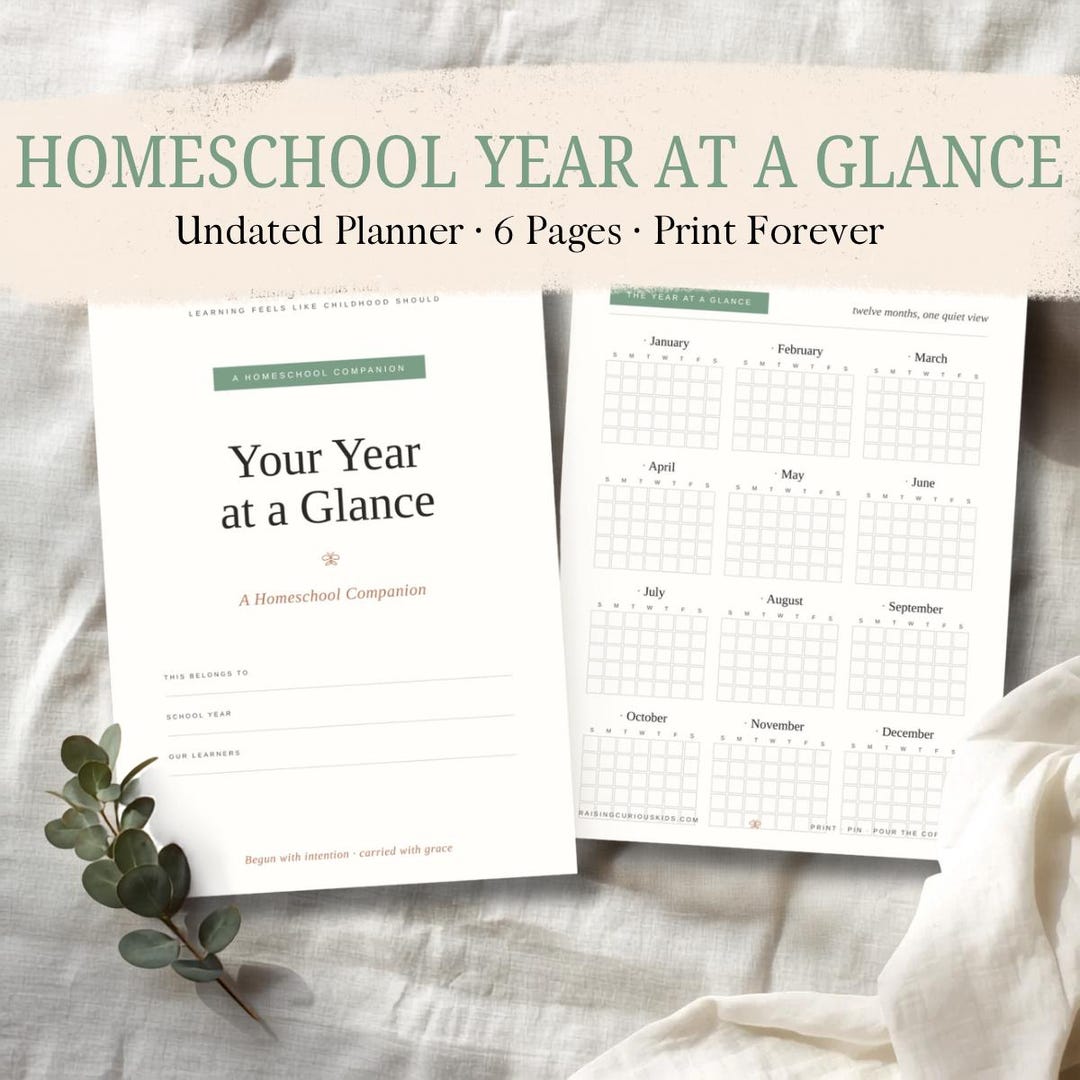
Year at a Glance Planner
Undated and print and go. Map your whole year on one page: terms, breaks, monthly themes, and your goals for each child. A secular homeschool planner that does the mapping step for you.
$7.99
Choose a Daily Rhythm, Not a Rigid Schedule
Here is the trap that catches new and seasoned homeschoolers alike: building a minute-by-minute schedule that collapses the first time a kid melts down at 9:14.
Plan a rhythm instead. Think in flexible blocks, not clock times. Morning block, focused-work block, lunch and reset, lighter afternoon block. The order stays steady even when the timing slides, which is what makes it survivable on real days.
A simple, repeatable daily layout is the difference between a year that runs on autopilot and one you rebuild every Sunday night. If you want a deeper breakdown of how to build one that holds, our guide on creating a homeschool schedule that actually works covers the full method, and our daily schedule bundle gives you eight ready-to-print layouts to start from.
Gather Curriculum and Supplies Without Overbuying
Notice that curriculum comes after the rhythm, not before. When you know your anchor goal and your daily blocks, you can shop for what fits your year instead of stuffing your year around what you impulse-bought.
Choose your core subjects first, then add only the supplies those subjects genuinely need. A short, boring list beats a cart full of pretty things you will never open. If you are still deciding on programs, our roundup of the best secular homeschool curriculum is a good place to compare options before you commit.
Set Up a Space That Works for Real Life
You do not need a dedicated schoolroom with a feature wall. You need a space your family can actually use and reset in under five minutes. If you want the full walkthrough, our guide to setting up your homeschool space covers the zones, storage, and wall pieces step by step.
A rolling cart, one shelf, and a few labeled bins handle most of what a homeschool needs. Keep daily-use materials within a child’s reach so they can set up and clean up without you. Independence at the supply shelf buys you back real minutes every single day. For more low-cost setup ideas, our post on homeschool room ideas on a budget shows what this looks like in small spaces.
A few things that make setup easier
- A rolling cart to corral daily supplies in one place. Find it on Amazon.
- Labeled book bins to keep each subject sorted. Find it on Amazon.
- A home laminator so schedules and routine cards survive daily use. Find it on Amazon.
- A visual timer to make time blocks concrete for younger kids. Find it on Amazon.
This post contains affiliate links. As an Amazon Associate I earn from qualifying purchases, at no extra cost to you.
Decide How You Will Keep Records
This is the unglamorous step that future-you will be grateful for. Depending on your state, you may need attendance, work samples, or a portfolio, so it is worth setting up your system before day one rather than reconstructing it in April.
Even where records are not required, a simple attendance log helps you see your real rhythm and notice burnout before it becomes a wall.
Build In Room for the Days That Fall Apart
No plan survives contact with a sick kid, a snow day, or a morning where nobody can find their shoes. The families who thrive are not the ones with perfect plans. They are the ones who planned for imperfection.
Leave one open block a week. Keep a short list of low-effort backup activities. Decide in advance what “a good enough day” looks like so you are not negotiating that definition mid-meltdown. When a day does come apart anyway, our guide on what to do when your homeschool day falls apart will help you reset without guilt.
Your Back-to-Homeschool Planning Checklist
If you skim nothing else, copy this. These are the steps in the order that makes each one easier:
- Review last year: keep what worked, drop what drained you.
- Choose one anchor goal for the whole year.
- Map the full year on a single page before planning any week.
- Build a flexible daily rhythm in blocks, not clock times.
- Pick your core curriculum, then buy only the supplies it needs.
- Set up a small, reset-in-five-minutes space kids can run themselves.
- Decide your record-keeping system before day one.
- Leave one open block a week and a short backup-activity list for hard days.
Print it, stick it on the fridge, and check off one line at a time between now and your first day. Eight small decisions are far less frightening than one giant unknown.
Back-to-Homeschool Planning: Common Questions
When should I start planning for the new homeschool year?
Four to six weeks before your start date is the sweet spot. That is enough time to map the year, order anything you are missing, and ease in slowly, without the panic of planning the week before you begin.
How long does back-to-homeschool planning actually take?
The big-picture work fits in one focused afternoon: review last year, set your anchor goal, and map the year onto a single page. After that, weekly planning takes about thirty minutes once your rhythm is set.
What do I actually need to start the homeschool year?
Less than you think. One anchor goal, a year mapped on a page, a flexible daily rhythm, your core curriculum, a small space kids can reset themselves, and a simple record system. Everything else is optional.
Your Fresh Start Is a Sequence, Not a Sprint
A calm homeschool year is not built from a perfect plan made in one heroic weekend. It is built from a handful of decisions made in the right order: look back, set one goal, map the year, choose a rhythm, then shop, set up, and prepare for the wobbly days.
Work down this list one step at a time and you will arrive at the first day of school steady instead of frantic. Start with the one step you have been avoiding, and let the calm year build from there.