
You pulled up the compulsory attendance page for Washington and hit a wall of requirements: a declaration, an annual test, and something about being “qualified” to teach your own kid. Compared to what your friend in Texas describes, this looks like a lot.
It is more than Texas, that part is true. But more paperwork here still means one form a year and one test a year, not a school district approving your lesson plans. Washington calls it home-based instruction, and the whole system fits on a single page once someone lays it out for you.
Here is exactly what the law asks for, the one rule that catches new families off guard, and how the pieces fit together.
Is Homeschooling Legal in Washington?
Yes. Washington homeschooling runs under RCW 28A.200.010, the home-based instruction statute, paired with the compulsory attendance law at RCW 28A.225.010. Together they spell out who has to be in some kind of school and what counts as an exemption.
Washington sits in the moderate-regulation range: notification, annual testing, and a parent qualification rule, but no curriculum approval and nobody checking in on your Tuesday. Compulsory attendance runs from age 8 to 18, one of the latest starting ages in the country, so nothing is required at all for a 6- or 7-year-old.
The Five Things Washington Actually Asks For
Strip away the legal language and Washington’s home-based instruction law comes down to five pieces. Miss one and you are technically out of compliance. Hit all five and you are done for the year.
- Qualify. Meet one of the state’s parent qualification options (more on this below).
- Declare. File a signed Declaration of Intent every year.
- Teach. Cover 11 required subjects.
- Test. Complete an annual assessment.
- Keep records. Hold onto your test results and your child’s immunization record.
None of these is complicated on its own. The one that surprises new families most is the first, because most states do not ask anything at all of the parent.
What You Have to Teach
Washington names eleven subject areas: occupational education, science, mathematics, language, social studies, history, health, reading, writing, spelling, and the appreciation of art and music. That is the list, not a syllabus. How you cover each one, and how deep you go, is entirely up to you.
A unit on gardening can carry science and occupational education at the same time. A family history project covers social studies, writing, and reading in one afternoon. The state names the categories. You fill them in however actually works for your kids.
How to Actually Start
If your child has never been enrolled
You have until your child turns 8 before any of this applies, so there is no rush if you are starting young. Once you are ready to formally begin home-based instruction, file your Declaration of Intent (details below) and start teaching.
If your child is currently enrolled in public school
Withdraw first. A short written notice to your district saying you are removing your child for home-based instruction, with a date, is enough. Keep a copy. This is the piece that proves you were not just skipping school.
Then file your Declaration of Intent with the superintendent of the public school district where you live. The deadline is September 15 of the school year, or within two weeks of the start of a quarter, trimester, or semester if you are beginning partway through the year. There is no state-level registry. The declaration goes to your local district and stays there.
Brand new to this? Our guide to how to start homeschooling covers curriculum and the first few weeks.
Do You Have to Keep Records in Washington?
Yes, though lightly. Hold onto your child’s annual test or assessment results and their immunization records. Washington does not collect these from you unless asked. You just need them on hand.
Most families add an attendance log and a folder of work samples on top of the minimum, since Running Start applications and college admissions later ask for more than the law technically requires. A wall-mounted file organizer near your teaching spot keeps the current year’s papers from disappearing into a backpack.
This post contains affiliate links. As an Amazon Associate I earn from qualifying purchases, at no extra cost to you.
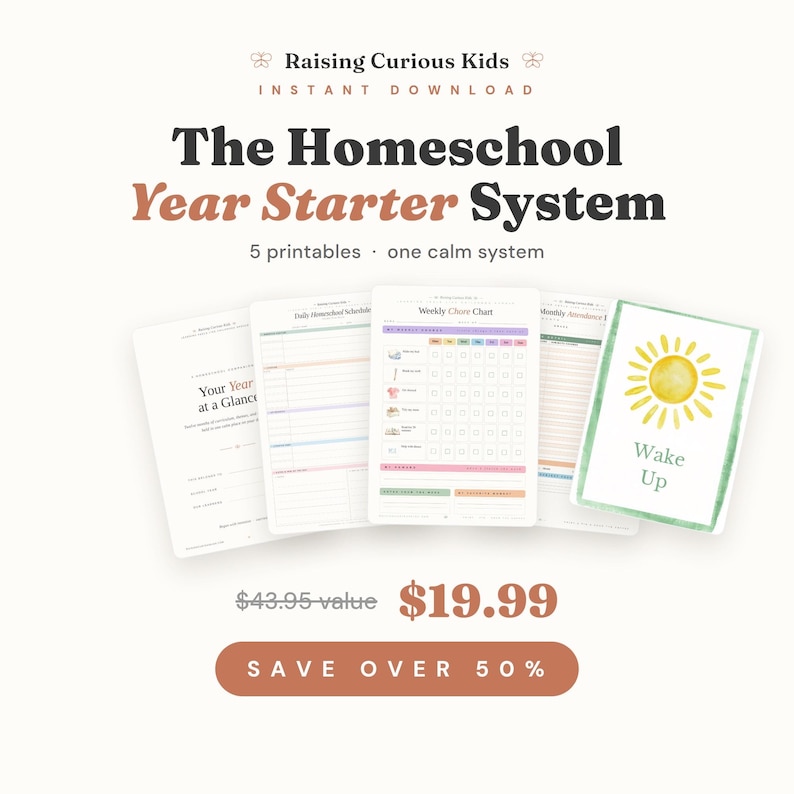
Everything for the Year, Records Included
The Attendance Tracker is one of five printables in our Homeschool Year Starter System: Year at a Glance, Daily Schedule, Attendance Tracker, Chore Chart, and 80 Routine Cards. A clean, print-and-go record for the whole year, plus the tools to plan and run it. Secular, no spreadsheet required.
$19.99 $43.95
Get the Year Starter System on Etsy →The Parent Qualification Requirement (Washington’s Unusual Rule)
This is the requirement that catches transplants from other states off guard, because most states do not ask parents to qualify for anything. Washington does. To teach under the standard home-based instruction path, you need to meet one of these:
- Have completed at least 45 college-level credit hours.
- Be supervised by a certificated teacher, with a minimum average of one contact hour per week and joint planning of your child’s objectives. A single certificated supervisor can oversee up to 30 students this way.
- Complete an approved course in home-based instruction.
- Be found sufficiently qualified by your local district superintendent.
If none of those fit, there is a fifth way in: enroll through a Private School Extension Program instead of filing on your own. The extension program takes on the paperwork, the record-keeping, and the compliance, and your parent qualification requirement disappears, because you are technically enrolled in their private school rather than filing as an independent home-based instructor.
Washington Homeschool Law: Common Questions
Do I have to notify anyone that I’m homeschooling?
Yes. File a Declaration of Intent with your local school district superintendent by September 15 each year, or within two weeks of starting mid-year. Washington does not run this through a state agency. It stays local.
Does my child have to take a standardized test every year?
Yes. Choose either a standardized achievement test approved by the state board, or an annual assessment by a certificated person. Either way, you keep the results. You do not submit them anywhere unless asked.
Can my homeschooler take public school classes or play sports?
Often, yes. Washington homeschoolers can enroll part-time in public school courses, and Running Start lets qualifying students take community college classes, tuition-free, that count toward both high school and college credit. Sports access depends on your district, so ask directly.
What if I don’t meet any of the parent qualification options?
Look at a Private School Extension Program. It is built for exactly this, handling the qualification and paperwork side so you can focus on teaching.
Other States and the Big Picture
Washington’s mix of testing plus a parent qualification rule is unusual. Most states pick one kind of oversight, not two. Our overview of homeschool laws by state maps out where every state falls on that spectrum. For contrast, California offers multiple pathways with no parent qualification at all, Texas asks for nothing beyond a few basic subjects, and New York sits at the high-regulation end with quarterly reports and an individualized instruction plan.
The Bottom Line for Washington Families
File your Declaration of Intent by September 15, teach the eleven subjects, and complete one assessment a year. If the parent qualification rule does not fit your situation, a Private School Extension Program clears it instantly. That is the whole system: five pieces, once a year each.
Get your first year organized, then get on with the good part. Start with planning your homeschool year, and grab the free weekly planner above to keep the daily rhythm calm.
Last reviewed: August 2026. This is a plain-language summary of Washington home-based instruction law as it stood on that date, not legal advice. Homeschool rules change, so before you make decisions for your family, confirm the current requirements with the official source: Washington OSPI, Home-Based Instruction. The governing statutes are RCW 28A.200.010 and RCW 28A.225.010.