You start researching Minnesota homeschool law expecting a quick answer and instead find a letter of intent, ten required subjects, an annual test, and an accrediting body with an acronym you have never heard of. It looks like a lot to track before you have taught a single lesson.
It is more than a no-notice state asks for, that part is true. But once you see the four pieces laid out, Minnesota is a once-a-year checklist, not an ongoing negotiation with the district. And one of those four pieces, the annual test, has a legal off-ramp most families never hear about.
Here is exactly what Minnesota requires, the subjects you have to cover, and how the testing requirement actually works.
Is Homeschooling Legal in Minnesota?
Yes. Minnesota home education runs under Minnesota Statutes 120A.22 and 120A.24. Compulsory attendance covers children ages 7 through 17, unless a student graduates earlier.
Minnesota sits in the moderate-regulation range: annual notice, an annual assessment, and a defined subject list, but no curriculum approval and no one reviewing your day-to-day lesson plans.
The Four Things Minnesota Actually Asks For
Underneath the statute language, Minnesota’s requirements come down to four pieces:
- Notify. File a Letter of Intent with your local superintendent every year.
- Qualify, if you are not the parent. Parents are automatically considered qualified to teach their own children, regardless of their own education. Non-parent instructors face separate requirements.
- Teach. Cover ten required subject areas, in English.
- Test. Complete a nationally norm-referenced standardized achievement test each year, unless your homeschool is accredited.
None of these involves ongoing paperwork. File once a year, teach the list, test once a year, and you are compliant.
What You Have to Teach
Minnesota law names ten subject areas: reading and writing, literature, fine arts, mathematics, science, history, geography, economics, government, and health and physical education. Instruction, textbooks, and materials have to be in English.
The state names the categories and stops there. There is no required textbook, no minimum hours per subject, and no public school standard you have to match. A unit on your state’s history covers geography and government in the same afternoon; a garden project can carry science and health together. How you combine them is entirely up to you.
How to Actually Start
If your child has never been enrolled
File your initial Letter of Intent with the superintendent of the school district where you live, listing each child’s name, age, and address, the subjects you plan to teach, the standardized test you intend to use, and your child’s immunization records. The Minnesota Homeschoolers Alliance and the Minnesota Association of Christian Home Educators both publish forms that meet the legal minimum.
If your child is currently enrolled in public school
Withdraw in writing first, then file the same Letter of Intent within 15 days of withdrawing. Keep a copy of both documents. There is no state-level registry; everything goes to your local superintendent and stays there.
Brand new to this? Our guide to how to start homeschooling covers curriculum and the first few weeks.
The Annual Test (and How to Skip It)
Every homeschooled child in the compulsory age range takes a nationally norm-referenced standardized achievement test each year, agreed on with your superintendent. There is no minimum score, and you do not submit the results anywhere unless your district specifically asks.
There is one legal exemption: children enrolled in a program accredited by the Home-Based Educators’ Accrediting Association, the only body Minnesota recognizes for this purpose, are exempt from the annual testing requirement. Accreditation runs a few hundred dollars a year and typically includes recordkeeping and transcript support in exchange. For most families, the standardized test is simple enough that accreditation is not necessary, but it is worth knowing the option exists if testing does not fit your child.
Do You Have to Keep Records in Minnesota?
Yes, in a light way. Hold onto your child’s annual test results and submit immunization records to your district in the first year of homeschooling and again in the seventh-grade year. Academic records only need to be handed over if you enroll a previously homeschooled child back into public school.
Most families keep a bit more than the minimum, since transcripts matter later for college applications even though Minnesota itself does not require them. A wall-mounted file organizer near your teaching spot keeps this year’s test results and work samples from disappearing into a backpack.
This post contains affiliate links. As an Amazon Associate I earn from qualifying purchases, at no extra cost to you.
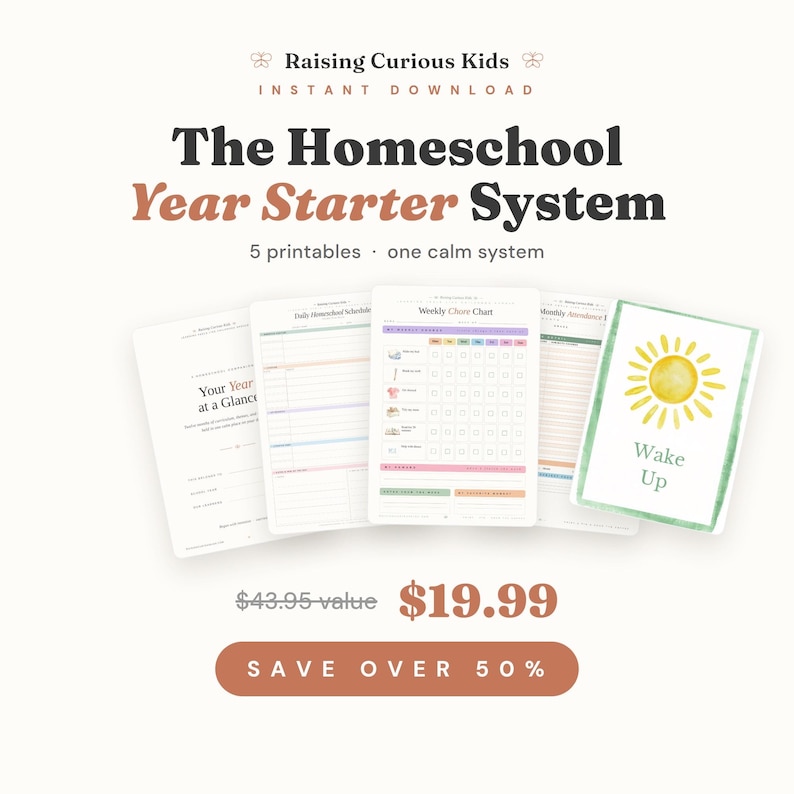
Everything for the Year, Records Included
The Attendance Tracker is one of five printables in our Homeschool Year Starter System: Year at a Glance, Daily Schedule, Attendance Tracker, Chore Chart, and 80 Routine Cards. A clean, print-and-go record for the whole year, plus the tools to plan and run it. Secular, no spreadsheet required.
$19.99 $43.95
Minnesota Homeschool Law: Common Questions
Do I have to notify the state or my district?
Your district, not the state. File a Letter of Intent with the superintendent of the school district where you live by October 1 each year, or within 15 days of withdrawing your child from public school mid-year.
Does my child have to take a standardized test every year?
Yes, unless your homeschool is accredited by the Home-Based Educators’ Accrediting Association. Otherwise, a nationally norm-referenced test is required annually, with no minimum score and no automatic reporting requirement.
Do I need a teaching degree?
No, if you are the parent. Minnesota automatically qualifies parents to teach their own children regardless of their educational background. Non-parent instructors face separate qualification rules.
Can my homeschooler play public school sports?
Yes. Minnesota law allows homeschooled students to participate in extracurricular activities, including sports, at their resident school district on the same basis as enrolled students. High schoolers can also take free college courses through the PSEO program.
Other States and the Big Picture
Minnesota’s combination of notice, testing, and a defined subject list places it solidly in the middle of the pack. Our overview of homeschool laws by state shows how sharply the rules shift from state to state. Next door, Wisconsin drops the testing requirement entirely, Illinois asks for no notice at all, and New York sits at the stricter end with quarterly reports and an individualized instruction plan. Just south, Iowa is lighter still, with a path that requires no notice and no testing.
The Bottom Line for Minnesota Families
File your Letter of Intent by October 1, teach the ten required subjects, and complete one standardized test a year, or look into HBEAA accreditation if testing does not suit your child. That is the whole system: four pieces, mostly handled once a year each.
Get your first year organized, then get on with the good part. Start with planning your homeschool year, and grab the free weekly planner above to keep the daily rhythm calm.
Last reviewed: August 2026. This is a plain-language summary of Minnesota home education law as it stood on that date, not legal advice. Homeschool rules change, so before you make decisions for your family, confirm the current requirements with the official source: Minnesota Department of Education, Homeschooling. The governing statutes are Minnesota Statutes 120A.22 and 120A.24.