
This post contains affiliate links. If you buy through them, RaisingCuriousKids may earn a small commission at no extra cost to you. We only suggest things we’d put in our own home.
Your child is somewhere between furious and tearful, and every ‘use your words’ you offer just makes it worse. The words aren’t there yet. That isn’t defiance, it’s development.
A feelings chart gives a child a way to show you what’s happening when they can’t explain it. They point instead of perform, and the naming itself takes some of the heat out of the feeling.
The chart is the easy part. Using it so it actually becomes a habit is where most families get stuck. Here’s how to make one stick.
What a feelings chart actually is (and why it works)
A feelings chart is a simple visual showing a range of emotions, usually with faces or characters, so a child can point to the one that matches how they feel. Some live on the wall. Some are cards a child can hold.
It works because naming a feeling calms the brain. Psychologists call it ‘name it to tame it,’ the idea that putting a word to an emotion lowers its intensity. A chart hands your child that word before they have the vocabulary to find it themselves.
It also buys you a beat. Instead of guessing why your four-year-old is unraveling, you both get a starting point to work from.
How to use a feelings chart with your child
Printing the chart takes five minutes. Building the habit takes a little intention. These three moves do most of the work.
1. Introduce it on a calm day
Never hand a child a new tool mid-meltdown. Show it when everyone is regulated, name a few feelings together, and let your child tell you about a time they felt each one.
Make it theirs. Let them choose where it lives and which feelings matter most. A chart a child helped set up is one they’ll actually reach for.
2. Ask, don’t tell
When a feeling starts to build, point to the chart and ask which one feels closest right now, instead of announcing that they’re angry. The question keeps your child in the driver’s seat.
If they can’t answer, narrate gently. Their body looks tense, their voice got loud, maybe frustrated? You’re modeling the skill, not labeling the child.
3. Pair every feeling with a next step
A chart that only names feelings stops half-finished. The real shift happens when ‘I feel angry’ leads straight to ‘so I’ll take five balloon breaths.’
Keep the response simple and repeatable. A feelings picture book builds vocabulary on calm days, but in the hard moment your child needs one clear action they already know.
Where to put it, and how to make it last
Put it at your child’s eye level, somewhere they pass often: the fridge, the bedroom door, or right inside a calm-down corner. A chart on a high shelf gets forgotten.
If you want it to survive daily handling, laminate it. Laminating pouches turn a paper chart into something that lasts the year, and a few sticky velcro dots let your child move a marker to today’s feeling.
For a wall version, removable mounting strips keep it up without wrecking the paint.
If you’d rather skip the DIY, this is exactly what our Feelings & Calm-Down Cards were built to do. Sixteen feelings cards let your child point to what they feel, and eight calm-down cards give them the next step, so the naming and the response live in one set.
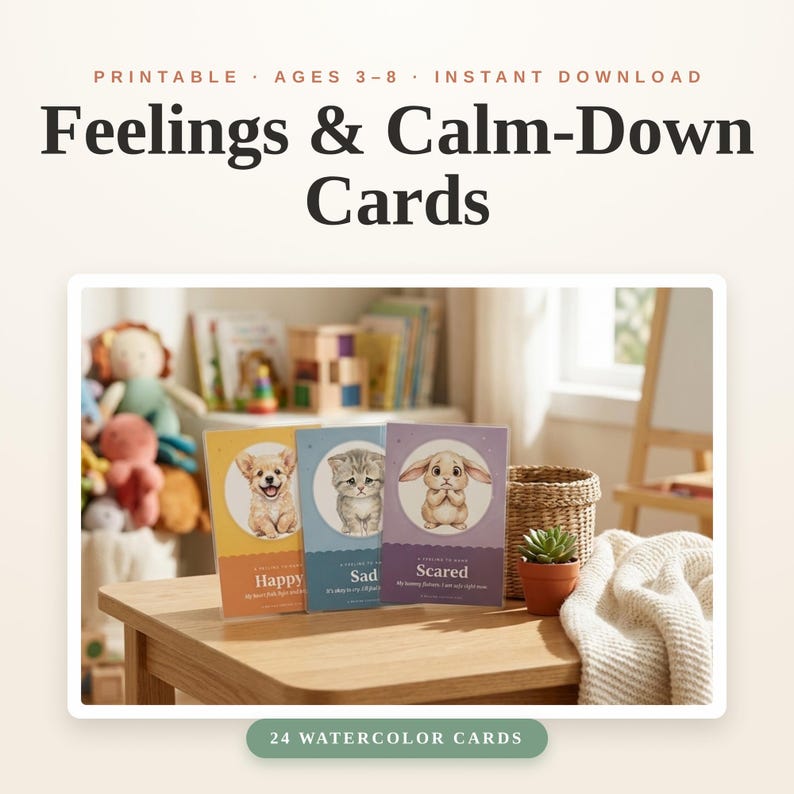
A feelings chart your child can actually hold
Feelings & Calm-Down Cards: 24 cards (16 feelings plus 8 calm-down strategies). Point, name, choose a next step. Print, laminate, done. Launch sale $7.49.
Want the whole system? The Calm & Routine Bundle pairs them with Visual Routine Cards and Screen-Free Activity Cards (134 cards) for $19.99.
Want a calm daily rhythm to go with the chart? Grab the free weekly planner and we’ll send it straight to your inbox.
Wall chart or cards: which works better?
A wall chart is great for visibility. It’s always there, and it turns ‘how do you feel?’ into a daily glance. The catch is that big feelings rarely happen standing in front of the fridge.
Cards go where the feeling is: in the car, at grandma’s, in the calm-down corner. A child can hold one, sort them, even hand you the card when words won’t come. Plenty of families use both, a chart for daily check-ins and cards for the hard moments.
Common mistakes that make a chart fizzle
Skipping the calm-day practice is the big one. A tool introduced in crisis feels like a punishment, not a help.
Stopping at the feeling is the next. Naming with no next step leaves your child stuck in the emotion with nowhere to go. Always pair it with one small action.
And overloading it. Twenty subtle emotions overwhelm a preschooler. Start with a handful of core feelings and add nuance as they grow.
A feelings chart works best inside a calmer rhythm overall. It pairs naturally with a calm-down corner for the hard moments and with emotional regulation activities practiced on ordinary days — naming the feeling is the first step, and the activities give your child somewhere to go once they have the word.
Give the feeling a name, and the rest gets easier
Your child doesn’t need to master twenty emotions this week. They need one reliable way to show you what’s happening inside when the words aren’t there yet.
Start with a few core feelings, practice on the good days, and always pair the name with a next step. The chart carries the part your child can’t do alone yet, until one day they can.
When you’re ready to skip the prep, the Feelings & Calm-Down Cards give you the naming and the calming in one printable set.