
This post contains affiliate links. If you purchase through them, I may earn a small commission at no extra cost to you.
It’s 10am and your child is on the floor, not because they’re hurt, but because the math page had a problem they didn’t understand. You stay calm. You offer help. They escalate. Twenty minutes later you’re both spent and nothing is learned.
This is not a discipline problem. This is a regulation problem — and the good news is that emotional regulation is a skill, which means it can be taught. The even better news: the best way to teach it isn’t through lectures or consequence charts. It’s through activities practiced on the good days, so the skill is available on the hard ones.
Here are 12 emotional regulation activities for kids that actually build the skill over time, organized by what they’re best for.
What Emotional Regulation Actually Means for Kids
Emotional regulation doesn’t mean staying calm. It means being able to move through a big feeling without the feeling taking over entirely. A well-regulated child can still feel angry — they just don’t throw things. They can feel disappointed — they just don’t shut down for the rest of the day.
The prefrontal cortex (the part of the brain that manages impulse control and emotional processing) isn’t fully developed until the mid-twenties. Young kids are genuinely not neurologically equipped to regulate on their own. They need co-regulation with a calm adult first, and then, over time, they build their own toolkit.
These activities build that toolkit. None of them are emergency interventions — they work best when practiced during calm moments so they’re accessible when things get hard.
Body-Based Activities (Movement and Breath)
The body and the nervous system are connected. When a child is dysregulated, the body is in a stress response — heart rate up, muscles tense, breathing shallow. Body-based activities work with that physiology directly, not around it.
1. Balloon Breathing
Have your child pretend their belly is a balloon. Breathe in slowly to “inflate” it, breathe out slowly to “deflate” it. Count to 4 in, hold for 2, out for 6. Practice this for two minutes during a calm moment — after breakfast, before read-aloud — so it becomes automatic. A breathing ball like a Hoberman sphere makes the visual concrete for younger kids and is worth keeping in your calm-down area.
2. Shake It Out
This one looks silly and that’s the point. Have your child shake their hands, then their arms, then their whole body for 30 seconds like they’re shaking water off. Animals do this instinctively after a stressful event to discharge the tension. Kids love it, and it actually works. Use it as a transition ritual — “shake out the hard thing before we start something new.”
3. Yoga Poses for Feelings
Assign specific poses to feelings: “angry energy” = warrior pose (strong and channeled), “worried” = child’s pose (safe and grounded), “sad” = mountain pose (steady and still). Practice the poses together during a calm moment, then reference them during the real moments. Kids’ yoga card decks make this a game, not a chore.
Sensory Regulation Activities
Some kids regulate through their senses before they can regulate through their thoughts. Heavy work, cold water, and tactile input all send calming signals to the nervous system. These are especially useful for kids who seem to escalate quickly or who have sensory sensitivities.
4. Playdough or Kinetic Sand
Squeezing, rolling, and pressing clay or kinetic sand provides deep proprioceptive input that calms the nervous system. Keep a container accessible in your calm-down corner. The act of creating something also gives a child a sense of control, which is often exactly what’s missing in a dysregulated moment.
5. Cold Water Reset
Running cold water over the wrists or splashing it on the face activates the mammalian dive reflex, which slows the heart rate and interrupts the stress response. This works for adults too. Make it a normal part of your “starting over” routine — “let’s wash our hands and faces and try again.”
6. Weighted Lap Pad or Blanket
Deep pressure is calming for many kids, especially those who seek sensory input. A weighted lap pad during reading time or emotional conversations gives the nervous system something steady to anchor to. It’s not a reward or a punishment — it’s just a tool, and keeping it neutral is important.
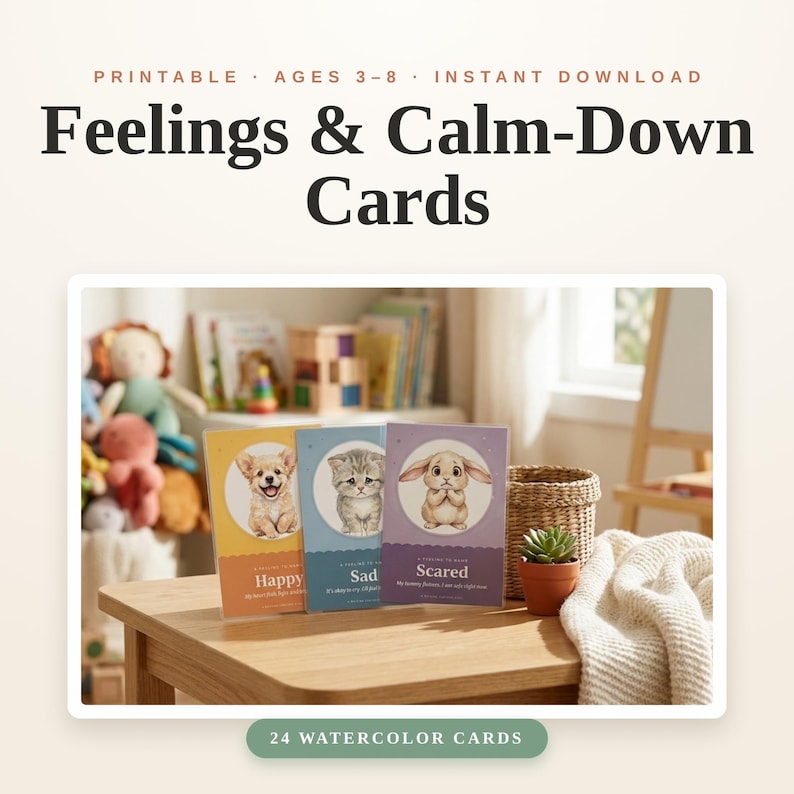
Feelings & Calm-Down Cards for Kids
Everything in this article, ready to print and use today. 16 feelings identification cards + 8 calm-down technique cards, illustrated and designed for ages 3-8. No prep beyond printing.
- 134 cards total — feelings, calm-down techniques, and bundle
- Watercolor illustrations, secular, no character licenses
- Instant PDF download, print at home or at a copy shop
Looking for a structured way to help your child name what they’re feeling before they try to regulate it? A feelings chart gives them the vocabulary for the emotion, which is the first step to working through it.
Creative and Expressive Activities
Younger children especially can’t always access words for their feelings — but they can draw them, build them, or act them out. Creative activities give emotions a channel out of the body without requiring verbal processing first.
7. Feelings Art
Ask your child to draw what their feeling looks like — not what happened, but the feeling itself. What color is angry? What shape is worried? Does scared have sharp edges or soft ones? This externalizes the emotion and creates a small distance from it. Over time, kids build a visual vocabulary for their inner world that’s surprisingly useful during actual hard moments.
8. The Feelings Jar
Fill a jar with glitter and water. When shaken, it looks like a storm. When still, the glitter settles. Use it as a metaphor: “Right now your brain looks like this. We’re going to wait until it looks like this.” Shake and watch together. It takes about 90 seconds for the glitter to settle, which is roughly how long a cortisol spike lasts. The jar gives the wait a visual, which makes it bearable for young children.
9. Emotion Charades
Act out emotions without words — the other person guesses. Happy, frustrated, nervous, proud, left out. The game builds emotional vocabulary and normalizes the full range of feelings without any of it feeling heavy. Play it at the dinner table or during transitions. Kids who can name and recognize emotions in others regulate their own better.
Connection-Based Activities
Co-regulation — calming down in the presence of a calm person — is how humans are wired to regulate, especially young children. These activities build the connection that makes co-regulation possible.
10. The Rose and Thorn Check-In
At the end of each day, share one rose (something good) and one thorn (something hard). Keep it short and low-pressure. The goal isn’t to fix the thorn — it’s to normalize that both exist, that hard things can be named without being catastrophic, and that you’re a safe person to say hard things to. That last part is more valuable than any strategy.
11. The Feelings Check-In Card
Keep a simple chart on the wall — a row of faces or emotion words — and make it a morning habit: “Point to how you’re starting the day.” No judgment, no fixing, just noticing. The calm-down corner is the place this check-in lives best, because it’s already associated with emotional awareness rather than with being in trouble.
12. Story-Based Emotional Modeling
Read picture books where characters experience big feelings and work through them. Afterward, ask: “What did she feel? What did she do? Did it help?” Books create emotional distance — the child is processing someone else’s experience, which is less threatening than processing their own. A good feelings book library does more than most worksheets. Build it slowly; the conversations around the books matter more than the books themselves.
How to Actually Make These Stick
The single most common mistake with emotional regulation activities is introducing them during a crisis. A child who is dysregulated cannot access new learning. Their brain is in survival mode.
Practice all of these on ordinary days. Make balloon breathing part of your morning routine. Play emotion charades on a Thursday afternoon when nobody is upset. Pull out the glitter jar during a calm read-aloud. When the hard moment arrives, the tool is already familiar — it doesn’t feel like an imposition, it feels like something your family does.
The goal is not a child who never falls apart. The goal is a child who has a few reliable ways to find their way back.
Frequently Asked Questions
What age can kids start learning emotional regulation?
As early as 18 months, through co-regulation with a calm caregiver. Structured activities like the ones in this article are most effective starting around age 3-4, when children have enough language and attention span to engage with them intentionally. That said, even toddlers benefit from consistent calm-down corners and breathing practice modeled by parents.
How long does it take for emotional regulation activities to work?
Most families see noticeable changes within 4-8 weeks of consistent practice — not perfect behavior, but a wider window of tolerance and faster recovery times. The key word is consistent. One glitter jar during a crisis won’t build the skill. Ten minutes a week of intentional practice over a few months will.
My child refuses all of these activities. What do I do?
Start with the one that requires the least from them — usually a sensory tool or a book. Don’t frame it as “for your feelings.” Just make it available. A glitter jar on the shelf, a feelings book in the basket. Children often start engaging with tools when they’re not being asked to. And your own regulation matters more than any tool: a child who watches a parent take a slow breath and say “I need a minute” is learning more than from any activity list.
What’s the difference between emotional regulation and behavior management?
Behavior management changes what a child does. Emotional regulation changes what they’re able to do. A child who complies because of consequences hasn’t learned regulation — they’ve learned compliance. Regulation gives them an internal capacity that transfers across situations, people, and years. It takes longer, but it’s the thing that actually lasts.