This post contains affiliate links. If you buy through them, RaisingCuriousKids may earn a small commission at no extra cost to you. We only suggest things we’d keep in our own home.
Your child has hit the point of no return. The shoe will not go on, the block tower fell over, the wrong cup showed up at dinner, and now there is screaming. You reach for the right words and your child reaches for the floor.
In that moment, nobody is learning a coping skill. The thinking part of the brain has gone offline, and asking a flooded child to choose a calming strategy is like asking them to read in the dark.
A calm down kit fixes the timing problem. It gathers a few simple, soothing things in one place, so when a big feeling hits, the next step is already decided. Your child does not have to invent a plan mid-meltdown. They just open the box.
What a calm down kit actually is
A calm down kit is a small, contained set of tools a child can use to settle their body when emotions run high. Think of it as a first aid kit for feelings: a box, a bin, or a zippered pouch holding a handful of items that help a child slow down, breathe, and come back to themselves.
The point is not the stuff. The point is removing decisions. A regulated brain can problem-solve. A flooded one cannot. When the calming options are already gathered and familiar, your child can reach for help without having to think their way there.
It works best as part of a bigger picture. The kit holds the tools, a calm-down corner gives them a place to use them, and emotional regulation activities practiced on ordinary days make the whole thing automatic. The kit is the grab-and-go version of all of it.
Signs a calm down kit would help your child
Most kids benefit from one, but a calm down kit earns its place fastest when big feelings show up faster than your child can handle them. If meltdowns arrive with little warning, or a small frustration tips into a full storm before anyone can step in, a ready-made kit gives that energy somewhere to land.
It also helps the child who goes quiet and shuts down rather than exploding. Withdrawal is regulation too, and the soft, low-key items in a kit meet that child where they are. The same goes for kids who struggle with transitions, get overwhelmed in busy places, or take a long time to recover once they are upset.
You do not need a diagnosis or a hard reason. If your child has feelings that are bigger than their words, which describes nearly every young child, a kit is worth building.
What to put in a calm down kit
You do not need a long list. Five or six well-chosen items beat a bin crammed with twenty. Pick one or two things from each category below and you have a kit that actually gets used.
Something to keep the hands busy
Big feelings live in the body, and busy hands give that energy somewhere to go. This is the easiest category to overfill, so choose a couple your child genuinely likes.
Fidget toys are the obvious start, but a simple stress ball or a tin of therapy putty often works better, because the squeezing gives real resistance. A small sealed container of kinetic sand is another favorite: quiet, tactile, and weirdly hypnotic for an upset kid.
Something that calms the body
Some kids settle fastest through deep pressure and quiet. A weighted lap pad laid across the legs gives the steady, grounding input that many children find instantly calming, without the cost or bulk of a full weighted blanket.
If your child is sensitive to noise, or comes undone in loud places, a pair of noise-canceling headphones can turn the volume of the world down enough for them to recover. Keep them in the kit so they are there the moment things get loud.
Something for the breath
Slow breathing is the single most reliable way to bring a body back down, and young kids do it far better with a prop than with instructions. Telling a four-year-old to take a deep breath rarely lands. Handing them something to blow almost always does.
A pinwheel is perfect: the slower they breathe out, the longer it spins. A small bottle of bubbles does the same job and adds a flicker of delight that breaks the spiral. A sensory bottle with glitter that swirls and settles gives anxious kids something to watch while their breathing slows on its own.
Something to name the feeling
Naming an emotion lowers its intensity, a process psychologists describe as ‘name it to tame it.’ But a flooded child rarely has the words, which is why a visual cue belongs in every kit.
A small feelings picture book builds that vocabulary on calm days. In the hard moment, a set of feelings cards lets your child point instead of explain. A little unbreakable mirror sounds odd until you watch a child study their own scrunched-up face and slowly recognize what it is showing them. There is more on building that habit in our guide to feelings charts for kids.
Something to do next
This is the piece most kits forget. Naming a feeling without a next step leaves your child stuck inside it. The kit needs an answer to ‘okay, now what.’
That is where calm-down strategy cards earn their place. Each one shows a single, doable action, like push the wall, blow out ten candles, or hug a stuffed animal, so the child goes straight from ‘I feel angry’ to ‘so I will do this.’ Keep the choices small and the actions physical, and here is a fuller set of calm-down strategies for the moment a meltdown hits.
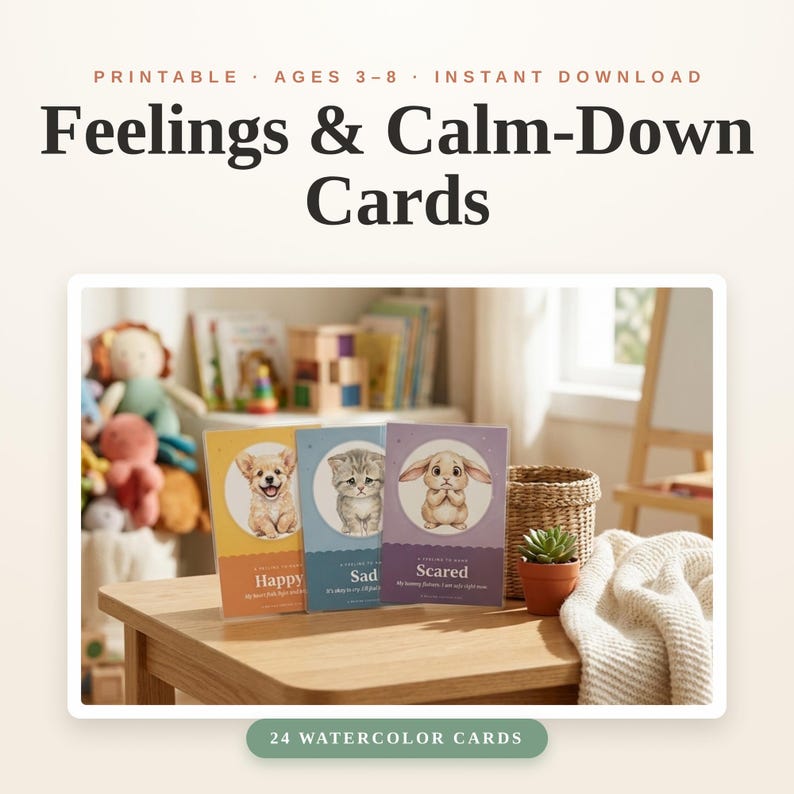
The naming and the calming, ready to print
Feelings & Calm-Down Cards: 24 cards in one set. Sixteen feelings cards so your child can point to what they feel, plus eight calm-down cards that give them the next step. Print, laminate, drop them in the kit. Launch sale $7.49.
Want the whole system? The Calm & Routine Bundle pairs them with Visual Routine Cards and Screen-Free Activity Cards (134 cards) for $19.99.
The container that holds it all
The box matters more than you would think. A clear storage bin with a lid lets your child see what is inside without dumping it, and a handle means the whole kit can move to wherever the feeling happens. A small caddy or a zippered pouch works just as well for a kit that lives in the car or a backpack.
Let your child decorate it. A kit they helped make is a kit they will actually open.
Want a calm daily rhythm to go with the kit? Grab the free weekly planner and we will send it straight to your inbox.
How to build a calm down kit by age
Toddlers and preschoolers (ages 2 to 5)
Keep it to three or four chunky, safe items: a stress ball, a pinwheel, a soft toy for squeezing, and one feelings card with simple faces. At this age the kit is mostly something you bring to them, narrating as you go, until they learn to reach for it on their own.
Early elementary (ages 6 to 8)
Now your child can run the kit with light support. Add the breathing props, a few strategy cards, and a feelings tool with more options. This is the age where ‘go get your calm down kit’ starts to work as a redirect instead of a demand.
Older kids (ages 9 to 12)
Older kids often resist anything that feels babyish, so let them build it. Swap the cartoon items for a journal, a more grown-up fidget, music with headphones, and a card listing strategies in their own words. The independence is the point. By now the goal is a kid who reaches for the kit without being told.
Calm down kit vs. a calm-down corner: what is the difference?
People mix these up, and they do work together, but they are not the same thing. A calm down kit is the set of tools. A calm-down corner is the place those tools live: a quiet, cozy spot your child can go to when feelings get big.
The kit is portable. It can move to the car, a relative’s house, or a backpack for a long errand. The corner stays put and gives your child a predictable retreat at home. Most families end up with both: a corner for the house and a slimmed-down travel kit for everywhere else. If you want to build the spot itself, here is how to set up a calm-down corner your child will actually use.
How to actually use the kit so it works
Introduce it on a calm day, never mid-meltdown. A tool that first appears during a screaming match feels like a punishment. Sit down together when everyone is regulated, go through each item, and try them out as a game.
Model it yourself. Say your own version out loud: ‘I am feeling frustrated, so I am going to take three big breaths.’ Kids copy what they see far more than what they are told.
Keep it where the feelings happen. Most kits live best inside a calm-down corner, but a second travel version in the car or a bag covers the meltdowns that strike in the cereal aisle. The kit only helps if it is within reach when the wave hits.
Mistakes that make a calm down kit backfire
Using it as a time-out. The moment ‘go to your kit’ means ‘go be alone because you are in trouble,’ the kit becomes a consequence and your child will refuse it. It is a place to feel better, not a punishment.
Overstuffing it. Twenty items is not a kit, it is a toy box, and a flooded child cannot choose from twenty things. Five or six is plenty.
Only bringing it out in crisis. A kit used only during meltdowns never gets familiar enough to work during one. Let your child play with it on calm days so the tools feel like old friends by the time they are needed.
Taking it away as a punishment. The kit is a regulation tool, not a privilege. Removing it when your child is struggling takes away the exact thing that helps.
A few questions parents ask
At what age can a child start using a calm down kit?
As young as two, with help. For toddlers you lead the way, handing over one item and narrating what you are doing. Somewhere around five or six, most kids can start reaching for the kit on their own with a gentle reminder.
What if my child throws the kit during a meltdown?
It happens, and it is not a failure. Calmly set the kit aside and stay near. Once the wave passes, you can revisit it together. The throwing usually fades as the kit becomes familiar and your child learns the items actually help. Pairing it with regular regulation practice on calm days speeds that up.
How many items should a calm down kit have?
Five or six is the sweet spot. Enough to offer a real choice, few enough that a flooded child can take it in at a glance. You can rotate items in and out as you learn what your child actually reaches for.
A plan beats a perfect reaction
You will not always say the calm, wise thing in the heat of a meltdown. No parent does. A calm down kit means you do not have to, because the plan is already made and sitting in a box your child can reach.
Start small. Pick a container, add a few things your child already likes, introduce it on a good day, and practice when nobody is upset. Over time the kit stops being something you hand them and becomes something they reach for themselves. That is the whole goal: a child who knows how to come back to calm, with a little less help each time.
When you want the naming and the calming ready to print, our Feelings & Calm-Down Cards drop both straight into the kit.