
This post contains affiliate links. If you buy through them, RaisingCuriousKids may earn a small commission at no extra cost to you. We only suggest things we’d keep in our own home.
The meltdown is already happening. Your six-year-old is on the kitchen floor because you cut the toast into squares instead of triangles, and the sound coming out of her could strip paint. You crouch down, you say ‘calm down, sweetheart,’ and it lands like gasoline on a fire.
You are not doing it wrong. ‘Calm down’ almost never works, because by the time a child is screaming, the part of the brain that hears reason has clocked out for the day.
What does work is a short list of moves you can run on autopilot, plus a few strategies your child can actually reach for. Here is what to do in the moment, and how to build the skills before the next storm.
Why ‘just calm down’ never works
When big feelings take over, a child’s brain floods. The thinking part goes quiet and the alarm part grabs the wheel. In that state your child literally cannot reach logic, choices, or your perfectly reasonable explanation about the toast.
So the first job is not to fix the feeling or win the argument. It is to help the body come down first. The thinking only comes back online after the body feels safe again. Skip that order and you will spend twenty minutes negotiating with someone who has temporarily lost the ability to negotiate.
What to do first: be the calm
Your child borrows your nervous system before they can run their own. This is called co-regulation, and it is the most powerful tool you have. A steady adult is contagious in exactly the way a panicked one is.
Before you say a word, drop your shoulders and slow your own breath. Lower your voice instead of raising it. Get down to their level rather than standing over them.
None of this is easy when you are also furious about the toast. Take one real breath for yourself first. You are not being passive. You are becoming the anchor your child is about to grab onto.
A simple sequence for the hard moment
You do not need a script memorized. You need three moves, in this order.
1. Connect before you correct
Get close, soften your face, and let your child know you are there. ‘I’m right here. This is hard.’ Connection tells the alarm system the threat is over, which is the thing that lets the body start to settle. The lesson about throwing toast can wait ten minutes, and it will land far better then anyway.
2. Name what you see
Put simple words to the feeling without fixing it. ‘You are so mad the toast is wrong.’ Naming an emotion lowers its intensity, a process researchers call ‘name it to tame it.’ You are not agreeing the toast is a tragedy. You are showing your child the feeling makes sense, which is what helps it pass. A feelings chart makes this easier for the kid who freezes and cannot find the word.
3. Offer a next step, not a lecture
Once the storm starts to ease, hand them something to do. ‘Want to squeeze the pillow, or blow out the candles with me?’ One small, physical action gives the leftover energy somewhere to go and moves your child from stuck to doing. Keep it to two options. A flooded brain cannot choose from ten.
Calm-down strategies that actually work
These are the actions you offer in step three, and the ones to practice on calm days so they feel familiar when it counts. Pick a few that fit your child instead of trying all of them at once.
Breathing they can see
Telling a kid to take a deep breath rarely works. Giving them something to blow almost always does. Have them blow out ten imaginary candles, one finger folding down at a time, or use a breathing ball that opens as they breathe in and closes as they breathe out. The visual does the teaching for you.
Big movement and heavy work
Anger is energy, and energy wants out. Wall push-ups, ten jumping jacks, carrying something heavy across the room, or a hard squeeze of a weighted stuffed animal all give that surge a job. Therapists call this heavy work, and it brings a revved-up body down faster than sitting still ever could.
Sensory grounding
Pulling a child’s attention into their senses interrupts the spiral. Run cool water over their hands, hand them a calm-down sensory bottle to watch the glitter fall, or play the five-senses game: name five things you see, four you hear, three you can touch. It is quietly powerful, and it works on grown-ups too.
A quiet place to land
Sometimes the strategy is simply somewhere to go. A calm-down corner gives your child a predictable spot to retreat to before a feeling boils over, stocked with the soft, low-key things that help them reset.
Words for the feeling
On calm days, build the vocabulary that goes missing in the hard ones. A feelings picture book at bedtime teaches your child that mad, frustrated, and disappointed are different things with different sizes. The more words they have for it, the less they need to scream it.
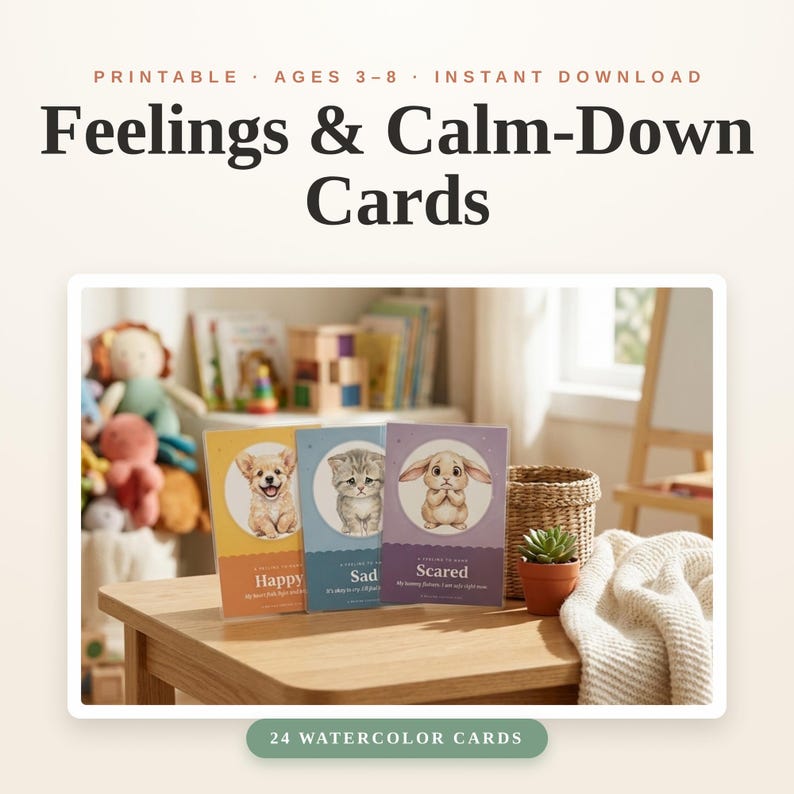
The feeling and the fix, ready to print
Feelings & Calm-Down Cards: 24 cards in one set. Sixteen feelings cards so your child can point to what they feel, plus eight calm-down cards that hand them the next step, the exact step-three move when the words are gone. Print, laminate, keep them within reach. Launch sale $7.49.
Want the whole system? The Calm & Routine Bundle pairs them with Visual Routine Cards and Screen-Free Activity Cards (134 cards) for $19.99.
Teach the strategies before you need them
Here is the part most advice skips: none of this works the first time you try it mid-meltdown. A strategy your child has never practiced is just one more confusing demand in a moment they are already drowning in. The skills have to be boring and familiar before they can be useful.
So practice on the good days. Blow out the candles together when nobody is upset. Play the five-senses game in the car. Do a round of wall push-ups for fun. Building these into everyday regulation practice turns them into reflexes your child can reach for on their own. Gathering the props into a calm-down kit means they are all in one place when the wave hits.
Want a calm daily rhythm to hold all of this together? Grab the free weekly planner and we’ll send it straight to your inbox.
Calm-down strategies by age
Toddlers and preschoolers (ages 2 to 5)
At this age you are doing most of the regulating for them. Keep it physical and simple: a big hug, blowing bubbles, rocking, or naming the feeling out loud while they fall apart in your lap. They will not really use a strategy yet. They will borrow yours, over and over, until it starts to sink in.
Early elementary (ages 6 to 8)
Now your child can run a strategy with a reminder. ‘What helps when you feel like this?’ starts to get a real answer. This is the age to post a short list of go-to moves where they can see it, so the choice is visible even when their thinking is not.
Older kids (ages 9 to 12)
Older kids want ownership, not instructions. Talk through what works while everyone is calm and let them name their own go-to strategies. Music with headphones, a walk, journaling, or a hard run often replace the bubbles and pinwheels of the younger years. The goal shifts from ‘I help you calm down’ to ‘you know how to calm yourself.’
Mistakes that make a meltdown worse
Reasoning too soon. Explaining why the toast is fine while your child is still flooded just adds noise. Wait for the body to settle, then talk.
Demanding eye contact or ‘use your words.’ Both ask for skills that are offline mid-meltdown. They tend to crank things up, not bring them down.
Treating the calming spot as punishment. The moment a calm-down corner becomes ‘go to time-out,’ your child will fight going. It is a place to feel better, never a consequence.
Expecting it to work instantly. Regulation is a skill that grows over years, not a switch you flip. Some days the only win is that you stayed calm while they did not. That still counts.
Questions parents ask
What are the best calm-down strategies for an angry child?
Movement-based ones, usually. Anger is a high-energy feeling, so wall push-ups, heavy work, squeezing something, or stomping it out give it a path that does not involve hitting or throwing. Pair the movement with naming the feeling once the sharpest edge comes off.
My child won’t do any strategy in the moment. What now?
That is normal, and it usually means the strategy is too new or your child is too flooded to find it. Drop back to plain co-regulation: stay close, stay calm, say little, and wait it out. Then practice the strategies hard on calm days so they feel familiar the next time.
How long should a meltdown last?
Most pass within five to fifteen minutes once you stop feeding them with demands. If your child’s meltdowns are very frequent, last a long time, or regularly involve hurting themselves or others, it is worth checking in with your pediatrician.
The real goal
You will not handle every meltdown perfectly. Nobody does, and your child does not need a perfect parent. They need a steady one who comes back, stays close, and slowly teaches them that big feelings are survivable.
Start with one strategy. Practice it on a calm Tuesday. Use it next time the toast is wrong. Each time you ride one out together, your child learns a little more about finding the way back to calm, and needs you a little less to get there.
When you want the naming and the calming ready to hand your child, our Feelings & Calm-Down Cards put both the feeling and the next step right into their hands.