
New York has a reputation as the hardest state in the country to homeschool in, and the list of paperwork is genuinely long: a letter of intent, an individualized plan, four quarterly reports, and an annual assessment.
Here is what the reputation leaves out. Every one of those pieces has a fixed format and a fixed date. Once you have mapped your first year, the rest is filling in blanks on a schedule you already know. Tens of thousands of New York families do this every year without drama.
Here is exactly what New York requires, in the order your year actually unfolds.
Is Homeschooling Legal in New York?
Yes. Home instruction in New York is governed by Section 100.10 of the Regulations of the Commissioner of Education, usually cited as 8 NYCRR 100.10. It is detailed, which cuts both ways: more steps, but very little guesswork about what is expected.
One thing to know upfront is that this is the only pathway. New York does not offer an umbrella school option or a private-tutor workaround. Every homeschooling family files the same four things.
The state does not require the teaching parent to hold a teaching certificate or any specific credential. Compulsory attendance generally runs from age six through sixteen, though some districts, including New York City, extend it to seventeen.
Step 1: File Your Letter of Intent by July 1
Your year starts with a written notice to the superintendent of your local school district stating that you intend to instruct your child at home. It is due by July 1 each year.
If you are starting partway through the year, or you move into a district after the year has begun, the notice is due within fourteen days of commencing home instruction. This is the deadline that matters most for families pulling a child out of school mid-year.
A plain letter is fine. There is no state form. Within ten business days the district sends you back a copy of Section 100.10 and a blank IHIP form.
Worth saying clearly: this is notification, not a request for permission. The district does not approve or deny your decision to homeschool. Send the letter by certified mail and keep the receipt, because the date you filed is the thing you may need to prove later.
Step 2: Submit Your IHIP
The Individualized Home Instruction Plan is your curriculum map for the year. It is due within four weeks of receiving the district’s materials, or by August 15, whichever comes later.
The IHIP has to include your child’s name, age, and grade level, the syllabi or curriculum materials or textbooks or plan of instruction you will use in each required subject, the name of the person providing instruction, and the four dates on which you will submit quarterly reports.
Required subjects vary by grade band, so check the regulation for the band your child falls into. You may use your district’s form or write your own document, as long as the required information is there.
Pay attention to those four report dates. You choose them, subject to one condition: they must be spaced in even and logical periods across the year. Most families land somewhere near mid-November, late January, mid-April, and June 30. Pick dates you can realistically hit, because you are committing to them in writing.
This post contains affiliate links. As an Amazon Associate I earn from qualifying purchases, at no extra cost to you.
The practical side of all this is record keeping, and the families who find New York manageable are almost always the ones who log as they go. A binder that lives on the shelf by your teaching space, or a wall-mounted file organizer where the week’s work lands, turns quarterly reporting from a scramble into a copy-and-paste job. A simple wall calendar with your four report dates circled does more for compliance than any app.
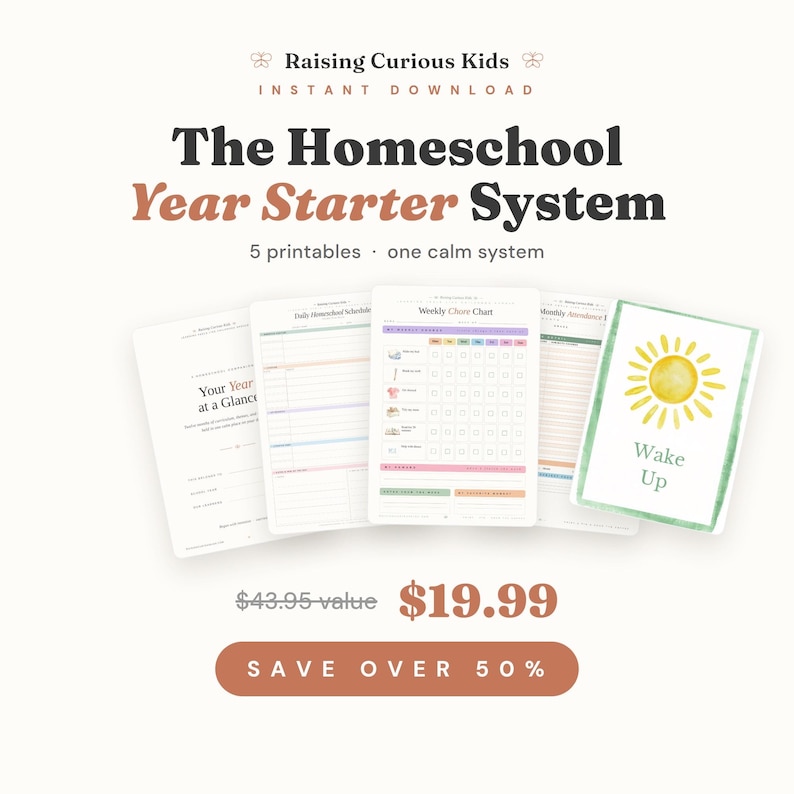
Everything for the Year, Records Included
The Attendance Tracker is one of five printables in our Homeschool Year Starter System: Year at a Glance, Daily Schedule, Attendance Tracker, Chore Chart, and 80 Routine Cards. A clean, print-and-go record for the whole year, plus the tools to plan and run it. Secular, no spreadsheet required.
$19.99 $43.95
Step 3: File Four Quarterly Reports
On each of the dates you named in your IHIP, you send the district a short report for each child. Four elements go in every one:
- Hours of instruction completed during the quarter.
- Material covered in each subject listed in your IHIP.
- A grade or a written evaluation of your child’s progress in each subject.
- A written explanation if less than 80 percent of the planned material was covered in any subject.
That last one surprises people. If you planned ten chapters of math and got through seven, you note it and say briefly why. It is not a penalty. The regulation simply assumes that real life happens and asks you to document it.
The field that causes the most pain is hours. Trying to reconstruct a full quarter of instruction time during the last week before a deadline is genuinely awful, and it is entirely avoidable with a daily log.
Step 4: Annual Assessment with the Fourth Report
Your annual assessment goes in with the fourth quarterly report, due by June 30. It takes one of two forms: a commercially published norm-referenced achievement test, or a written narrative evaluation.
Which option is open to you depends on grade level:
- Grades 1 through 3. A written narrative evaluation is permitted every year.
- Grades 4 through 8. A narrative evaluation is permitted in alternate years, with a standardized test in the years between.
- Grades 9 through 12. A standardized test is required annually.
Adequate progress on a test generally means a composite score above the 33rd percentile, or evidence of one year of academic growth. You declare which method you are using back in the third quarterly report, so decide before spring.
New York Homeschool Law: Common Questions
Do I need a teaching degree or certification?
No. New York does not require the person providing home instruction to hold any specific credential.
What happens if I miss a deadline?
Missing a filing does not trigger instant truancy proceedings, but it does start a formal process. A program found out of compliance can be placed on probation and required to submit a plan of remediation. Build your year around the dates rather than testing them.
Is New York City different?
Somewhat. NYC runs its own Office of Homeschooling with its own submission process, and it issues a Letter of Compliance once your notice and IHIP are accepted. Compulsory attendance also runs to seventeen there.
Can my child earn a diploma or play school sports?
Home instruction in New York does not lead to a state high school diploma, and there is no statewide right for homeschooled students to join public school interscholastic teams. Families typically issue a parent transcript, and colleges across the state, public and private, admit homeschooled applicants routinely.
Is unschooling legal in New York?
Yes, but it has to be translated into the state’s format. Your IHIP still lists subjects and materials, and your quarterly reports still log hours and progress. The learning can be interest-led; the paperwork cannot be.
Other States and the Big Picture
New York sits at the strictest end of the national range, alongside Pennsylvania, which asks for an affidavit, a portfolio, and an outside evaluator. Our overview of homeschool laws by state shows just how wide the spread is. At the other extreme, Texas requires no registration, no testing, and no reporting at all. For a nearby contrast, neighboring Connecticut asks for none of this, with no required notice and no testing.
If you are moving into New York from a low-regulation state, the shift is real. Give yourself one full year of building the habit, and it stops feeling like surveillance and starts feeling like a filing system.
The Bottom Line for New York Families
File your letter of intent by July 1, submit your IHIP by August 15 or four weeks after the district responds, send four quarterly reports on the dates you chose, and include your annual assessment with the fourth report by June 30. That is the whole cycle.
It is more documentation than almost anywhere else in the country, but it repeats identically every year. Log your hours daily, keep every submission, and the second year takes a fraction of the effort of the first.
Just getting started? Walk through how to start homeschooling and planning your homeschool year, then grab the free weekly planner above to keep the daily rhythm steady.
Last reviewed: August 2026. Homeschool law changes, and the details above are a plain-language summary, not legal advice. Before you make decisions for your family, confirm the current rules with the official source: New York State Education Department – Home Instruction. Governing regulation: Section 100.10 of the Regulations of the Commissioner of Education (8 NYCRR 100.10). File your letter of intent and IHIP with your local school district superintendent. New York City families file through the NYC Office of Homeschooling.