
You have decided to homeschool in Tennessee, and the first thing the internet hands you is a fork in the road. Register with the school district. Or join an umbrella school. Or enroll in an online program. Three answers, all technically correct, and no one tells you which one is actually the easy button.
Tennessee gives you three legal ways to homeschool, and the one you pick decides how much paperwork and testing you sign up for. That choice is the whole ballgame here.
Here is what each path asks of you, why most Tennessee families quietly pick the same one, and the records you are on the hook to keep.
Is Homeschooling Legal in Tennessee?
Yes. Home education in Tennessee is spelled out in state law, mainly Tennessee Code Annotated section 49-6-3050, which sets up the independent home school and works alongside the rules for church-related and accredited online schools.
Tennessee lands in the middle of the national range. It does not approve your curriculum or check your lesson plans, but on the independent path it does ask for annual notice, some standardized testing, and attendance records. Compulsory school age runs from 6 to 17.
The Three Legal Paths (and Which One to Pick)
Path 1: Independent home school
You register directly with your local school district and teach your own child. This is the most independent route, and it comes with the most direct reporting: an annual Notice of Intent, attendance records, and state testing in a few specific grades. The teaching parent needs a high school diploma or GED.
Path 2: Church-related umbrella school
You enroll your child in a church-related school (sometimes called a Category IV school) that oversees home education. The umbrella handles the relationship with the state, which is why this path skips the district Notice of Intent and, in most cases, the mandatory state testing. It is the reason the large majority of Tennessee homeschoolers use an umbrella instead of registering independently.
Path 3: Accredited online school
You enroll in an accredited online or distance-learning program that operates as a private school. The program carries the accreditation and record-keeping, so your day looks less like designing a curriculum and more like keeping up with an existing one. Good fit if you want structure handed to you.
Most families weighing freedom against paperwork end up choosing between Path 1 and Path 2. The rest of this guide focuses on the independent path, since that is where the state rules actually land on you.
What the Independent Path Actually Requires
If you register as an independent home school, here is the real checklist:
- File a Notice of Intent. Send it to your local director of schools before the school year starts, and renew it each year. It lists your children, their ages and grade levels, and where school happens.
- Have a diploma. The teaching parent needs a high school diploma or GED.
- Teach 180 days. Plan for at least 180 days of instruction at roughly four hours a day.
- Test in grades 5, 7, and 9. Independent students take the state assessment (TCAP) in those three grades.
- Keep attendance. Track the days you school and turn your attendance in to the district at the end of the year.
What is not on the list matters too. Tennessee names no required subjects for the independent home school. You pick the curriculum, the approach, and the schedule. The state is watching the paperwork, not your reading list.
How to Actually Start
If your child has never been enrolled
Pick your path first. Going independent means filing your Notice of Intent with the district before the year begins. Going with an umbrella means enrolling through that school, which then walks you through its own start steps.
If your child is currently in public school
Withdraw before you begin so the school stops counting your child absent. On the independent path, your Notice of Intent to the district doubles as the signal that you are now home educating. With an umbrella, the school usually provides proof of enrollment you can hand to the district.
New to all of this? Our guide to how to start homeschooling walks through curriculum and those first shaky weeks.
Do You Have to Keep Records in Tennessee?
On the independent path, yes. Attendance is the one record the state actually asks for, and you send it to the district at the end of each school year. Miss it and you have a compliance gap that is annoying to fix later.
Beyond attendance, a light paper trail saves you real headaches down the road: joining a co-op, applying to college, moving to a new district, or answering a school that contacts you by mistake. A yearly attendance log plus a folder of work covers it. A wall-mounted file organizer near your teaching spot keeps this year’s papers from disappearing into the bottom of a backpack.
This post contains affiliate links. As an Amazon Associate I earn from qualifying purchases, at no extra cost to you.
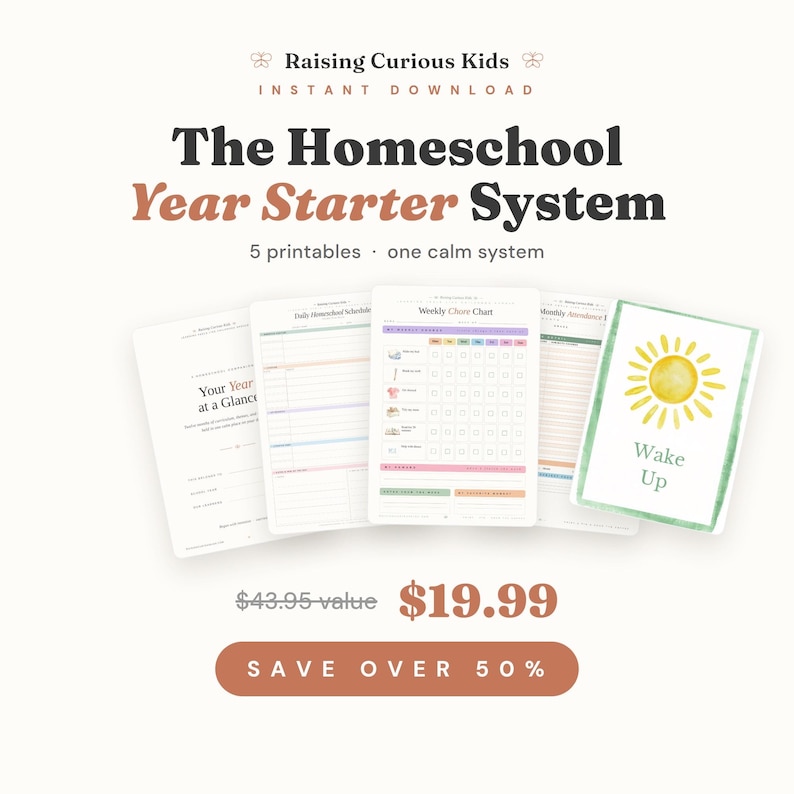
Everything for the Year, Records Included
The Attendance Tracker is one of five printables in our Homeschool Year Starter System: Year at a Glance, Daily Schedule, Attendance Tracker, Chore Chart, and 80 Routine Cards. A clean, print-and-go record for the whole year, plus the tools to plan and run it. Secular, no spreadsheet required.
$19.99 $43.95
Get the Year Starter System on Etsy →Why Most Tennessee Families Use an Umbrella School
Spend a week in Tennessee homeschool groups and you will notice how many families are enrolled in a church-related umbrella rather than registered with their district. The pattern is not an accident.
The umbrella path skips the district Notice of Intent and, for most families, the mandatory TCAP testing in grades 5, 7, and 9. For a parent who does not want a standardized test setting the rhythm of certain years, that is a meaningful difference. Umbrella schools do charge a fee and set their own light requirements, so it is a trade, not a free pass.
Neither path is more “real” than the other. Independent gives you a direct relationship with the state and no middle party. Umbrella gives you fewer state touchpoints for a modest fee. Pick the trade that fits your family, not the one a stranger in a Facebook group swears by.
Tennessee Homeschool Law: Common Questions
Does my child have to take a standardized test?
On the independent path, yes, in grades 5, 7, and 9. Under a church-related umbrella school, that state testing generally does not apply. This is the single biggest practical difference between the two paths.
Do I need a college degree to teach?
No. The independent home school asks the teaching parent to have a high school diploma or GED. There is no college requirement.
Can my homeschooler play sports or take a class at the public school?
Often, yes. Tennessee allows homeschooled students to take part in some public school activities and courses, and many districts open the door to individual classes. Access varies by district and by the sanctioning rules for sports, so ask your local school what it offers.
Are there vouchers or scholarship funds for homeschoolers?
Tennessee’s school-choice scholarship programs are built around private-school enrollment, not independent home schools. If funding is part of your plan, confirm the current eligibility rules on the state source before you count on it.
Other States and the Big Picture
Tennessee sits in the middle of the pack, stricter than its low-regulation neighbors but far from the most demanding states. Our overview of homeschool laws by state shows how sharply the rules shift from one border to the next. For nearby comparisons, just across the northern line Kentucky keeps things lighter with a single notice and no testing, Georgia asks for an annual declaration and its own testing, North Carolina requires yearly standardized tests you keep on file, and Virginia runs on a notice-plus-annual-assessment system.
The Bottom Line for Tennessee Families
Start by choosing your path, because that one decision sets your paperwork for years. Go independent and you file a Notice of Intent, teach 180 days, test in grades 5, 7, and 9, and keep attendance for the district. Go with an umbrella and you trade a fee for fewer state touchpoints. Either way, no one is grading your curriculum.
Sort the path, keep your attendance clean, and then get to the good part. Start with planning your homeschool year, and grab the free weekly planner above to keep the daily rhythm calm.
Last reviewed: August 2026. This is a plain-language summary of Tennessee home education law as it stood on that date, not legal advice. Homeschool rules change, so before you make decisions for your family, confirm the current requirements with the official source: Tennessee Department of Education, Home Schooling in Tennessee. The governing statute is Tennessee Code Annotated section 49-6-3050.