North Carolina has one of the largest and most established homeschool communities in the country, and its rules have a reputation for being clear rather than heavy. The state gives you real freedom over what and how you teach — in exchange for a few specific steps you cannot skip.
The part that trips people up is that you register with a state office, not your local school district, and you give your child one standardized test a year. Neither is as intimidating as it sounds once you see the whole picture.
Here is exactly what North Carolina requires, in the order you will actually do it.
Is Homeschooling Legal in North Carolina?
Yes. North Carolina classifies a homeschool as a non-public school under state law (General Statutes 115C-563 through 115C-565). Oversight runs through a single state office, the Division of Non-Public Education (DNPE), which keeps the process consistent statewide instead of leaving it to individual districts.
Compulsory attendance in North Carolina covers ages 7 through 16, so those are the years the requirements below apply to.
Step 1: File a Notice of Intent With DNPE
Before you open your homeschool, you file a Notice of Intent to Operate a Home School with DNPE, online at ncdnpe.org. The notice lists the name and address of your school and names the chief administrator — that is you, the teaching parent.
This is a one-time filing to establish your school; you notify the state, not your local district. DNPE sends back an acknowledgment with the date your school officially opened, and you keep that. That date is your clock for the annual test.
Step 2: Meet the Basic Operating Rules
North Carolina sets a few baseline conditions for the person running the school and how it operates:
- Diploma requirement. The chief administrator must hold at least a high school diploma or a GED. No teaching certificate is needed.
- Nine months of operation. You run the school on a regular schedule for at least nine calendar months a year, not counting holidays and vacations. There is no set number of hours per day.
- Records on file. You keep annual attendance records and disease immunization records for each student.
Attendance is where a lot of families want a simple system rather than a scribbled note, since the nine-month schedule and attendance records go hand in hand. Keeping those records somewhere consistent — a binder, or a wall-mounted file organizer by your teaching space — means you are never scrambling if DNPE ever asks to see them.
This post contains affiliate links. As an Amazon Associate I earn from qualifying purchases, at no extra cost to you.
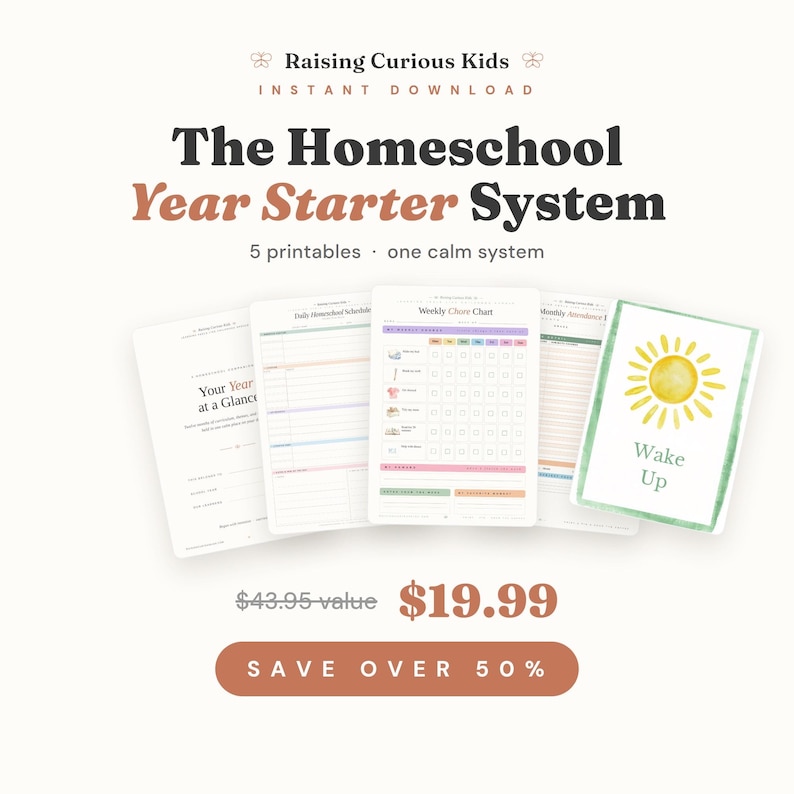
Everything for the Year, Records Included
The Attendance Tracker is one of five printables in our Homeschool Year Starter System: Year at a Glance, Daily Schedule, Attendance Tracker, Chore Chart, and 80 Routine Cards. A clean, print-and-go record for the whole year, plus the tools to plan and run it. Secular, no spreadsheet required.
$19.99 $43.95
Get the Year Starter System on Etsy →Step 3: Give an Annual Standardized Test
This is the requirement that makes North Carolina different from its neighbors. Each academic year, every enrolled student takes a nationally standardized achievement test that covers English grammar, reading, spelling, and mathematics.
A few important details that surprise new families:
- You keep the results. Test scores stay on file at your home school for at least one year and are provided to DNPE only if requested. You do not submit them to anyone routinely.
- There is no passing score. No one grades the result and there is no consequence for a low score. Treat the test as a diagnostic for you, not a report card for the state.
- You arrange and pay for it. There is no state funding for the test. You choose from commonly used nationally normed tests and buy it yourself; DNPE keeps a list of options.
- Timing. The first test happens within the first year after DNPE acknowledges your notice, then once during each following year. Testing in the same month each year makes the year-to-year comparison more useful.
North Carolina Homeschool Law: Common Questions
Do I notify my local school district?
No. You file with the state Division of Non-Public Education (DNPE), not your district. That is one of the things that makes North Carolina’s process consistent everywhere in the state.
Do I have to submit my child’s test scores?
No. You keep the scores on file at home for at least a year. You only provide them if DNPE specifically requests them. There is no minimum score.
Do I need a teaching degree to homeschool in North Carolina?
No. The chief administrator needs a high school diploma or GED. That is the only educational qualification the law sets.
Which subjects am I required to teach?
North Carolina does not mandate a subject list, but your annual test must cover English grammar, reading, spelling, and math — so in practice you will want to make sure those are part of your year. Beyond that, curriculum is entirely your choice.
Other States and the Big Picture
North Carolina sits at the more structured end of the friendly states: register once, run nine months, test yearly. For comparison, our overview of homeschool laws by state shows the full range. Texas asks for no registration or testing at all, and Florida swaps the required test for a choice of annual evaluations.
The Bottom Line for North Carolina Families
File your Notice of Intent with DNPE, keep your diploma on hand, run your school for nine months, hold on to attendance and immunization records, and give one standardized test a year that you keep at home. That is the complete compliance picture — and within it, you have full control over what and how you teach.
Just getting started? Walk through how to start homeschooling and planning your homeschool year, then grab the free weekly planner above to keep the daily rhythm steady.
Last reviewed: July 2026. Homeschool law changes, and the details above are a plain-language summary, not legal advice. Before you make decisions for your family, confirm the current rules with the official source: NC Division of Non-Public Education — Home School Requirements. Governing law: N.C. General Statutes 115C-563 through 115C-565. File your notice at ncdnpe.org.