Florida is one of the most popular states in the country to homeschool — more than 150,000 kids learn at home here — and the rules are friendlier than the paperwork makes them sound. But there are real steps, and skipping one can put your program on probation.
So let us make it simple. There are three things Florida asks of a home education program: tell your county you are starting, keep a portfolio, and get one evaluation a year. That is the whole shape of it.
Here is exactly what each one means, when it is due, and how to stay comfortably on the right side of the law without turning your kitchen into a compliance office.
Is Homeschooling Legal in Florida?
Yes. Home education has been a recognized, parent-directed option in Florida law since 1985. The main pathway, used by the large majority of families, is the Home Education Program under Florida Statute 1002.41.
Under that program you direct your child’s education, choose your own curriculum, and set your own schedule. There is no required brand of curriculum, no list of mandatory subjects, and no minimum number of school days. What the state asks for is a little bit of documentation, not control over how you teach.
Step 1: File Your Notice of Intent
To open a home education program, you file a written Notice of Intent with your county’s district school superintendent. You have 30 days from the day you start to get it in.
The notice is short. It includes the names, addresses, and birthdates of each child in the program, and a parent signs it. The district cannot demand extra information beyond what the statute lists. Many families send it by certified mail so they have proof of the date — that date matters, because it sets your evaluation deadline for every year after.
Step 2: Keep a Portfolio
Florida asks you to keep a portfolio of your child’s education. It has two parts:
- A log of educational activities, written as you go, that lists by title any reading materials you use.
- Samples of your child’s work — writings, worksheets, workbooks, or creative pieces that show what they have been doing.
You keep the portfolio for two years. The superintendent can ask to inspect it, but only with 15 days’ written notice, and the inspection is just to confirm it exists and meets the requirements — no one grades its contents. You do not hand it over to anyone who casually asks. Keeping it organized as you go, rather than reconstructing it in a panic each spring, is the real trick. A cheap accordion file or a wall-mounted file organizer turns this from a dreaded task into a two-minute weekly habit.
This post contains affiliate links. As an Amazon Associate I earn from qualifying purchases, at no extra cost to you.
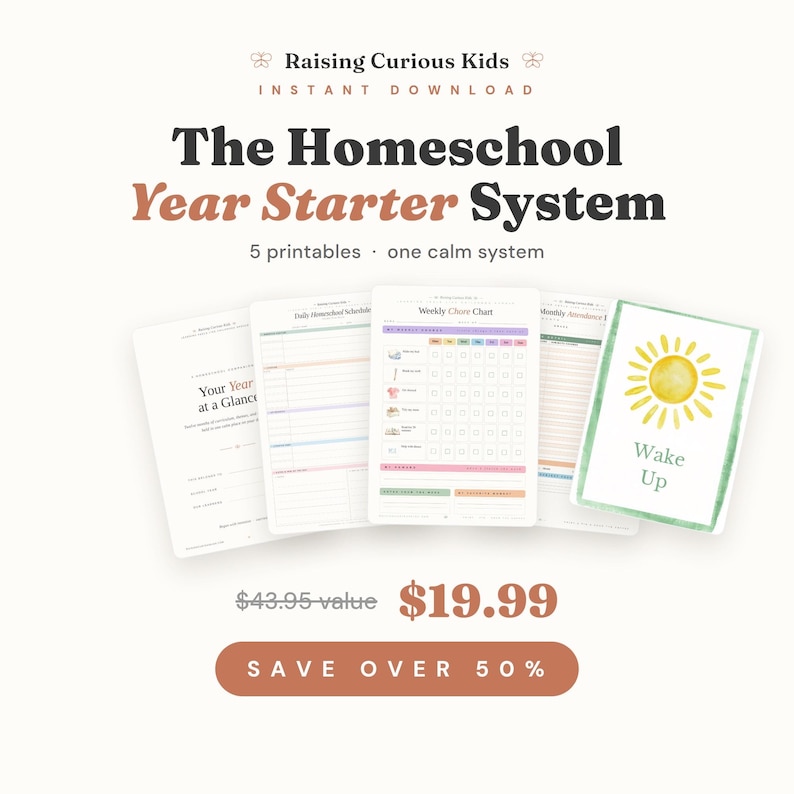
Everything for the Year, Records Included
The Attendance Tracker is one of five printables in our Homeschool Year Starter System: Year at a Glance, Daily Schedule, Attendance Tracker, Chore Chart, and 80 Routine Cards. A clean, print-and-go record for the whole year, plus the tools to plan and run it. Secular, no spreadsheet required.
$19.99 $43.95
Get the Year Starter System on Etsy →Step 3: Get One Annual Evaluation
Once a year, on the anniversary of your Notice of Intent, you provide an evaluation showing your child made progress relative to their own ability, and you submit it to the superintendent’s office. The law gives you five ways to do it, so you can pick what fits your child:
- A Florida-certified teacher of your choice reviews the portfolio and talks with your student. This is the most popular option — affordable, low-stress, and no test day.
- Your child takes a nationally normed standardized achievement test, administered by a certified teacher.
- Your child takes a state assessment at a district-approved location.
- A licensed psychologist evaluates your child.
- Any other measurement tool you and the superintendent agree on.
Note that testing is only one of five options, not a requirement. Most families never sit their child down for a formal test at all.
A Quick Word on the Other Pathways
The Home Education Program above is what most families use, but Florida has other legal routes: enrolling under a private or umbrella school, hiring a private tutor, or homeschooling through the state’s PEP scholarship, which runs on a different set of rules and reports to a scholarship organization instead of your county. If a friend’s requirements sound different from yours, this is usually why — you may simply be on different pathways.
Florida Homeschool Law: Common Questions
How soon do I have to file the Notice of Intent?
Within 30 days of starting your home education program. It is a one-time filing to open the program, not something you refile every year.
Does my child have to take a standardized test in Florida?
No. A standardized test is just one of five evaluation options. Many families use a certified-teacher portfolio review every year instead.
What subjects am I required to teach?
Florida does not mandate specific subjects or hours for the Home Education Program. Instruction should be sequentially progressive and appropriate for your child, but you choose the content.
How long do I keep the portfolio?
Two years. For high school records, it is wise to keep them longer, since they help with transcripts and college applications.
Other States and the Big Picture
Florida lands in the moderate middle: a little documentation, a lot of freedom. For context, our guide to homeschool laws by state shows how much this varies. Texas asks for essentially nothing, fellow Gulf state Louisiana has families choose between a registered home study program and a nonpublic school, and North Carolina requires a yearly standardized test, so Florida sits comfortably in the middle of the three.
The Bottom Line for Florida Families
File your Notice of Intent within 30 days, build your portfolio a little at a time, and choose an evaluation method that suits your child before you need it. Do those three things and the legal side of homeschooling in Florida runs quietly in the background while you get on with the actual teaching.
New to the whole thing? Start with how to start homeschooling, then use the free weekly planner above to keep your days steady from week one.
Last reviewed: July 2026. Homeschool law changes, and the details above are a plain-language summary, not legal advice. Before you make decisions for your family, confirm the current rules with the official source: Florida Department of Education — Home Education. The governing statute is Florida Statute 1002.41; requirements for the PEP scholarship pathway differ.