
You started reading about homeschooling in Alabama and immediately hit a fork: church school, private school, or private tutor. No single homeschool law, just three doors. It is more confusing on paper than it is in practice.
Almost everyone walks through the same door, and once you know which one, the rest is short. Alabama asks for very little: no state testing, no approved curriculum, and for most families, a single form filed once.
Here is how Alabama’s three paths actually work, which one the large majority of families choose, and exactly what you file to start.
Is Homeschooling Legal in Alabama?
Yes, and it has been since 1982. Alabama does not have a statute with the word homeschool in it. Instead, families teach at home legally by operating under one of three existing structures: a church school, a private school, or a private tutor.
That sounds heavier than it is. Two of the three paths carry almost no state oversight, and the one most families use asks for a single enrollment form and nothing more from the state. Compulsory attendance runs from age six to seventeen.
The Three Legal Paths (and Which One to Pick)
Alabama gives you three legal routes. They are not equal in how much work they involve, and most families land on the first for good reason.
Path 1: Enroll in a church school (the standard path)
This is what most Alabama homeschoolers do. A church school is a school operated as a ministry of a church, and state law lets a child be taught at home as an enrolled church school student. You can join an existing church school, often called a cover school, or in some cases establish one in your home.
The appeal is simplicity. You report your child’s enrollment to the local superintendent on a one-page form signed by you and the church school’s administrator, usually just once when you enroll. There is no state testing, no state-required curriculum, and no set number of instructional days written into the church school law. The church school itself may set its own policies, so those vary from one to the next.
Path 2: Operate as a private school
You can also teach at home under the private school structure. This path involves more ongoing paperwork. You notify the superintendent by the end of the first week of the public school year, teach in English, cover the branches of study taught in public schools, and file weekly attendance reports. Families who want a more formal school framework sometimes choose it, but the reporting is heavier than the church school route.
Path 3: Hire a private tutor
The private tutor path is the most regulated and the least common. The tutor must be a certified Alabama teacher, must teach the subjects required in public schools in English, and must provide at least three hours of instruction a day for 140 days a year, between 8 a.m. and 4 p.m. A statement is filed with the superintendent before instruction begins. Most families skip this unless a certified teacher is already doing the teaching.
For the large majority of Alabama families, Path 1 is the answer, and the rest of this guide leans that way.
What Alabama Requires You to Teach
This is where Alabama is unusually hands-off. Under the church school option, the state does not hand you a subject list or a required number of days. Those are set by the church school you enroll in, if at all. Many families simply cover the core: reading and language arts, math, science, and social studies.
The private school and private tutor paths are stricter. Both must teach in English and cover the same branches of study required in public schools. Only the private tutor path carries a state-set schedule, the three-hours-a-day, 140-days rule.
Whichever path you choose, covering the core subjects well is what actually protects your child’s options later, regardless of what the minimum happens to be.
How to Actually Start
File your enrollment notice
For the church school path, contact the church school you are joining and complete the enrollment form for your local superintendent, signed by you and the school’s administrator. In most cases this is a one-time filing done when you enroll, not an annual chore.
If your child is currently enrolled
Have your church school enrollment in place first, then follow your current school’s withdrawal process so there is no truancy gap. Send written notice and keep a dated copy of everything.
New to homeschooling entirely? Our guide to how to start homeschooling covers choosing curriculum and finding your rhythm in the first few weeks.
Do You Have to Keep Records in Alabama?
Yes, and this is the one habit worth building from day one. Under the church school option, the principal teacher, which is usually you, must keep an attendance register for every school day of the year. That is the core legal record.
Beyond attendance, Alabama does not require you to submit grades, test scores, or work samples to the state. But you are the one who will build the transcript and issue the diploma at the end, so a running record of curriculum, samples, and progress pays off later.
A system you maintain all year beats reconstructing it every spring. A wall-mounted file organizer near your teaching spot, with a slot for the attendance register, subject notes, and work samples, keeps the whole thing in one place.
This post contains affiliate links. As an Amazon Associate I earn from qualifying purchases, at no extra cost to you.
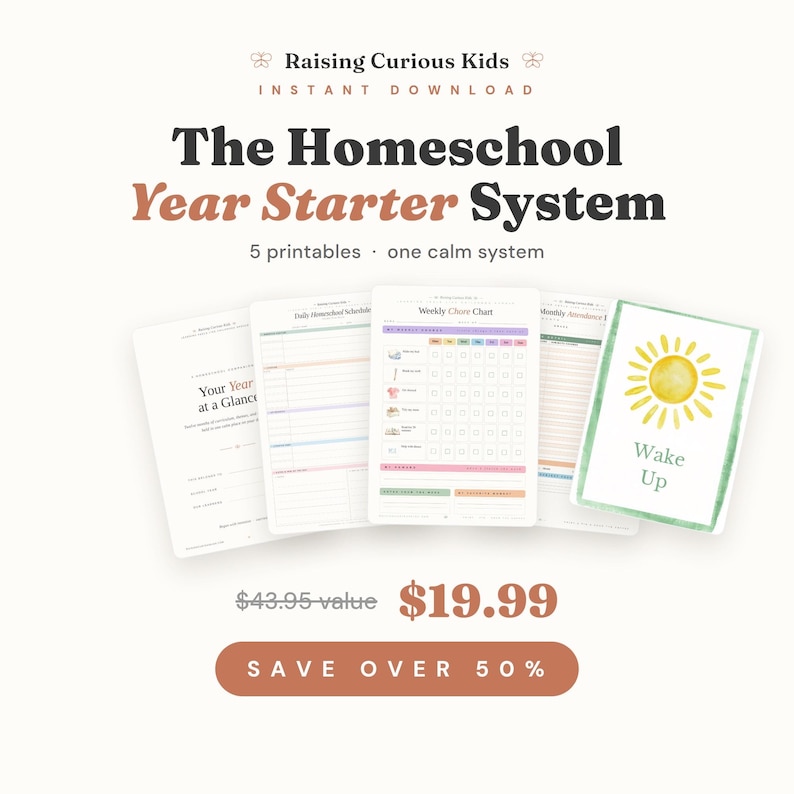
Everything for the Year, Records Included
The Attendance Tracker is one of five printables in our Homeschool Year Starter System: Year at a Glance, Daily Schedule, Attendance Tracker, Chore Chart, and 80 Routine Cards. A clean, print-and-go record for the whole year, plus the tools to plan and run it. Secular, no spreadsheet required.
$19.99 $43.95
Get the Year Starter System on Etsy →About That “Church School” Label
If you are a secular family, the word church can feel like a wall. It usually is not. The church school is the legal entity that holds your child’s enrollment. It does not require your home instruction to be religious, and it does not require your family to belong to a church.
That said, church schools vary. Some cover schools welcome families of any faith or none and stay out of your curriculum entirely. Others expect you to agree with a statement of faith to enroll. It is worth asking a few direct questions before you sign on, so you land with one that fits how you actually teach.
One current detail worth knowing: Alabama’s CHOOSE Act now offers eligible families an Education Savings Account, recently up to about $2,000 per student, that can go toward curriculum, tutoring, and other approved expenses. Eligibility rules and deadlines apply, so confirm the current terms before you count on it.
Alabama Homeschool Law: Common Questions
Which path should I choose?
For most families, the church school option, because it carries the lightest state reporting: usually a one-time enrollment notice plus an attendance register. The private school path adds weekly reporting, and the private tutor path requires a certified teacher.
Do I have to notify anyone that I am homeschooling?
Yes. Under the church school path you report enrollment to your local superintendent on a form signed by you and the church school administrator, typically once. Alabama does not use a yearly letter of intent, but notification through your chosen path is required, not optional.
Does my child have to take a standardized test?
No. Alabama does not require standardized testing under any of the three paths. You can test for your own information, but no results go to the state.
Do I need to be a certified teacher?
Only for the private tutor path. The church school and private school options do not require a teaching certificate or a college degree from the parent.
Other States and the Big Picture
Alabama sits among the lighter-touch Southern states, though its three-path structure is unusual. Our overview of homeschool laws by state shows how far the rules swing from one state to the next. For contrast, neighboring Georgia wants a Declaration of Intent and testing every three years, Tennessee offers three paths of its own with a notice of intent, and Florida pairs a portfolio with one annual evaluation.
The Bottom Line for Alabama Families
Pick your path, almost certainly the church school option, file the enrollment notice with your superintendent, keep a daily attendance register, and cover the core subjects well. Do that and you are fully compliant, with wide freedom over how you teach and no state test in sight.
Then get on with the good part. Start with planning your homeschool year, and grab the free weekly planner above to keep the daily rhythm calm.
Last reviewed: August 2026. Homeschool law changes, and the details above are a plain-language summary, not legal advice. Before you make decisions for your family, confirm the current rules with a trusted source: HSLDA’s Alabama guide and Homeschool Alabama. The governing provisions include Alabama’s church school and compulsory attendance laws and the private tutor statute, Ala. Code § 16-28-5.