
This post contains affiliate links. If you buy through them, RaisingCuriousKids may earn a small commission at no extra cost to you. We only suggest things we’d keep in our own home.
The tears come out of nowhere. One minute your kid is building with blocks, the next the tower falls and the whole afternoon is on fire. Or the game ends, or the sock feels wrong, or her sister looked at her the wrong way.
Big feelings like these are not a discipline problem. They are a skills gap. A child who falls apart over a fallen tower is not being difficult on purpose. She just does not yet have the tools to handle a feeling that size.
Coping skills are those tools. They are the specific, teachable moves that help a child ride a hard feeling instead of drowning in it. This is the full toolkit: what to reach for in the moment, what to build on the calm days, and how it all shifts as your child grows.
What coping skills actually are
A coping skill is anything that helps your child manage a strong feeling without hurting themselves, someone else, or the room. That is the whole definition. It does not have to be deep or fancy.
Blowing on a pinwheel is a coping skill. So is squeezing a pillow, asking for a hug, or walking away to be alone for a minute. The best ones are small, physical, and easy to reach when thinking is hard.
Here is the part worth holding onto: your child is not born knowing these. Coping skills are learned, the same way tying shoes is learned, through showing and practicing and a lot of repetition. Which means the meltdown you are dreading is also the thing you are teaching through.
In-the-moment coping skills
These are the ones for when the feeling is already big. The goal is not to fix anything or talk it out. It is to help the body come down first, because a flooded brain cannot use logic until it feels safe again. For the full play-by-play of a live meltdown, our guide to calm-down strategies for kids walks through it step by step.
Breathing they can see
Telling a kid to take a deep breath almost never works. Giving them something to blow does. Have them blow out ten pretend candles, one finger folding down each time, or hiss like a snake until the air runs out. A breathing ball that opens and closes with each breath does the teaching for you, so you are showing instead of explaining.
Move the feeling out
Anger and frustration are high-energy feelings, and that energy wants somewhere to go. Ten jumping jacks, pushing hard against a wall, stomping across the room, or a big squeeze of a weighted stuffed animal all give the surge a job. Occupational therapists call this heavy work, and it settles a revved-up body faster than sitting still ever could.
Ground the senses
Pulling attention into the body interrupts the spiral. Cool water over the hands. A sensory fidget tool to hold and press. The five-senses game: name five things you see, four you hear, three you can touch. It is quiet, and it works on grown-ups too.
A place to land
Sometimes the skill is simply somewhere to go before the feeling boils over. A calm-down corner gives your child a predictable spot to reset, stocked with the soft, low-key things that help. Not a punishment, not a time-out. A place to feel better.
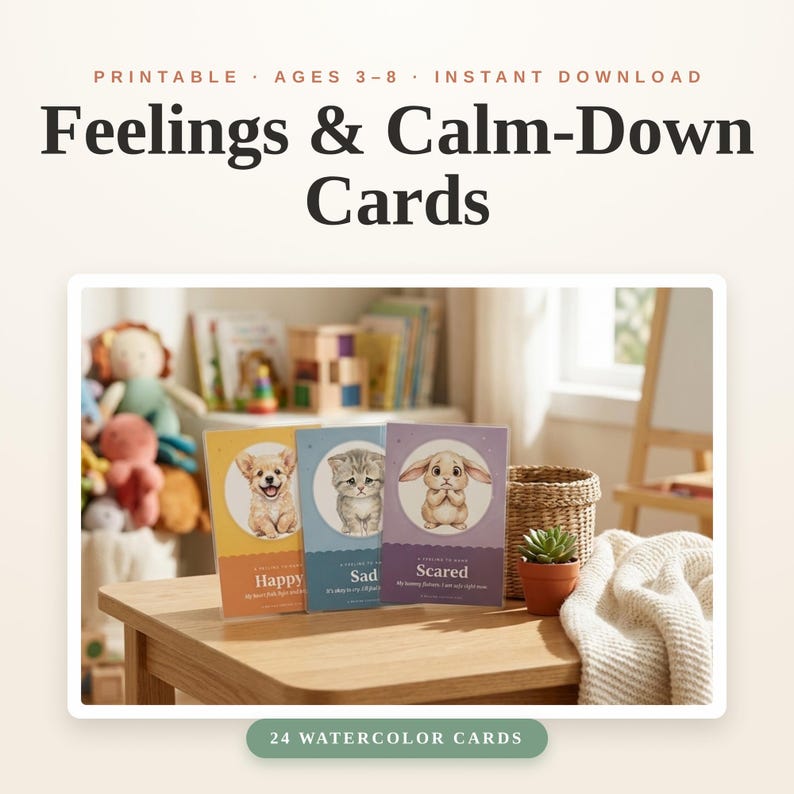
The feeling and the fix, ready to print
Feelings & Calm-Down Cards: 24 cards in one set. Sixteen feelings cards so your child can point to what they feel, plus eight calm-down cards that hand them the next step when the words are gone. Print, laminate, keep them within reach. Launch sale $7.49.
Want the whole system? The Calm & Routine Bundle pairs them with Visual Routine Cards and Screen-Free Activity Cards (134 cards) for $19.99.
Everyday coping skills that build the muscle
None of the in-the-moment tools work the first time you try them mid-meltdown. A skill your child has never practiced is just one more confusing demand in a moment they are already drowning in. The real work happens on the calm days.
Give feelings their names
A child who can say ‘I’m frustrated’ is halfway to handling it. Naming a feeling actually lowers its intensity, so the more words your child has, the less they need to scream. Read a feelings picture book at bedtime, narrate your own feelings out loud, and keep the vocabulary growing when nobody is upset.
Keep the tools in one place
When the wave hits, nobody wants to hunt for the pinwheel. Gathering the props your child likes into a calm-down kit keeps everything together and grab-and-go. Build it with them, so they know what is in there and why.
Practice when it’s boring
This is the step everyone skips. Blow out the candles together on a Tuesday when nobody is upset. Play the five-senses game in the car. Do wall push-ups for fun. Folding these into everyday regulation practice turns them into reflexes your child can reach for alone, instead of a strategy they have to learn in the worst possible moment.
Want a calm daily rhythm to hold all of this together? Grab the free weekly planner and we’ll send it straight to your inbox.
Coping skills by age
Toddlers and preschoolers (ages 2 to 5)
At this age, you are the coping skill. They cannot self-regulate yet, so they borrow your calm: a hug, rocking, blowing bubbles, you naming the feeling out loud while they fall apart in your lap. Keep it physical and simple. They are not really using a tool yet. They are learning what calm feels like by catching yours.
Early elementary (ages 6 to 8)
Now a strategy works with a reminder. ‘What helps when you feel like this?’ starts to get a real answer. Post a short list of go-to moves where your child can see it, so the choice stays visible even when their thinking is not.
Older kids (ages 9 to 12)
Older kids want to own it, not be told. Talk through what works while everyone is calm and let them pick their own: headphones and music, a walk, shooting hoops, writing it down. The goal shifts from ‘I help you calm down’ to ‘you know how to calm yourself.’
What gets in the way
Reaching for it too late. A coping skill offered for the first time at peak meltdown just feels like noise. Teach it calm, use it hard.
Turning the calm-down spot into a punishment. The moment it becomes ‘go to time-out,’ your child will fight going. Keep it a place to feel better, never a consequence.
Expecting a fast fix. Regulation grows over years, not weeks. Some days the only win is that you stayed steady while they did not. That still counts.
Questions parents ask
What are coping skills for a child, exactly?
Any healthy way a child handles a strong feeling without hurting themselves, someone else, or the surroundings. Deep breaths, movement, asking for help, taking space, squeezing something. Small and physical beats deep and complicated every time.
At what age can kids learn coping skills?
You can start naming feelings and modeling calm from toddlerhood. Real independent use usually shows up around six to eight and keeps maturing through the tween years. Match the tool to the age and keep your expectations honest.
What if nothing seems to work?
First, check that you are teaching the skills on calm days, not only during meltdowns. If your child’s big feelings are very frequent, very intense, or regularly involve hurting themselves or others, it is worth a conversation with your pediatrician.
Where to start
You do not need the whole toolkit at once. Pick one in-the-moment skill and one calm-day habit, and practice them until they are boring. That is how a coping skill becomes a reflex instead of a lecture.
Big feelings are not the problem to get rid of. They are the training ground. Every storm you ride out together teaches your child that hard feelings pass, and that they are slowly learning their own way back to calm.
When you want the naming and the calming ready to hand your child, our Feelings & Calm-Down Cards put the feeling and the next step right in their hands.