

You already have a chore chart. Maybe it even worked, for about three weeks. Then the novelty wore off, one kid started skipping tasks, and you went right back to being the one who remembers everything.
A chart is a tool, not a system. The system is the bigger structure around it: how chores get assigned, how often they rotate, whether money is involved, and what happens when a kid ignores the list. Get the system wrong for your family and even the prettiest chart will end up back on the fridge doing nothing.
Here are the four chore systems that actually hold up in real homes, who each one fits best, and how to pick without overhauling your whole week.
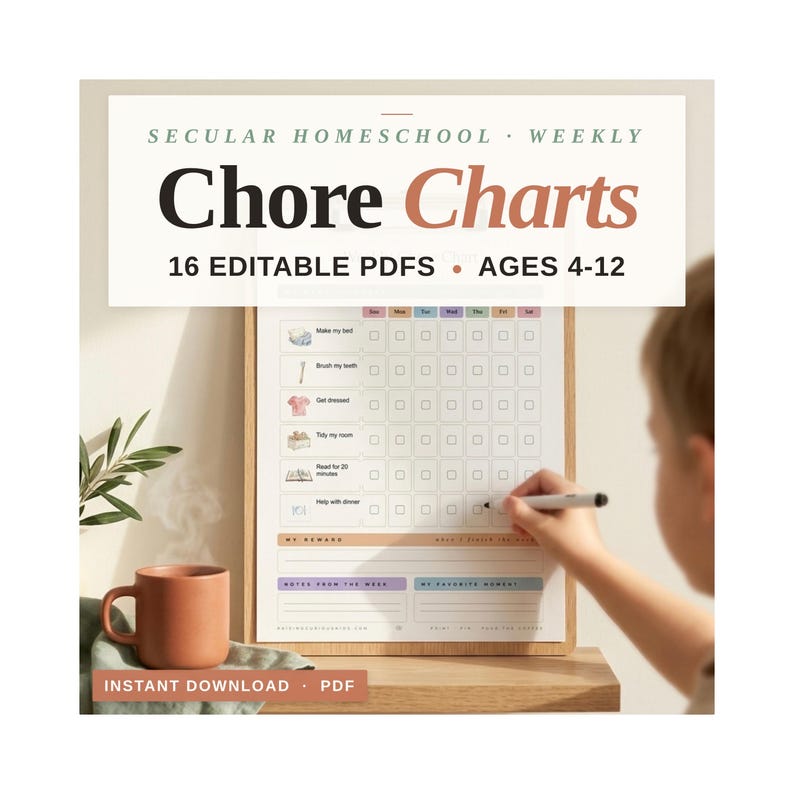
Editable Chore Chart Printable
Whichever system you choose, you still need somewhere to track it. Sixteen editable charts in four calm color palettes, plus a Chores by Age guide so you are not guessing what to assign.
$7.99
Why the system matters more than the chart
A chart tells a child what to do. A system decides who does what, how often it changes, and what happens next. Most chore charts fail not because the design is wrong, but because no one ever chose a system to sit underneath it.
If you already have a chart mapped out by age, our guide to age-appropriate chores by stage covers exactly which tasks fit which ages. This is the layer above that: the framework that decides how the chart actually runs week to week.
The 4 chore systems, compared
1. The fixed chart system
Each child has the same set of chores every day, tied to their age. This is the system most families start with because it is the simplest to set up and the easiest for kids to memorize.
Best for: Younger kids (ages 3 to 8) and families who want predictability over variety.
Watch out for: It can go stale. Kids stop reading a chart they have seen every day for months, so plan to refresh the tasks every season.
2. The chore jar system
Tasks are written on slips of paper and drawn at random, either daily or weekly. The unpredictability is the whole point, since kids do not know what they will pull.
Best for: Multiple kids close in age who compete over who gets the good jobs versus the bad ones. A random draw removes the sense of unfairness. A simple jar with wooden sticks is all you need to set one up.
Watch out for: Harder to plan around. If a chore genuinely needs to happen today, a random draw is not the right system for it.
3. The rotation system
A set list of chores rotates between siblings on a weekly or monthly schedule, so no one is stuck with the same task forever. Works especially well for the jobs nobody wants, like dishes or trash.
Best for: Two or more kids ages 6 and up. It teaches every child every skill over time, and it heads off the “why do I always have to” complaint before it starts.
Watch out for: Needs a visible tracker, like a rotating chore wheel or a chart with names that move, or the rotation quietly stops happening.
4. The allowance-linked system
Chores earn a set amount toward weekly allowance, either per task or as a flat rate tied to completing the full list. Money becomes the motivator instead of a sticker or a chart.
Best for: Kids ages 8 and up who are ready to learn budgeting alongside responsibility.
Watch out for: Decide ahead of time whether basic household chores are paid or expected for free, and stay consistent. Mixing the two is what causes most of the arguments with this system.
This post contains affiliate links. As an Amazon Associate I earn from qualifying purchases, at no extra cost to you.
How to choose the right system for your family
Start with two questions: how many kids are sharing chores, and what actually motivates them. One child who likes routine usually does best with a fixed chart. Two or more kids who compare notes on fairness usually need a jar or a rotation. A kid who already understands money is often more consistent with an allowance link than with a sticker chart.
Age matters less than personality here. A capable six year old and a cautious nine year old might want the same system for different reasons, so watch how your kids actually respond in the first two weeks rather than picking based on a rule of thumb.
Systems can combine, too. Many families run a fixed chart for the youngest kids and a rotation for anyone eight and up, all inside the same weekly family routine, so the household runs on one rhythm instead of several competing ones.
When a kid resists the system, not just the chore
Sometimes the pushback is not about the task, it is about the system feeling unfair or confusing. Before switching everything, sit down with your child and ask what specifically feels hard. Often the fix is smaller than a full overhaul, like moving a rotation day or adjusting a payout.
If resistance turns into a bigger meltdown, that is a different problem than the chore itself. Our piece on calm-down strategies for kids can help you get through the moment before circling back to the chore conversation.
Want the whole week to run calmer?
Grab the free weekly homeschool planner and bring a little structure to your days. No spam, unsubscribe anytime.
Chore systems for kids: common questions
What is the best chore system for multiple kids?
Rotation tends to work best once you have two or more kids old enough to handle a range of tasks. It spreads the unpopular jobs evenly and removes the fairness arguments a fixed chart can create between siblings.
Should chores be tied to allowance?
There is no single right answer. Many families keep basic chores unpaid as part of being in the household, then pay for extra jobs beyond the normal list. If you do link chores to money, decide the rule ahead of time and hold it steady so kids are not negotiating it weekly.
How often should a chore system change?
Revisit it every few months, or sooner if you notice tasks being ignored across the board. That is usually a sign the system, not the child, needs an adjustment.
Can I mix chore systems?
Yes, and most families end up doing this naturally. A fixed chart for younger kids alongside a rotation for older ones is one of the most common combinations, as long as everything lives on one visible tracker.
There is no single correct chore system, only the one that fits how your family actually operates. Pick one, give it two weeks before judging it, and adjust from there. The goal was never a perfect chart. It was a house where the list is not living entirely in your head.