This post contains affiliate links. If you buy through them, I may earn a small commission at no extra cost to you.
She was fine at breakfast. Then somewhere between the car and the classroom door, your kid went quiet, gripped your hand a little tighter, and asked the same question for the third time. What if nobody plays with me? What if I forget the words to the song? You can see the worry sitting in her shoulders before she even gets it out.
Anxiety in kids doesn’t always look like fear. Sometimes it looks like a stomachache before school, a meltdown over a sock, or a five-year-old who suddenly won’t sleep alone. It’s exhausting to watch, and most of us instinctively reach for the one thing that almost never works: trying to talk her out of it.
Here’s a different order to try. One that works with your child’s brain instead of against it.
Why “calm down” makes it worse
When a child is anxious, her body flips into fight-or-flight. Heart racing, muscles tight, brain scanning for danger. In that state, the thinking part of her brain has basically gone offline. She literally cannot reason her way out yet.
So when we say “calm down,” “you’re fine,” or “there’s nothing to be scared of,” it lands on a kid who is not physically able to hear it. Worse, it tells her that what she feels is wrong. Now she’s anxious and alone in it.
The fix isn’t better arguments. It’s a different sequence: settle the body first, then reach the mind. Everything below follows that order.
Start with the body, not the words
Before you explain anything, your job is to help her nervous system feel safe. The fastest way to do that is to borrow yours. Kids co-regulate, meaning they catch calm from a calm adult the same way they catch panic from a panicked one.
Get low. Soften your voice. Slow your own breathing down on purpose, because she’s reading your body more than your words. You don’t have to feel calm. You just have to act it long enough for her to borrow it.
A breath she can actually follow
“Take a deep breath” is too vague for a worried kid. Give her something to do with her body instead. Trace a finger up one side of her hand as she breathes in, pause at the top, trace down the other side as she breathes out. Five fingers, five slow breaths.
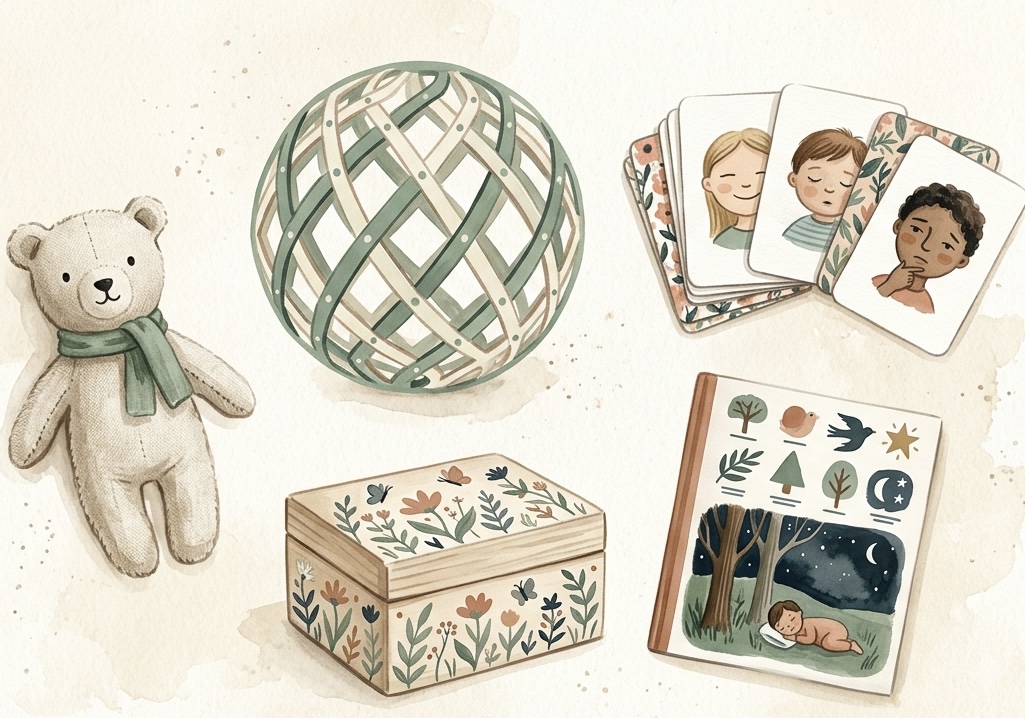
Or hand her a breathing ball, one of those expanding sphere toys, and let it do the counting for her. Open the ball, breathe in. Close it, breathe out. A slow exhale is the part that flips the calm switch, so linger on the way down.
Give the worry somewhere to go
Anxious energy is physical, and sometimes it needs a physical exit before any breathing will stick. This is where heavy work helps. Wall pushes, carrying a stack of books, a hard squeeze from a hug, or ten jumping jacks all send a quiet signal to the brain that the body is safe.
A weighted stuffed animal on the lap does the same thing more gently, which is why so many kids reach for one at bedtime. The steady pressure is grounding. Keep one within reach of wherever the worries tend to show up.
Try a breathing ball for the exhale work and a weighted stuffed animal for the grounding pressure. Both live better in a basket by the couch than in a drawer she forgets about.
Then name the worry out loud
Once her body settles, her thinking brain comes back online, and now words can actually help. Start by naming what you see, not fixing it. “Your tummy feels wobbly about the sleepover.” “You’re scared they’ll laugh.”
Putting a feeling into words takes some of the sting out of it. Kids feel understood, and the worry shrinks from a giant nameless thing into something small enough to hold. If she can’t find the words, a feelings chart gives her a place to point.
Then get curious instead of reassuring. “Tell me about it” opens the door wider than “don’t worry” ever will. You’re not agreeing that the fear is realistic. You’re just letting her know it makes sense to feel it, which is the thing she actually needs from you.
Shrink the what-if
Anxiety loves the future. Almost every worry starts with “what if,” and it always tells the scariest possible version of the story. Part of your job is to gently pull her back to right now.
Grounding does this fast. Try the 5-4-3-2-1 game: name five things you can see, four you can hear, three you can touch, two you can smell, one you can taste. Call her a sensory detective and it stops feeling like a chore. It works because you cannot spiral about tomorrow while you’re busy counting the sounds in the room.
For the worries that keep circling back, try a worry box. Any container will do, decorated however she likes. She writes or draws the worry, folds it up, and puts it in the box, where it can wait until a set “worry time” later that day. It sounds too simple to work. It works because it tells her brain the worry is handled, so it can stop looping.
When she’s stuck replaying the same fear, you can also change the ending. Tell the worried story together, then stop before the end and make up two or three new endings. One silly, one realistic, one where she handles it just fine. It reminds her the scary version isn’t the only one.
The words that help, and the ones that don’t
What you say in the hard moment matters more than we’d like it to. A few phrases quietly make anxiety bigger, even though they come from love.
Skip these:
- “Calm down.” (She can’t yet, and now she feels rushed.)
- “There’s nothing to be scared of.” (It tells her the feeling is wrong.)
- “You’re fine.” (She’s clearly not, and you just skipped past her.)
- “Stop worrying.” (If only worry worked like a switch.)
- “Big kids aren’t scared of that.” (Now she’s anxious and ashamed.)
Try these instead:
- “I’m right here. We’ll figure it out together.”
- “That does feel scary. Tell me about it.”
- “Your body is doing that thing where it feels big. Let’s breathe.”
- “You’ve done a hard thing before. Remember when you did?”
- “What would help right now?”
Notice that none of them argue with the fear. They sit beside it. That’s the whole shift.
Practice calm before she needs it
Here’s the part most advice skips. You can’t teach a calming skill in the middle of a meltdown any more than you can teach swimming to someone who’s drowning. The tools have to be familiar before the hard moment, or they won’t be there when it counts.
So practice when everyone’s regulated. Do the finger breathing while you wait for pasta to boil. Play 5-4-3-2-1 in the car. Build the worry box together on a lazy Sunday. When it’s a game on a good day, it becomes muscle memory on a bad one.
Visuals make this stick, because an anxious kid can’t always remember her options when her brain is flooded. A small set of cards she can flip through, one calming strategy per card, turns “I don’t know what to do” into “I’ll pick this one.” A dedicated calm-down corner gives those tools a home she can go to on her own.
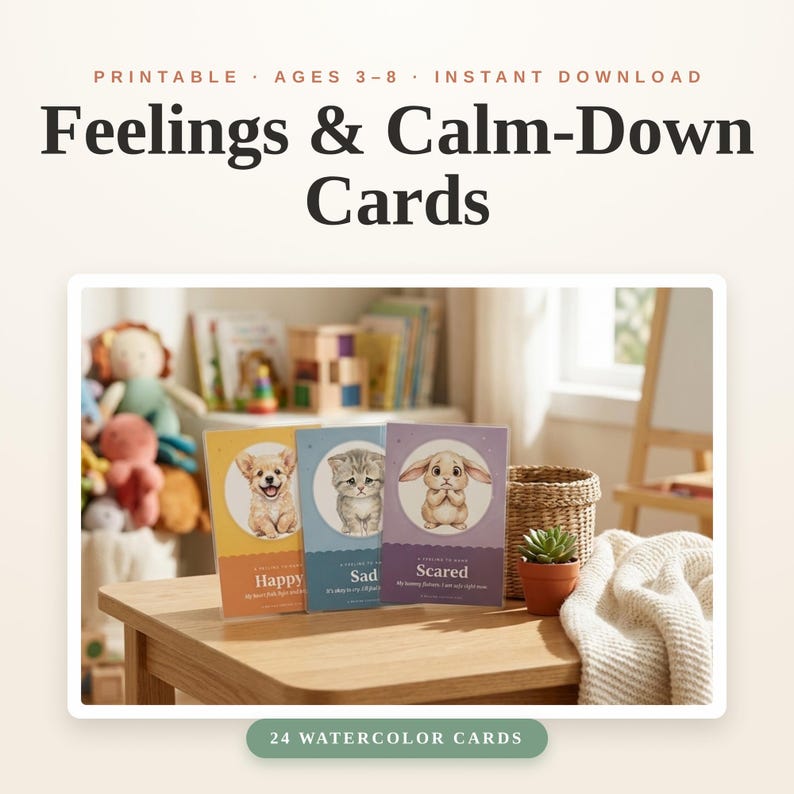
From the Shop
Feelings & Calm-Down Cards
Printable cards that give your child a visual way to name the feeling and pick a calming strategy, right when the worry hits.
See the cards on Etsy →A short book can help too. Stories like picture books about worry give kids language for what’s happening inside them, and reading one together on a calm night plants the idea that worries are normal and manageable. If bedtime is when the worries come, a predictable bedtime routine does a lot of quiet heavy lifting.
When it’s more than everyday worry
Some worry is just part of growing up, and the strategies above are usually enough. But if anxiety is taking over her days, keeping her from school, friends, sleep, or things she used to love, that’s worth more support than a blog post can give.
There’s no prize for handling it alone. A pediatrician or a child therapist can help you sort out what’s typical and what needs a hand, and getting that help early tends to make everything easier. Reaching out isn’t a sign you’re failing. It’s one more calming tool, just a bigger one.
For the everyday stuff, though, keep it simple. Settle the body, name the worry, shrink the what-if. You won’t get it right every time, and a rough day doesn’t undo the calm ones. What your child remembers isn’t the perfect words. It’s that when the worry got big, you stayed. Want the full toolkit? Start with these coping skills for kids.