You have decided to homeschool in Texas, and now you are staring at a browser tab wondering which forms you file, who you notify, and whether some office is about to start checking up on you. That worry is the number one thing that stalls new Texas families before they even begin.
Here is the short version, and it is genuinely good news. Texas is one of the easiest states in the country to homeschool. There is no form. There is no state office to register with. No one grades your year.
Below is exactly what the law asks of you, what it does not, and the two or three steps that actually matter on day one.
Is Homeschooling Legal in Texas?
Yes, and it has been settled law since 1994. In Leeper v. Arlington ISD, the Texas Supreme Court ruled that a home being used to educate a child qualifies as a private school. Private schools in Texas are not regulated by the state, so your homeschool is not either.
The Texas Education Agency says this in plain terms on its own website: it does not “regulate, index, monitor, approve, register, or accredit” home schools. That single sentence is the whole reason Texas paperwork is close to nonexistent.
In 2025, the state went a step further and wrote those protections into statute, so the freedom families have relied on for thirty years is now spelled out in law, not just in a court ruling.
What Texas Actually Requires
There are only three requirements, and they all come straight from the Leeper decision:
- The instruction has to be real. The law calls it “bona fide,” which just means you are actually teaching your child, not using the label to skip school.
- Your curriculum has to be in written or visual form. Books, workbooks, printed materials, online lessons, video — anything you can point to counts. Purely making it up out loud does not.
- You cover five subjects: reading, spelling, grammar, math, and a course in good citizenship.
That is the entire list. No minimum number of hours. No required days per year. No mandated curriculum brand. No teaching degree. And critically, no test and no report to anyone.
How to Actually Start (It Depends on One Thing)
The steps split based on whether your child is currently enrolled in public school.
If your child has never been in public school
You simply start. Pick your materials, cover the five subjects, and begin. There is no one to tell and no box to check first.
If your child is currently enrolled
You need to formally withdraw before you begin, or the school can keep marking your child absent and, in a worst case, file for truancy. Send the district a short written letter of withdrawal that names your child, states the date you are withdrawing, and says you are moving to a private home-education program. Send it in a way you can prove was delivered, like certified mail or tracked email.
New to all of this? Our full walkthrough on how to start homeschooling covers choosing curriculum, setting a rhythm, and the first few weeks in more detail.
Do You Have to Keep Records in Texas?
No. Texas does not require you to keep attendance, grades, or work samples. But keeping a light record is still one of the smartest things you can do, for reasons that have nothing to do with the state.
Records make life easier later: applying to college, transferring back into public school, or answering a district that mistakenly contacts you. A simple attendance log and a folder of work samples per year is plenty. Many families keep everything in one spot with something like a wall-mounted file organizer so the current year is always within reach.
This post contains affiliate links. As an Amazon Associate I earn from qualifying purchases, at no extra cost to you.
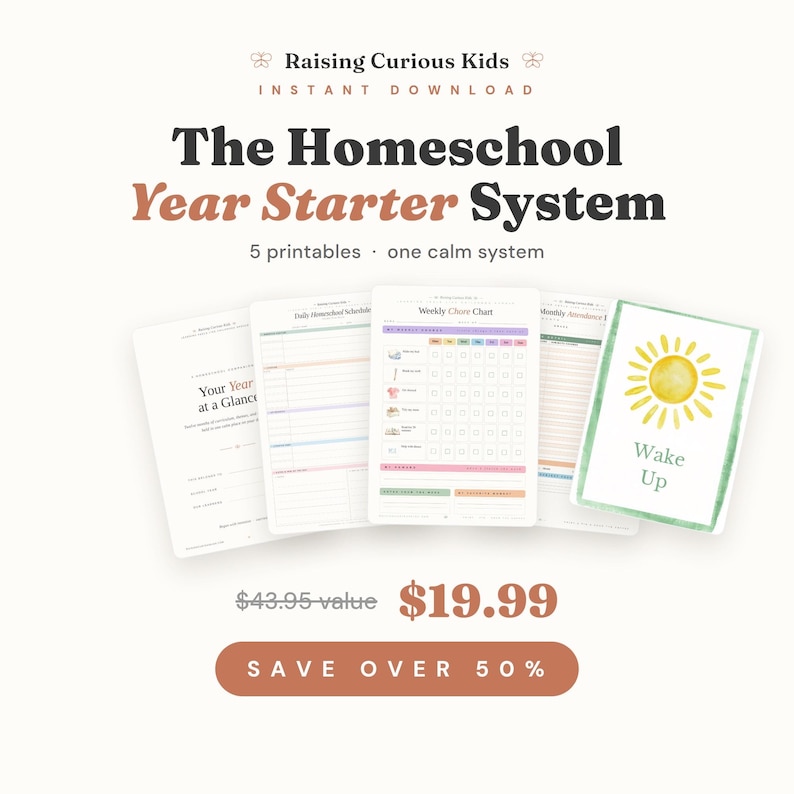
Everything for the Year, Records Included
The Attendance Tracker is one of five printables in our Homeschool Year Starter System: Year at a Glance, Daily Schedule, Attendance Tracker, Chore Chart, and 80 Routine Cards. A clean, print-and-go record for the whole year, plus the tools to plan and run it. Secular, no spreadsheet required.
$19.99 $43.95
Get the Year Starter System on Etsy →What About the New Texas ESA Funding?
In 2025 Texas created the Texas Education Freedom Accounts (TEFA) program, its first-ever state funding that follows the student. Homeschool families can receive up to about $2,000 per student per year for approved materials and services.
It is worth understanding before you assume it is free money. Participating comes with its own strings, including testing requirements, and the program is new and still being rolled out. Check the current terms on the official state program page before you count on it, and do not let the paperwork of a funding program get confused with the near-zero paperwork of simply homeschooling.
Texas Homeschool Law: Common Questions
Do I have to notify anyone that I am homeschooling?
No. If your child was never enrolled, you tell no one. If your child is being withdrawn from public school, you send a withdrawal letter to that district — but that is a courtesy to end enrollment, not a registration.
Does my child have to take a standardized test?
No. Texas does not require any testing for homeschoolers. Testing only enters the picture if you opt into the ESA funding program or choose to test for your own information.
Which subjects am I required to teach?
Five: reading, spelling, grammar, math, and good citizenship. Beyond that, you decide what your family studies and how.
Can my homeschooler play public school sports?
Since 2021, Texas homeschoolers can participate in University Interscholastic League (UIL) activities, including sports, if they meet the same eligibility rules as enrolled students. Whether a specific team has room is a local district matter, so contact your district to ask.
Other States and the Big Picture
Texas sits at the very light end of the regulation scale, alongside a handful of other trust-the-parent states. If you are comparing states or planning a move, our overview of homeschool laws by state shows how the rules shift from almost nothing to annual testing depending on where you live. Illinois and Michigan are close cousins with almost no requirements, while just across the eastern border Louisiana has you choose between a registered home study program and a nonpublic school setup, Florida adds a notice and an annual evaluation, and North Carolina requires registration and a yearly test.
The Bottom Line for Texas Families
Texas trusts parents. There is no registration, no testing, and no oversight — just teach five subjects with real intent and a written curriculum, and you are compliant. Withdraw properly if your child is currently enrolled, keep a light record for your own sake, and then spend your energy on the actual teaching instead of the paperwork.
Ready to build the year around that freedom? Start with our guide to planning your homeschool year, then grab the free weekly planner above to keep the day-to-day calm.
Last reviewed: July 2026. Homeschool law changes, and the details above are a plain-language summary, not legal advice. Before you make decisions for your family, confirm the current rules with the official source: Texas Education Agency — Home Schooling. For funding specifics, see the state’s official Education Freedom Accounts program page.