California confuses more new homeschool families than almost any other state, and it is not because the rules are hard. It is because there is no law with the word “homeschool” in it. You go looking for a homeschool statute and come up empty, and that empty space is where the anxiety grows.
Here is what is actually going on. Most California families homeschool by running a small private school in their own home. You file one form a year, teach a handful of subjects, and keep a few records. That is the whole framework, and once you see it laid out, it stops being scary.
Here is exactly what California requires, in the order you will actually do it.
Is Homeschooling Legal in California?
Yes. California does not have a dedicated homeschool law, so families use an existing one: the private school exemption. Under Education Code Section 48222, a child enrolled full-time in a private school that has filed the required paperwork is exempt from public school attendance. You file that paperwork, and your home becomes a legally recognized private school.
About nine in ten independent California homeschoolers take this path. Compulsory attendance covers ages six through eighteen, so those are the years the steps below apply to.
Step 1: File a Private School Affidavit (PSA)
Once a year you file a Private School Affidavit with the California Department of Education, online at the CDE website. The statutory window is October 1 through 15, and the filing system stays open most of the year for families starting mid-year. The affidavit establishes your home as a private school and lists you as the administrator.
One point trips up nearly everyone: you file with the state, not your local school district. Do not call your district office to ask about homeschooling paperwork. The PSA goes straight to the CDE, and that is the entire registration.
Step 2: Teach the Required Subjects
California does not approve your curriculum or hand you a lesson plan, but the law does name the subjects a private school must offer. For grades 1 through 6 (Education Code Section 51210) and grades 7 through 12 (Section 51220), those areas include English, mathematics, science, social studies, and several others such as visual and performing arts, health, and physical education.
How you cover them is completely up to you. There is no state test, no curriculum approval, and no minimum hour count under the PSA path. You choose the materials and set the pace.
Step 3: Keep Basic Records
A private school keeps a few standard records, and yours is no different. California asks you to maintain three things:
- An attendance register. A record of the days school was in session and your student attended.
- A list of courses of study. The subjects you are teaching that year.
- Immunization and health records. Your student’s shot records or a valid exemption on file.
You keep teacher qualification records too, which for most families just means noting who is teaching. None of this gets submitted anywhere routinely. It lives in your files in case it is ever requested, which is rare.
Attendance is the record most families want handled cleanly rather than tracked on a scrap of paper. Keeping it somewhere consistent — a binder, or a wall-mounted file organizer by your teaching space — means you are never scrambling if anyone ever asks to see it.
This post contains affiliate links. As an Amazon Associate I earn from qualifying purchases, at no extra cost to you.
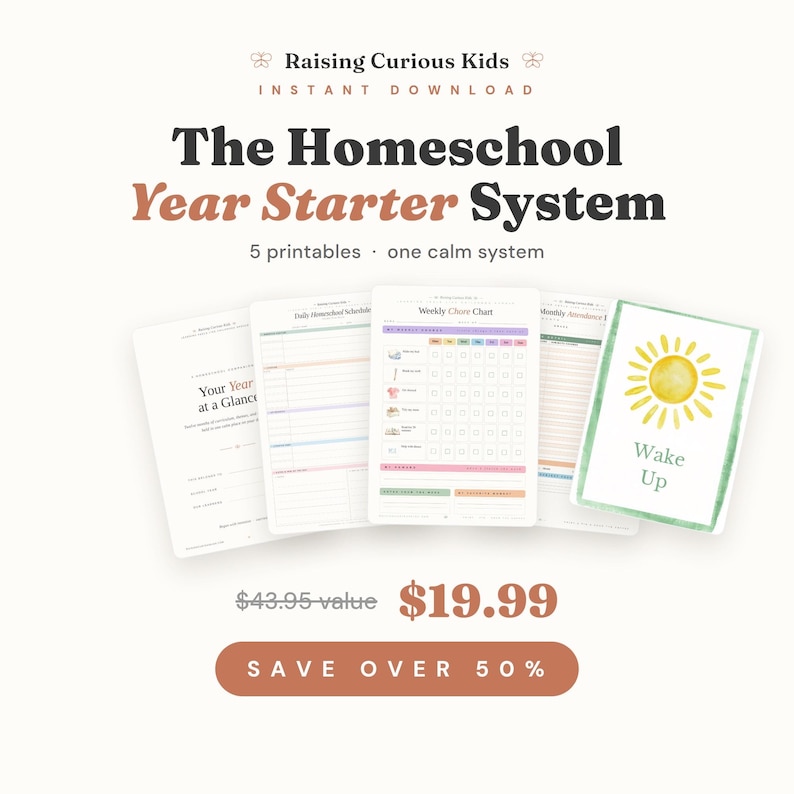
Everything for the Year, Records Included
The Attendance Tracker is one of five printables in our Homeschool Year Starter System: Year at a Glance, Daily Schedule, Attendance Tracker, Chore Chart, and 80 Routine Cards. A clean, print-and-go record for the whole year, plus the tools to plan and run it. Secular, no spreadsheet required.
$19.99 $43.95
The Four California Homeschool Paths
The PSA is the most common route, but it is not the only one. California families generally pick from four options:
- Private School Affidavit (PSA). You run your own home-based private school. Most independence, no funding, minimal oversight.
- Private School Satellite Program (PSP). You enroll under an umbrella private school that handles the affidavit and keeps some records for you.
- Public charter or independent study. A publicly funded program that often provides a stipend and materials, in exchange for more reporting and less curriculum freedom.
- Credentialed private tutor. A route for a parent who holds a California teaching credential, or who hires one.
Most families reading this will land on the PSA. If you want funding and are comfortable with more oversight, a charter is worth a look.
California Homeschool Law: Common Questions
Do I notify my local school district?
No. Under the PSA path you file the Private School Affidavit with the California Department of Education, not your district. Contacting your local district about homeschooling paperwork is a common early mistake.
Is standardized testing required?
No. California does not require homeschooled students to take standardized tests under the PSA path, and no one reviews or approves your program.
Do I need a teaching credential?
No, not on the PSA path. A credential is required only if you choose the private tutor option. Filing a PSA and running your own home private school needs no credential.
When exactly do I file the PSA?
The statutory filing period is October 1 through 15. If you are starting mid-year, the online system is open most of the year to accommodate you.
Other States and the Big Picture
California sits at the low-regulation end once you understand the private school framework: one affidavit, required subjects, basic records, no testing. For comparison, our overview of homeschool laws by state shows the full range. Texas asks for even less, while Florida adds an annual evaluation you will not find in California.
The Bottom Line for California Families
File your Private School Affidavit with the CDE between October 1 and 15, teach the required subjects at your own pace, and keep an attendance register, a course list, and immunization records at home. That is the complete compliance picture under the most common path — and within it, you have full control over what and how you teach.
Just getting started? Walk through how to start homeschooling and planning your homeschool year, then grab the free weekly planner above to keep the daily rhythm steady.
Last reviewed: August 2026. Homeschool law changes, and the details above are a plain-language summary, not legal advice. Before you make decisions for your family, confirm the current rules with the official source: California Department of Education — Private Schools & Schooling at Home. Governing law: California Education Code Sections 33190, 48222, 51210, and 51220. File your affidavit at the CDE Private School Affidavit system.