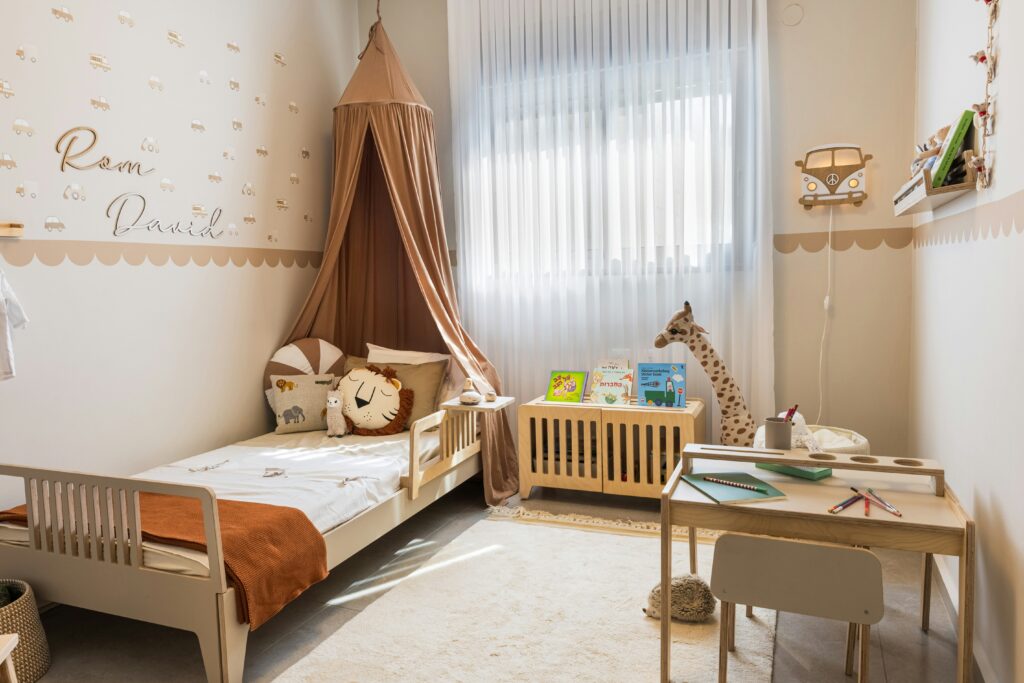
You open Pinterest looking for homeschool room inspiration and get a converted bonus room with floor-to-ceiling shelving, a reading loft, and a globe on a plinth. You close the app and look at your dining table, which is also your desk, and also where dinner happens in four hours.
Here is the good news, and it is not a consolation prize. Small spaces homeschool better than big ones in a few specific ways. Everything is within arm’s reach. Nothing gets lost in a room nobody goes into. And the constraint forces you to own less, which is the thing every family with a dedicated room eventually has to learn the hard way.
What you need is not more square footage. You need a setup that goes vertical, packs down, and stays out of the way of your actual life.
This post contains affiliate links. As an Amazon Associate I earn from qualifying purchases, at no extra cost to you.
Stop Looking for a Room. Start Looking for Three Zones.
The mistake is searching for one space that does everything. In a small home that space does not exist, and hunting for it keeps you stuck.
Instead, split the job into three zones that can live in three different places:
- A work surface. Where the writing happens. Usually a table you already own.
- A storage home. Where the supplies live between sessions. Almost never in the same place as the work surface.
- A display wall. Where the routine, the calendar, and the current work are visible.
Once you stop needing those three things to be adjacent, options appear everywhere. The kitchen table works. The hallway wall works. The closet works.
1. Make the Dining Table Your Classroom (Properly)
Most small-space families end up at the dining table anyway. The difference between that being fine and that being a daily fight is whether the table can be cleared in under two minutes.
Set a hard rule: nothing homeschool-related permanently lives on the table. Everything arrives at 9 a.m. and leaves by lunch. The table stays a table.
2. Buy One Cart and Let It Do Everything
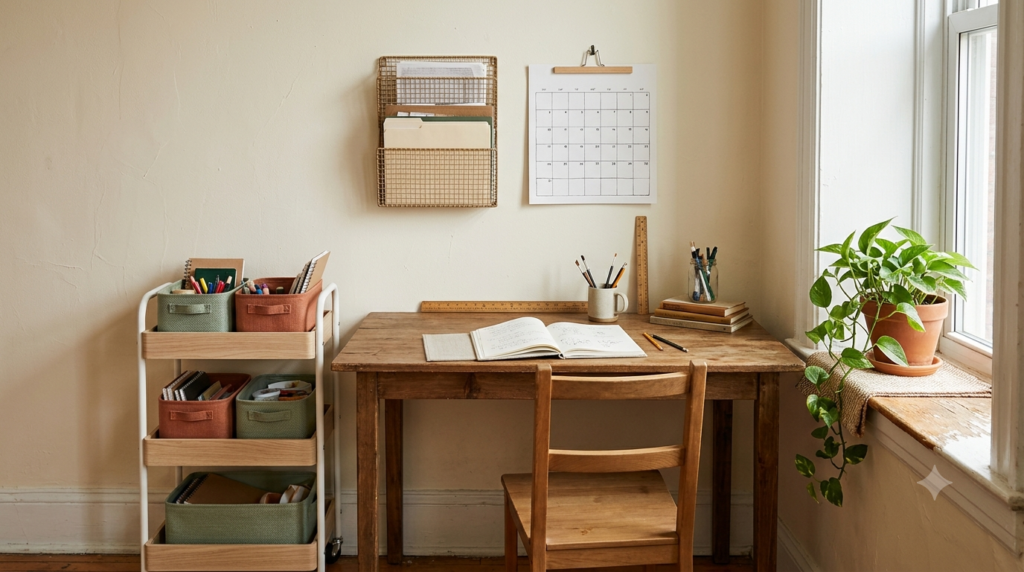
If you buy a single thing for a small space homeschool, make it a rolling cart. Three tiers hold a startling amount, it wheels to whatever table you are using, and it parks in a corner or beside a bookshelf when the day ends.
This is the single highest-leverage purchase in a small home because it converts any surface into a school space in about four seconds, and it un-converts it just as fast.
3. Go Vertical Before You Go Wider
Floor space is what you do not have. Wall space is almost always sitting empty, especially the two to five feet above furniture.
A wall file organizer holds today’s worksheets, this week’s readers, and the folder that otherwise lives on the counter. Mounted beside the table, it replaces an entire piece of furniture and takes up four inches of depth.
If you are renting, this is all doable with adhesive strips and command hooks. I broke down the exact three-piece wall setup in my guide to homeschool wall ideas, and it is designed for walls you are not allowed to drill.
4. Use the Back of a Door
Every door in your home has a full sheet of unused vertical storage on the back of it. An over-the-door shoe organizer with clear pockets is the cheapest supply storage that exists, and it makes everything visible, which matters more than it sounds.
Bedroom door, pantry door, closet door. Pick one and you have just added storage without losing a square inch of floor.
5. Turn One Closet Shelf Into the Whole School
A single shelf in a hall closet, with three or four stackable storage bins, holds more curriculum than most families use in a year. One bin per child, or one bin per subject.
The closet-door version of this has a real advantage over open shelving: when the door shuts, the visual clutter is gone. In a small home, that matters for everyone’s nervous system, not just for looks.
6. Put the Routine on the Wall So You Stop Being It
In a small space you are always within earshot, which means you become the human reminder for every single step of the day. That is exhausting, and it is fixable.
A visible routine list does the reminding instead. When the sequence is posted at kid height, you stop narrating the morning and they start running it.
Give your small space a routine that runs itself
The Visual Routine Cards from the Raising Curious Kids shop turn “what do I do next?” into a checklist your kid can follow without you. Print, laminate, and hang them on the wall or the fridge. Morning, after-school, and bedtime sequences included, and they take up no floor space at all.
7. Hang One Calendar Everyone Can See
Small homes run on shared space, which means everyone needs to know what is happening without asking. A simple wall calendar in the kitchen or hallway covers school, work, and appointments in one glance.
This is also the piece that keeps homeschool from swallowing the whole house. When the week is visible, the boundaries between school time and family time hold better.
8. Give Every Kid One Hook and One Bin
Individual ownership prevents the pile. A wall hook for the bag and headphones, one bin for their materials, and the rule that both get used before free time starts.
Two kids sharing a nine-inch strip of wall is entirely workable. Two kids sharing a vague “put your stuff away” is not.
9. Use a Cork Board Instead of a Gallery Wall
Kids need their work displayed, and in a small home a rotating cork board beats taping paper across every available surface.
One board, one pin each, swap when something new comes home. The work gets honored, the walls stay calm, and nothing accumulates.
10. Take School Outside the House
A small home makes the library, the park, and the coffee shop into extensions of your classroom rather than field trips. Read-alouds happen on a picnic blanket. Nature study happens on a walk.
This is not a workaround for lacking space. Families with dedicated homeschool rooms often struggle to get out of them, and their kids are the poorer for it.
11. Own Less Curriculum Than You Think You Need
The truest small-space strategy is not a storage hack. It is buying less.
Most homeschool clutter is aspirational: the science kit for next year, the manipulatives for a method you tried once, the six workbooks you bought because they were on sale. In a small home, that stuff has a visible cost every single day.
Buy for this term. Use the library for read-alouds. Store digital where you can. If you want a full pass at what stays and what goes, my small-space storage guide and my list of homeschool organization ideas both go deeper on this.
What a Small Space Setup Actually Looks Like
Put together, a working small space homeschool is unglamorous and almost invisible:
- The dining table, cleared by lunch.
- One rolling cart parked in the corner.
- A wall file organizer, a routine list, and a calendar on one three-foot strip of wall.
- Three bins on a closet shelf behind a door.
- One hook and one bin per kid.
That is it. It costs a fraction of a dedicated room and it works better, because nothing in it can be avoided by simply not going into that room.
Start With the Cart and the Wall
You do not need to do all eleven of these. Pick two: get a cart so the table clears, and claim one three-foot strip of wall so the routine lives somewhere other than your mouth.
Those two changes remove most of the daily friction in a small home. Everything else on this list is refinement you can add over the next few months, one weekend at a time.
Once you have the space sorted, the next piece is what happens in it. Walk through how to set up a learning space kids actually use and setting up your homeschool space before the school year, then grab the free weekly planner above to give your new corner a rhythm from day one.