It’s 4 p.m. The backpack is dumped by the door, there’s a worksheet somewhere under the cereal bowls, and your kid is lying half-off the kitchen chair announcing they can’t find a pencil. You know the drill: ten minutes of hunting for supplies before a single thing gets done, and by then everyone’s already frustrated.
Here’s the thing almost nobody tells you. The problem usually isn’t your kid’s focus, and it isn’t your homeschool curriculum or their teacher’s worksheet. It’s that learning has no home in your house — no single spot that says “this is where we do the thinking.”
A learning space fixes that, and you don’t need a spare room or a Pinterest-perfect setup to make one. You need a corner that does three specific jobs. This works whether you homeschool full-time or your kid comes home from school with an hour of homework — the setup is exactly the same.
You Don’t Need a Room — You Need a Corner
The phrase “learning space” makes people picture a converted bedroom with a wall of built-in shelving. Skip that image. A learning space is a zone, not a room, and the best ones are often three feet of wall and a small table.
What matters is that it’s consistent. When a kid sits in the same spot every day, their brain starts associating that spot with focus, the same way a bed signals sleep. The location does part of the parenting for you.
And the goal here is calm, not clever. A quiet, uncluttered corner in soft, grounded colors will out-perform a busy, over-decorated one every time. Kids focus better in spaces that feel settled, so resist the urge to fill every inch.
The 3 Jobs a Learning Space Has to Do
Before you buy a single bin, get clear on what this corner is actually for. A learning space that works does exactly three things, and if it’s missing one, that’s usually where the daily friction lives.
- It tells the kid what to do. A visible routine or checklist means you’re not the human reminder for every step.
- It holds the supplies. Pencils, paper, and whatever they need that day live here — so “I can’t find it” stops eating your afternoon.
- It stays calm enough to focus. Low clutter, low noise, one clear surface to work on.
Every choice below serves one of those three jobs. If something doesn’t, it doesn’t belong in the corner.
Where to Put It (Even in a Small Home)
You have more options than you think. The best spot is wherever your kid already naturally lands, not the room that’s furthest from the noise.
- A corner of the kitchen or dining area, so you can cook and answer questions at the same time.
- The end of a hallway or a wide landing, where a narrow table fits against the wall.
- A nook in their bedroom for older kids who focus better away from siblings.
- The dining table itself — with everything living on a rolling cart that wheels away at dinner.
That last option is the small-home secret. A single rolling cart turns any table into a learning space in about four seconds, then disappears when you need the table back. A stackable set of storage bins under the table does the same job for less.
What to Put on the Wall
The wall is the most underused part of any learning space, and it’s where the magic actually happens. Vertical space keeps your one work surface clear while still giving the corner everything it needs.
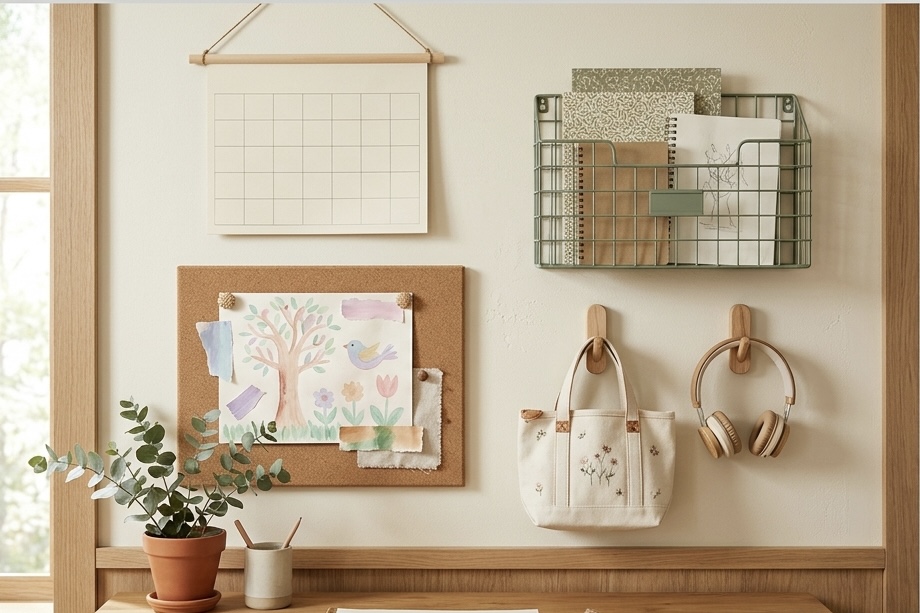
Three things earn their place on the wall. A simple wall calendar so the week is visible at a glance. A cork board or a couple of wall hooks to display finished work and hold headphones or a bag. And a spot for the day’s papers — a wall file organizer keeps today’s worksheet off the floor and out of the backpack black hole.
If you want the full breakdown of what to hang and how to do it in a rental without damaging walls, I walked through my exact three-piece setup in this guide to homeschool wall ideas. The same three pieces work above a homework desk just as well.
Keep the Supplies From Taking Over
Supplies are what turn a calm corner into a disaster zone within a week. The fix is a hard rule: everything in the learning space has a home, and everything goes back to it.
A single caddy or a few labeled bins is enough for most families — one for writing tools, one for paper, one for the current project. You’re not organizing a classroom, you’re containing about a shoebox of stuff.
If you’re working with almost no square footage, the vertical and hidden-storage tricks in my small-space storage guide will stretch a tiny corner further than you’d expect.
Make It Run Itself (The Part Most People Skip)
Here’s the step that separates a corner that works from a corner that becomes a junk pile: the routine. A learning space only runs itself when the kid knows the sequence without being told.
The sequence is simple and it’s the same every day. Sit down, check the list, do the thing, put it away. When that flow is posted where they can see it, you stop being the one who nags — the wall does it instead.
This is exactly why visual routine cards work so well in a learning space. A short, pictured checklist (“snack, homework, pack for tomorrow, free time”) gives your kid a job list they can run on their own, which is the whole point of building the corner in the first place. Pairing that with a calm morning routine means the day has a rhythm from the first hour to the last.
Give your learning space a routine that runs itself
The Visual Routine Cards from the Raising Curious Kids shop turn “what do I do next?” into a checklist your kid can follow on their own. Print, laminate, and hang them right in the corner — morning, after-school, and bedtime sequences included.
For After-School Families, Not Just Homeschoolers
If your kid goes to regular school, you might think a learning space is overkill. It’s the opposite. The hardest transition of the day is the one from school-brain to home-brain, and a dedicated spot smooths it.
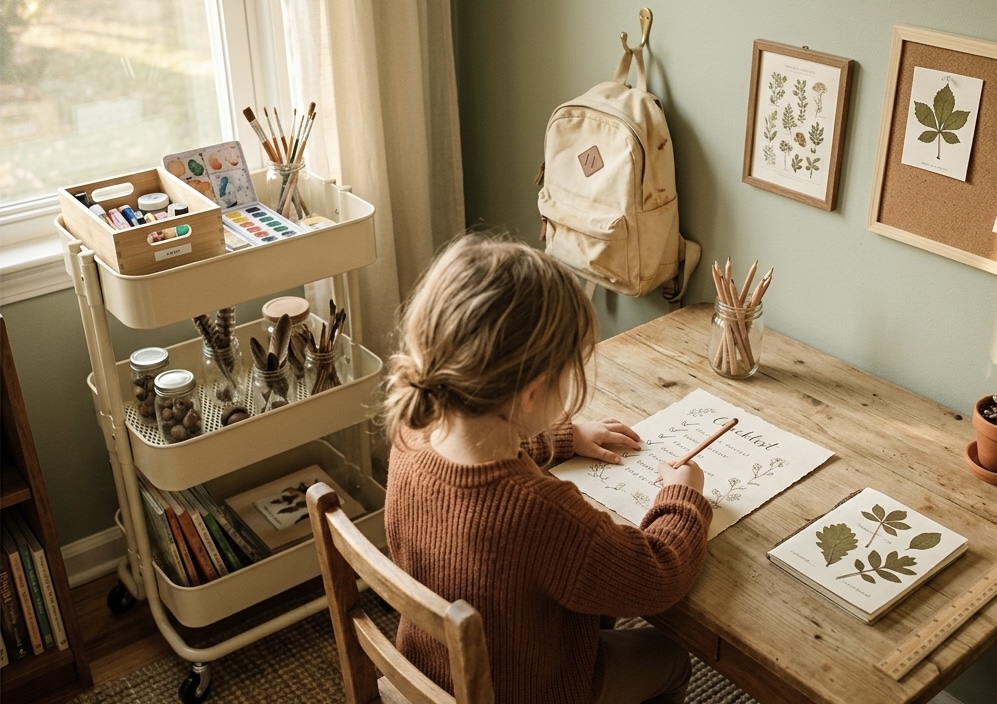
A learning corner gives the after-school hours a landing pad: a place to drop the folder, a visible list of what’s due, and a calm surface to work on before free time. The 4 p.m. battle usually isn’t about attitude — it’s about a kid who doesn’t know where to start.
Homeschool or not, the win is the same. When learning has a home, you stop being the glue holding the afternoon together, and your kid starts running the routine themselves.
Start With One Corner
A learning space isn’t a decorating project — it’s a friction-removal project. You’re not building something beautiful for a photo, you’re building something that makes the work happen without a fight.
Pick the corner your kid already gravitates to, clear one surface, hang one list, and contain the supplies. That’s a working learning space, and you can build it this weekend with what you already own. Add the pretty parts later, once the routine is sticking.
Want a head start on the routine piece? Grab the free weekly planner below — it’s the simplest way to give your new corner a rhythm from day one.