Your kid asks what you are doing today for the fourth time before nine. You answer again, this time while hunting for the glue stick, and somewhere in there the morning slips away with nothing actually started.
A good homeschool wall quietly fixes most of that. It answers the what-are-we-doing questions, holds the shape of the day, and teaches a little on its own without you saying a word.
You do not need a themed classroom or a wall of laminated everything. You need three pieces, hung where little eyes can reach, doing real work. Here is how to build a homeschool wall that earns its space.
This post contains affiliate links. If you buy through them, RaisingCuriousKids may earn a small commission at no extra cost to you. We only point to things we would actually use.
What a Homeschool Wall Is Actually For
A working wall is not decoration. It is the one calm voice in the room that never gets tired of answering the endless question of what comes next.
Kids glance up, get their bearings, and move on their own. Less asking, less nagging, and a little more independence in a day that usually runs on your energy alone.
So there is a single test for anything you hang: does a child actually use it, or does it just fill space? If nobody looks at it, it is noise, and a calm wall gets read while a busy one gets ignored.
The 3-Piece Homeschool Wall (Start Here)
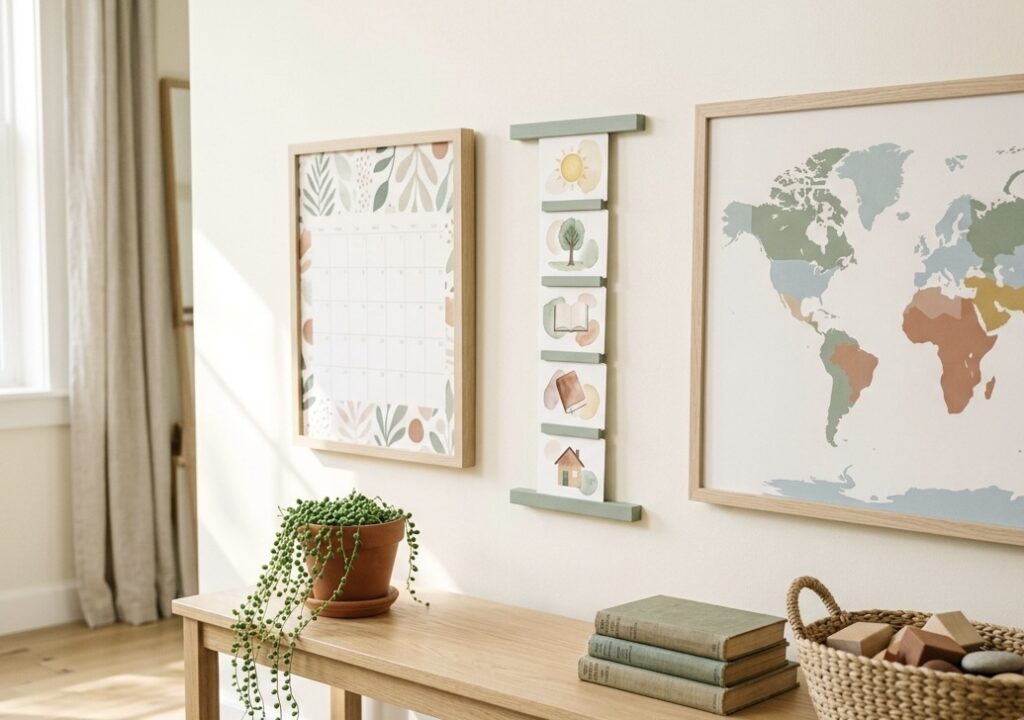
Almost every wall that works comes down to the same three jobs: the day, the year, and the thing you are curious about right now. Get these up and your wall is already doing its job.
1. A visual daily schedule — the day
This is the piece that answers what comes next for you. A row of picture cards or a simple printable strip at eye level lets a child see the shape of the morning and move through it without a running commentary from you.
If mornings are your hardest hour, a set of morning routine cards on the wall gives kids a path to follow before you have finished your coffee.
2. A year-at-a-glance calendar — the year
Kids live in today. A year calendar on the wall makes the big picture visible: the breaks to look forward to, the field trip to count down to, the rhythm of the months laid out where everyone can see it. A magnetic wall calendar keeps it all visible without a single push pin.
3. A current-topic display — the curiosity
This is the piece that changes. Whatever you are learning about right now, a map, a few book covers propped on a ledge, a couple of anchor charts, gives curiosity somewhere to land. A simple world map poster on its own teaches quiet geography all year.
Those three cover structure, the big picture, and wonder. Everything after this is a bonus, not a requirement.
Print Your Wall in an Afternoon
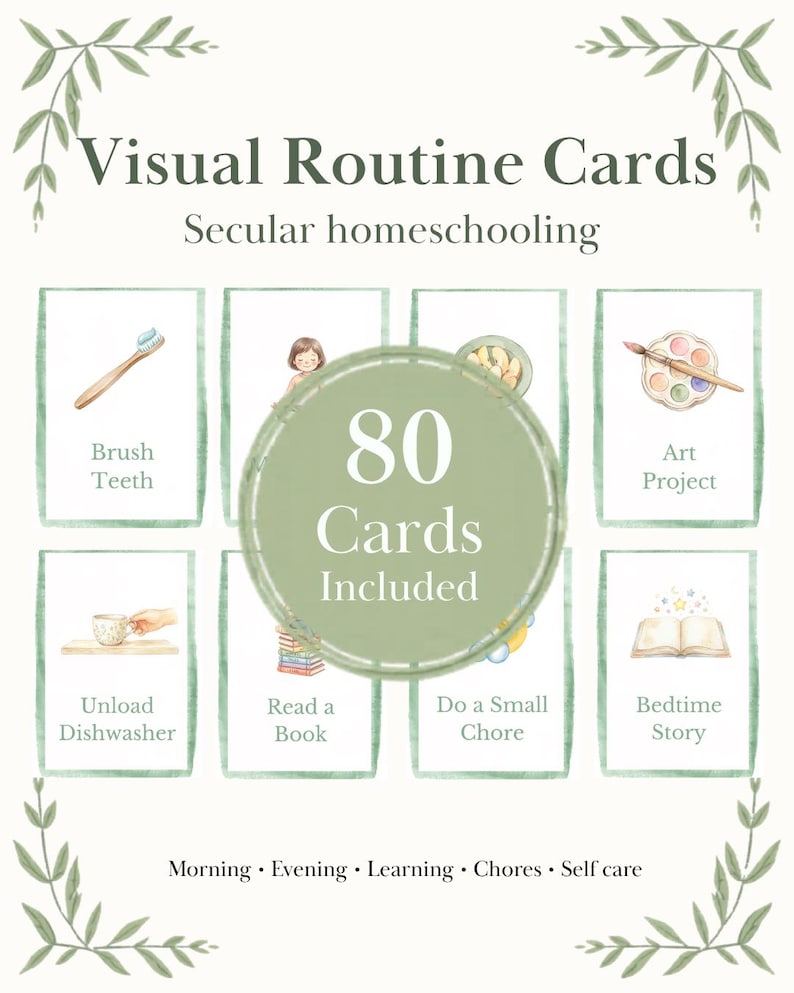
The three core pieces, made to print, hang, and last — calm and clutter-free, not busy:
- Visual Routine Cards for a wall schedule your kids can follow on their own.
- Year at a Glance Planner for the year calendar on your wall.
- Daily Schedule Bundle for an at-a-glance flow to each day.
What to Add Once the Basics Are Working
When the three core pieces are earning their keep, a few extras make the wall pull even more weight. Add them one at a time, and only if they get used.
- A spot to show off finished work. A small corkboard or a line of clips and hooks turns look-what-I-made into a rotating little gallery.
- An in-progress pocket. A hanging wall file keeps current workbooks and printables off the table and within reach.
- Reference lines at their height. An alphabet and number line at a child’s eye level gets glanced at a hundred times a week without a single lesson.
- One calm-down cue. A short what-to-do-with-a-big-feeling visual gives a child somewhere to look when the day gets hard.
Keep it to what actually gets used. A wall with four working pieces beats a wall covered in twenty.
How to Hang It Without Wrecking the Wall
You do not need to put holes in anything, which matters if you rent or if the wall is really a rotating claim on shared space.
- Removable picture-hanging strips. A pack of picture-hanging strips holds posters and boards flat with no nails and no marks.
- Washi tape or a magnetic strip. Perfect for the current-topic pieces you swap every couple of weeks.
- A snap-in poster hanger. A magnetic poster hanger lets you change out a map or calendar in seconds.
Lean into vertical. A wall does a full day of work without stealing a single square foot of floor, which is the whole point when space is tight.
Arrange It So Kids Actually Use It
A wall only works if the people it is for can reach it with their eyes. A few small choices decide whether kids read the wall or walk right past it.
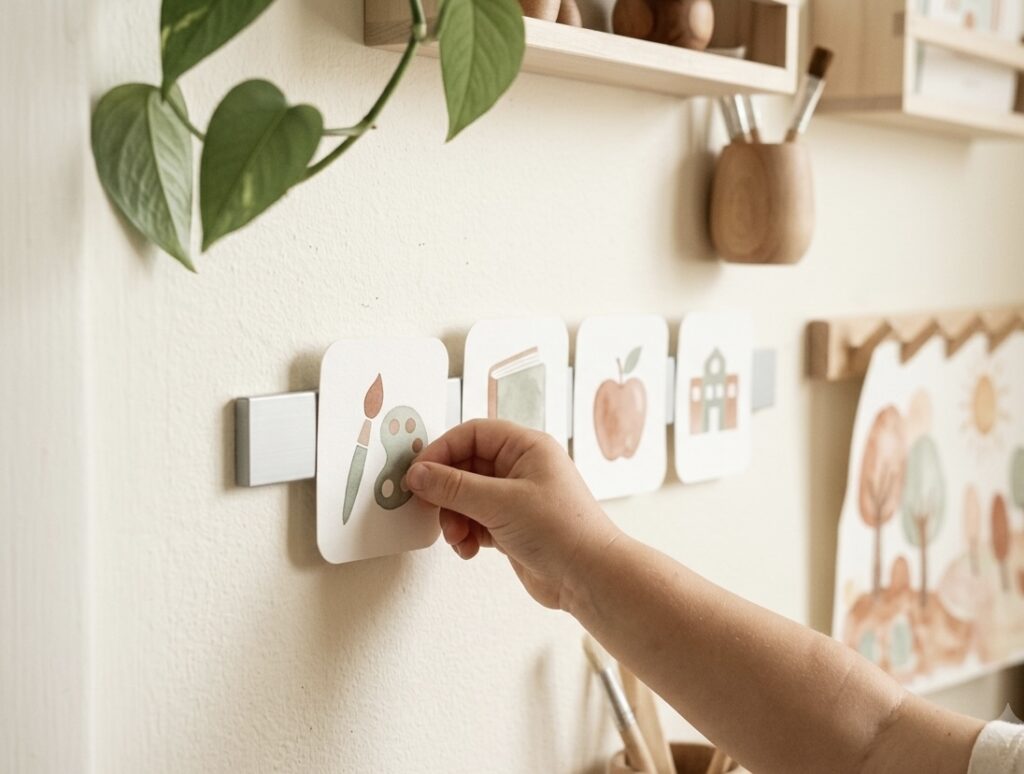
- Hang at their eye level, not yours. A schedule a child cannot see is a schedule a child will not follow.
- Group by job. Day pieces together, reference pieces together, the changing display in its own spot. Order is easier to use than a scatter.
- Leave breathing room. White space around each piece is what lets the eye land. Crowded walls read as clutter and get tuned out.
- Give each kid something that is clearly theirs. One clip, one name card, one square of the wall cuts the that-is-mine friction in a shared space.
No Wall to Spare? Here Is What Still Works
Plenty of families do not have a free stretch of wall, and the whole system still works on almost any vertical surface.
- The fridge or a metal door. Magnets do the entire job, and everything wipes clear in seconds.
- A tri-fold board. Stands up for school and folds flat to tuck away at dinner.
- A tension rod and curtain clips. Strung across a nook or window, it holds cards and pages at any height.
- The side of a bookshelf or a cabinet door. Small, out of the way, and always at kid height.
This is where the wall meets small-space reality. For the whole setup around it, our guides to setting up a homeschool space and homeschool room ideas on a budget walk through building a corner without a dedicated room. And if what you really want is the shared calendar-and-chores hub, the family command center guide builds that in a single weekend.
Once the wall is up, the daily rhythm is the next piece. This free weekly planner is a calm place to start, with no setup required.
Keep the Wall Working All Year
A wall earns its space by staying useful, and that takes only a few small habits.
- Refresh the current-topic display every few weeks. Swap the map, the books, and the anchor charts so the wall grows with your kids instead of fading into the background.
- Retire what nobody looks at. If a piece has not been used in a month, take it down. Empty space beats ignored space.
- Take the schedule down for a week if it stops working. Sometimes kids only notice how much they leaned on it once it is gone.
The Bottom Line
The best homeschool wall is not the prettiest one. It is the one your kids actually read.
Start with three pieces, the day, the year, and the thing you are curious about, hung where little eyes can reach. Add a piece at a time, keep it calm, and let the wall do some of the teaching for you.
Grab the free weekly planner to set your rhythm, then finish your fresh start with the back to homeschool supply list.
Frequently Asked Questions
What should I put on a homeschool wall?
Start with three pieces: a visual daily schedule so the day is predictable, a year-at-a-glance calendar for the big picture, and a current-topic display for whatever you are learning right now. That covers structure, planning, and curiosity without turning the wall into visual noise.
How do I make a homeschool wall in a rental?
Use removable picture-hanging strips, washi tape, or a magnetic strip so nothing leaves a mark. For pieces you swap often, a magnetic poster hanger or the side of the fridge works without touching the wall at all.
Do I need a homeschool wall if I do not have a dedicated room?
No. The fridge, a fold-away tri-fold board, a tension rod across a nook, or a cabinet door all do the same job in the space you already have.
At what height should I hang a homeschool wall?
At the child’s eye level, not the adult’s. A schedule or calendar a child can see for themselves is one they can use without waiting on you.