
New Jersey might be the best-kept secret in American homeschooling. To start, you tell no one, file nothing, and wait for no one’s approval. You just begin.
That is not an exaggeration. New Jersey sits between two of the most paperwork-heavy states in the country, and asks for almost none of what they do. No notice, no registration, no testing, no reporting.
There is exactly one standard you have to meet, and it is worth understanding clearly. Here is what New Jersey actually requires, and the one thing smart families do anyway.
Is Homeschooling Legal in New Jersey?
Yes, and it is one of the simplest places in the country to do it. Home education in New Jersey runs under state law N.J.S.A. 18A:38-25, which says a parent must have their child attend public school or “receive equivalent instruction elsewhere than at school.” That “elsewhere” clause is your legal right to homeschool.
Compulsory attendance applies to children ages 6 through 16. Beyond that single equivalent-instruction standard, the state asks for nothing: no notification, no registration, no approval from a school board, no standardized testing, and no teacher certification. You do not need a college degree.
The One Standard: “Equivalent Instruction”
Everything in New Jersey comes down to one word: equivalent. Your child’s education has to be academically equivalent to what the public schools provide. Two court cases from the 1960s settled what that means, and both landed in the family’s favor.
In State v. Massa (1967), the New Jersey Supreme Court ruled that “equivalent” does not mean “identical.” You are not required to copy the public school’s curriculum, schedule, or methods. In State v. Vaughn (1965), the court established that if a family is ever charged with truancy, the burden of proof falls on the state to show the instruction is not equivalent, not on the parent to prove that it is.
In plain terms: you cover the major subjects at a level appropriate for your child’s age, in good faith, and you are meeting the standard. Reading, writing, math, science, and social studies are the core the state has in mind.
What New Jersey Does Not Require
- No notice or registration. If your child has never been in public school, you tell no one.
- No approval. No school board signs off on your decision to homeschool.
- No testing. Standardized tests and annual evaluations are not required.
- No set hours or days. You choose the schedule: year-round, four-day weeks, whatever fits.
- No mandated curriculum. You pick the materials and textbooks you use.
- No teacher qualifications. No degree and no certificate needed.
Here is the one thing experienced New Jersey families do anyway: they keep simple records. Not because the state collects them, but because if a question ever comes up, a light paper trail is what ends it quickly. An attendance log showing roughly 180 days plus a folder of your child’s work is plenty. A wall-mounted file organizer near your teaching spot keeps the week’s work from vanishing into a backpack, and a simple wall calendar makes tracking your days effortless.
This post contains affiliate links. As an Amazon Associate I earn from qualifying purchases, at no extra cost to you.
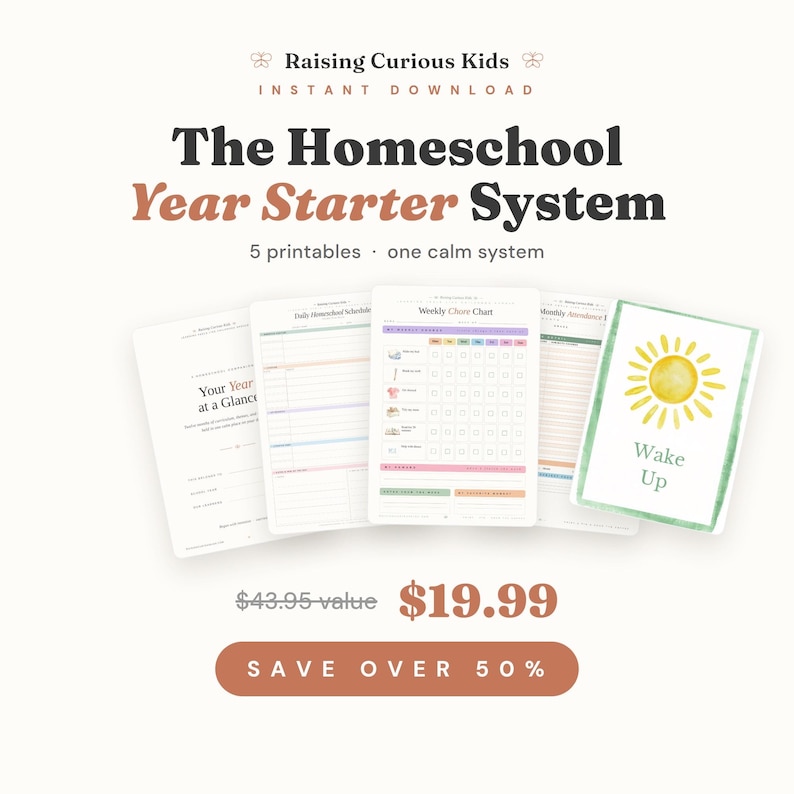
Everything for the Year, Records Included
The Attendance Tracker is one of five printables in our Homeschool Year Starter System: Year at a Glance, Daily Schedule, Attendance Tracker, Chore Chart, and 80 Routine Cards. A clean, print-and-go record for the whole year, plus the tools to plan and run it. Secular, no spreadsheet required.
$19.99 $43.95
Get the Year Starter System on Etsy →How to Actually Start
If your child has never been enrolled
You begin. Choose your materials, start teaching the core subjects, and you are homeschooling legally from day one. There is nothing to file and no one to notify.
If your child is currently in public school
Send a withdrawal letter to your local school before you begin. It is not legally required for most grades, but it closes your child’s enrollment cleanly and stops any absences from being flagged as truancy. Send it by certified mail, or hand-deliver two copies and have one signed as received. One exception: if your child is in grades 9 through 12, the New Jersey Department of Education asks that a transfer form be completed when you withdraw.
New to all of this? Our guide to how to start homeschooling walks through curriculum and the first few weeks.
Why Records Still Matter in a No-Rules State
It sounds odd to keep records in a state that never asks for them, but this is exactly where a little documentation pays off. The whole system rests on good faith: the state assumes you are educating your child unless it has reason to think otherwise.
If a truancy question ever arises, the burden is on the state, but you still want to be able to show your good-faith effort in about five minutes. An attendance log, a list of the materials you use, and a folder of work samples do that. For a high schooler, a running transcript matters later for college applications, so start it early.
New Jersey Homeschool Law: Common Questions
Do I have to notify anyone?
No, not if your child was never enrolled. If you are pulling a child out of public school, you send that school a withdrawal letter (and a transfer form for grades 9 through 12), which is not a state registration.
Does my child have to take a standardized test?
No. New Jersey requires no testing and no annual assessment. You can test privately if you want the data, but nothing is submitted anywhere.
Do I need a teaching degree?
No. There are no qualifications required to teach your own child at home in New Jersey.
What subjects do I have to teach?
The law names no specific subjects. The expectation is that you cover the same broad areas public schools do, so children generally learn language arts, math, science, and social studies, with the rest up to you.
Can my homeschooler get special education services?
Possibly. Under federal law, homeschooled students in New Jersey are treated as parentally-placed private school students, which can make them eligible for certain district services like evaluations or speech therapy. Ask your local district.
Other States and the Big Picture
New Jersey is a genuine outlier. It sits between New York, which asks for a letter of intent, an individualized plan, four quarterly reports, and an annual assessment, and Pennsylvania, which requires an affidavit, a portfolio, and an outside evaluator. New Jersey asks for none of it. Our overview of homeschool laws by state shows just how wide that spread runs, from New Jersey’s near-total freedom to some of the most detailed reporting in the country.
And if you are comparing the hands-off states, Connecticut takes a similar approach, with no required notice and no testing.
The Bottom Line for New Jersey Families
You can start today. Provide an education that is academically equivalent to public school across the core subjects, and you are complying with the law. No notice, no test, no evaluator, no forms.
Then do the one smart thing the state does not require: keep a light record so any question is easy to answer. Set it up once and it stops being a worry. Start with planning your homeschool year, and grab the free weekly planner above to keep the daily rhythm calm.
Last reviewed: August 2026. This is a plain-language summary of New Jersey home education law as it stood on that date, not legal advice. Homeschool rules change, so before you make decisions for your family, confirm the current requirements with the official source: New Jersey Department of Education, and see the NJDOE Frequently Asked Questions on homeschooling. Governing law: N.J.S.A. 18A:38-25, the “equivalent instruction” standard.