

Massachusetts is the state that makes new homeschoolers nervous, and it is the one place where that caution is partly justified: you cannot simply start. You need your district’s approval first.
But “approval” sounds scarier than it is. There is no state test to pass and no official deciding whether you are worthy. There is a plan you submit, a short list of reasonable things your district can ask about, and a set of things it is not allowed to demand.
Once you know where those lines are, the process is far more manageable than its reputation. Here is exactly how homeschooling approval works in Massachusetts, and what your district can and cannot require.
Is Homeschooling Legal in Massachusetts?
Yes, and it has been settled law since 1987. Massachusetts has no dedicated homeschool statute. Instead, home education falls under the compulsory attendance law, M.G.L. c. 76, Section 1, which allows a child to be “otherwise instructed in a manner approved in advance” by the superintendent or school committee.
That single phrase, “approved in advance,” is what makes Massachusetts different. Compulsory attendance runs from ages 6 through 16. You do not need a teaching certificate or a college degree, but you do need your local district’s sign-off before you begin.
The Case That Set the Rules: Care and Protection of Charles
Everything about Massachusetts approval traces back to one 1987 case, Care and Protection of Charles. The state’s highest court laid out what a district may and may not ask for, and that framework still governs every town today.
The court named four things a district may reasonably consider when reviewing your plan:
- The proposed curriculum and the number of hours of instruction in each subject.
- The competency of the parents to teach, though not a requirement that they be certified or hold a degree.
- The materials you plan to use: textbooks, workbooks, and other resources.
- How progress will be evaluated, which may include periodic standardized testing or another agreed-upon method.
Just as important is what the court said districts cannot do. They cannot require that you hold a teaching license, cannot mandate home visits as a condition of approval, and cannot impose conditions that are not essential to the state’s interest in your child’s education. The standard is whether your instruction “equals in thoroughness and efficiency” that of the local public schools, not whether it looks identical.
Your Education Plan
The heart of Massachusetts homeschooling is the education plan you submit to your district each year, usually before or early in the school year. There is no state form and no statewide deadline. Each of the roughly 350 districts sets its own timeline, so submit yours well before you intend to begin.
A solid plan addresses the four factors from the Charles case: the subjects you will teach, a general sense of the hours or schedule, the materials you will use, and how you will evaluate progress. You choose how to cover the required subjects, which mirror what public schools teach, and you can teach them in your own sequence and style.
The parents who find Massachusetts smoothest are the ones who keep their plan and records tidy, because the same paperwork carries into next year’s renewal. A wall calendar with your submission date circled keeps you ahead of the district’s timeline, and a wall-mounted file organizer where the week’s work lands turns your year-end evaluation into a simple review of what you already have.
This post contains affiliate links. As an Amazon Associate I earn from qualifying purchases, at no extra cost to you.
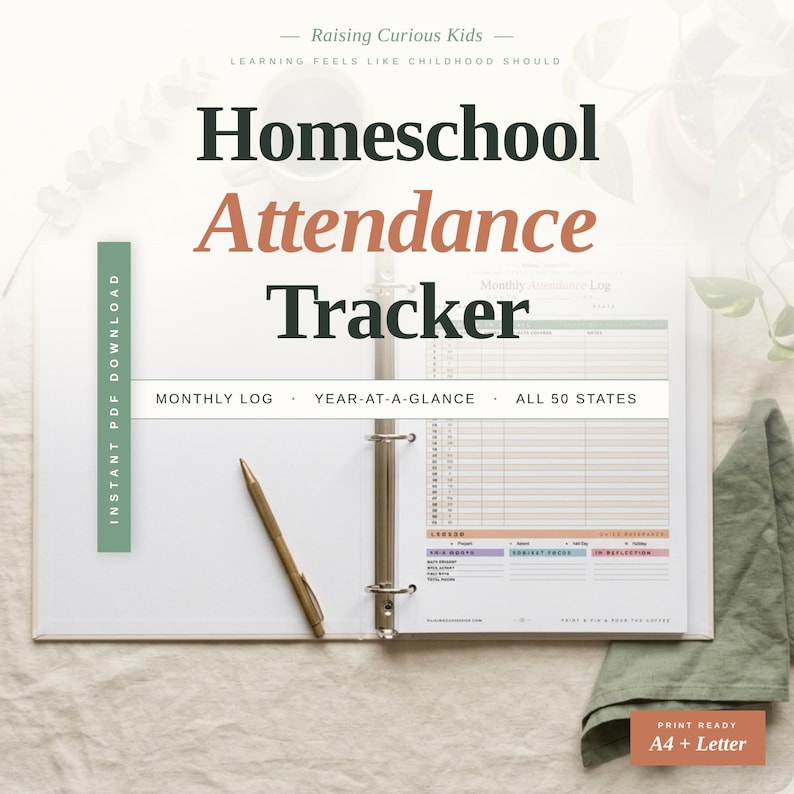
Done-for-You: Homeschool Attendance Tracker
Many Massachusetts districts want to see hours of instruction and days of attendance as part of your plan and your year-end evaluation. This undated printable tracker makes that the easiest field to fill: log the day in thirty seconds and the record writes itself. Print once, keep it at the front of your plan binder, and the number the district asks about is always ready.
Required Subjects
Massachusetts expects home instruction to cover the same core subjects the public schools teach. In practice that means reading, writing, spelling, English grammar, math, science, and geography, along with U.S. history and the Constitution, health and physical education, and drawing or music, plus good citizenship.
You are not handed a mandated textbook list or a pacing schedule. The subjects are the frame; how you fill them is yours. A district cannot reject your plan simply because your approach differs from the public school’s.
Evaluating Progress
Every Massachusetts plan has to say how your child’s progress will be measured, and this is one of the areas the Charles case specifically addressed. Districts commonly accept one of a few options:
- A standardized achievement test.
- A portfolio review of your child’s work, sometimes by a teacher or agreed-upon evaluator.
- A written progress report or narrative evaluation from the parent.
Which options your district accepts varies, so ask early. Because the rules are local, two families in neighboring towns can have genuinely different experiences. That is the trade-off Massachusetts makes: no statewide testing mandate, but a district-by-district approval you renew each year.
How to Actually Start
If your child has never been enrolled
Contact your district’s central office, ask about their home education process, and submit your education plan for approval before you begin instruction. Build in time for a possible round of revisions.
If your child is currently in public school
Submit your plan and secure approval before you withdraw, so there is no gap where absences could be treated as truancy. Once approved, notify the school in writing that you are removing your child to home educate.
Brand new to this? Our guide to how to start homeschooling covers curriculum and the first few weeks.
Massachusetts Homeschool Law: Common Questions
Do I really need approval before I start?
Yes. Massachusetts is one of only a few approval states. Submit your education plan and get your district’s sign-off before beginning; starting without it can open a truancy question.
Can the superintendent just say no?
Not arbitrarily. Approval cannot be unreasonably withheld, and if a plan is denied you can revise and resubmit, or appeal to the school committee. In practice, most disagreements are resolved through small revisions, not formal appeals.
Do I need a teaching degree?
No. The Charles decision is explicit that parents do not need a college or teaching degree. A district may ask about your general competency, but it cannot deny your plan on that basis alone.
Is standardized testing required?
It depends on your district. Some accept a portfolio review or a written progress report instead of a test. You propose your evaluation method in your plan.
Does the state approve my plan?
No. All oversight is local. The Department of Elementary and Secondary Education does not review or approve home education plans; your school district does.
Other States and the Big Picture
Massachusetts sits at the stricter end of the national range, in the same company as New York and Pennsylvania, which also ask for detailed plans and evaluations. What sets Massachusetts apart is that it is all local, so your exact experience depends on your town. Our overview of homeschool laws by state shows how far the spread runs, all the way to states like Texas that require nothing at all. Right next door, Connecticut sits at the opposite end, with no required notice, no testing, and no approval to seek.
The Bottom Line for Massachusetts Families
Submit an education plan to your district, get it approved before you begin, cover the core subjects, and choose an evaluation method you can live with. Renew it each year. That is the whole cycle.
It is more up front than most states, but it is predictable, and your rights inside it are well protected by decades of case law. Keep your plan and records organized and year two is far lighter than year one. Start by planning your homeschool year, and grab the free weekly planner above to keep the daily rhythm steady.
Last reviewed: August 2026. This is a plain-language summary of Massachusetts home education law as it stood on that date, not legal advice. District policies vary and homeschool rules change, so before you make decisions for your family, confirm the current requirements with the official source: Massachusetts Department of Elementary and Secondary Education, Home Schooling, and your local school district. Governing law: M.G.L. c. 76, Section 1, with the approval framework set by Care and Protection of Charles (1987). Approval is a local decision made by your school committee or superintendent.