You are ready to homeschool in Indiana, and the internet cannot agree on what that takes. One page says you have to register with the state. Another says you do nothing at all. They are describing the same law, and the second one is much closer to the truth.
Indiana is one of the most homeschool-friendly states in the country. There is no form to file to begin, no permission to ask for, and no test to pass. What the state does expect is small, specific, and easy to get right.
Here is exactly what Indiana law asks of you, the one requirement most families forget, and how to start this week.
Is Homeschooling Legal in Indiana?
Yes. Indiana law treats your homeschool as a nonpublic, non-accredited school, defined in Indiana Code 20-33-2-12. That single classification is what places your family outside the reach of public school curriculum rules, testing mandates, and teacher-certification requirements.
Indiana is a no-notice, low-regulation state. It does not approve your curriculum, does not schedule your days, and does not need to be told you have started. Compulsory attendance runs from age 7 to 18, so children are not covered by the attendance law until they turn 7.
What Indiana Actually Requires
Strip away the noise and Indiana law asks for four things, all of them manageable.
- Teach in English, with instruction equivalent to what public schools provide. The state does not define equivalent, which leaves the how entirely to you.
- Provide 180 days of instruction each academic year, counted between July 1 and June 30.
- Keep a daily attendance record showing those days. There is no required form; a simple log is enough.
- Be ready to share basic information, your attendance record and the number and grade levels of your children, if the state or your local superintendent asks. Most families are never asked.
Notice what is not on that list. No standardized testing. No named list of subjects you must teach. No minimum hours in a day. No college degree or teaching license for you. Equivalent instruction is generally understood to cover the core academic areas any school would, reading and writing, math, science, and social studies, but you choose the materials and the pace.
How to Actually Start
How you begin depends on one thing: whether your child is currently enrolled in a public school.
If your child has never been enrolled
You simply start. Choose your materials, teach the required 180 days, keep your attendance log, and you are homeschooling legally. There is no one to notify and no form to send.
If your child is currently enrolled
Withdraw your child from the public school before you begin, so the district stops marking absences. A short written notice to the school that you are withdrawing to homeschool, with the date, does the job. Send it so you can prove it arrived, and keep a copy.
One Indiana-specific wrinkle: if you are withdrawing a high school student, the principal is required to give you an exit form explaining the rules for non-accredited nonpublic schools, which you sign. It is a formality, not a permission slip.
Brand new to all of this? Our guide to how to start homeschooling walks through choosing curriculum and surviving the first few weeks.
Do You Have to Keep Records in Indiana?
Yes, and this is the requirement families most often overlook. Indiana Code 20-33-2-20 asks you to keep an accurate daily record of attendance covering your 180 days. You do not submit it anywhere, but your local superintendent or the state Secretary of Education can request it, so it needs to exist.
Beyond attendance, the state asks nothing, but a light paper trail is worth keeping for your own sake. Records smooth out the moments that come later: joining a co-op, applying to college, moving back into public school, or answering a district that contacts you by mistake. A folder of work samples plus your attendance log is plenty. A wall-mounted file organizer near your teaching spot keeps the current year’s papers from vanishing into the bottom of a backpack.
This post contains affiliate links. As an Amazon Associate I earn from qualifying purchases, at no extra cost to you.
Everything for the Year, Records Included
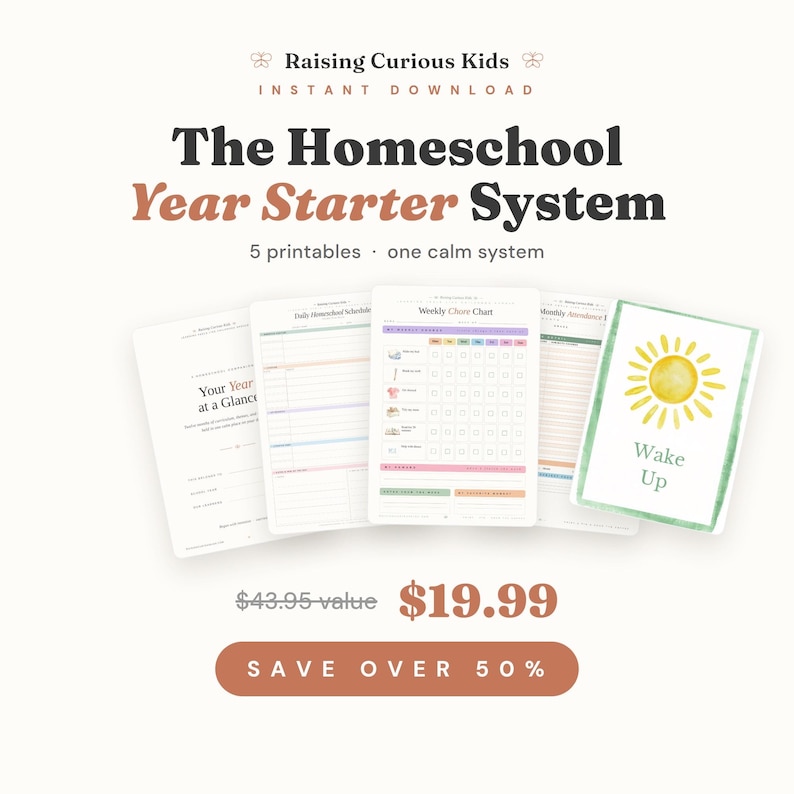
The Attendance Tracker is one of five printables in our Homeschool Year Starter System: Year at a Glance, Daily Schedule, Attendance Tracker, Chore Chart, and 80 Routine Cards. A clean, print-and-go record for the whole year, plus the tools to plan and run it. Secular, no spreadsheet required.
$19.99 $43.95
Get the Year Starter System on Etsy →Indiana’s Homeschool Tax Break (and What It Is Not)
Indiana is one of the few states that hands homeschool families a small financial break. If your child is homeschooled, you can claim a state tax deduction of up to $1,000 per child for education expenses like curriculum, textbooks, and supplies. Keep your receipts and claim it on your Indiana return.
You will also hear about Indiana’s Education Scholarship Account, or ESA, which can be worth far more. That program is limited to students with disabilities who meet specific criteria, so it is not a general homeschool fund. For most families, the $1,000 deduction is the benefit that actually applies.
Indiana Homeschool Law: Common Questions
Do I have to notify anyone that I am homeschooling?
Not to start. If your child was never in public school, you tell no one. If you are withdrawing from public school, you notify that district to end enrollment, which is not a registration with the state.
Does my child have to take a standardized test?
No. Indiana requires no testing for homeschoolers. You can test privately if you want the data, but nothing is reported to anyone.
What actually counts toward the 180 days?
Any day of real instruction between July 1 and June 30 counts, and there is no rule about which days or how many hours. Learning on a Saturday counts. A focused morning counts. If your child was enrolled in a school for part of the year, those days count too. You just need the total to reach 180.
Can my homeschooler play public school sports?
Not automatically. Indiana does not guarantee homeschoolers access to public school teams; it is decided locally and by athletic-association rules. Some districts let homeschoolers enroll part-time in a class or two, so ask yours what it allows, and look into the homeschool leagues that operate around the state.
Other States and the Big Picture
Indiana sits at the light end of the national range, but the rules change sharply the moment you cross a state line. Our overview of homeschool laws by state shows just how different they get. For nearby comparisons, Illinois asks almost nothing of families either, Michigan is similarly hands-off, Ohio adds a short annual notification that Indiana does not, and just across the Ohio River Kentucky treats your homeschool as a private school with a notice and yearly recordkeeping.
The Bottom Line for Indiana Families
Teach in English, cover a real program for 180 days, and keep an attendance log you could hand over if asked. That is the whole legal picture. Withdraw properly if your child is enrolled now, save your receipts for the tax deduction, and you are fully compliant, with more freedom than families in most other states.
Then get on with the good part. Start with planning your homeschool year, and grab the free weekly planner above to keep the daily rhythm calm.
Last reviewed: August 2026. Homeschool law changes, and the details above are a plain-language summary, not legal advice. Before you make decisions for your family, confirm the current rules with the official source: Indiana Department of Education Homeschool FAQ. The governing statute is Indiana Code 20-33-2.