You looked up how to homeschool in South Carolina and immediately hit Option 1, Option 2, and Option 3. It sounds like a test you have to pass before you have even started. It is really just three doors into the same room.
South Carolina lets you homeschool under your school district, under a statewide association, or under a smaller accountability association, and the door you pick sets how much oversight you get. Almost every family lands on the same one, for good reasons.
Here is what the three options actually mean, which one most families choose, and how to start without getting tangled in paperwork.
Is Homeschooling Legal in South Carolina?
Yes. Homeschooling has been legal in South Carolina since 1988, and the law lives in Title 59, Chapter 65 of the state code. It gives you three separate legal paths, each with its own accountability body.
One rule holds no matter which path you choose: the teaching parent must have at least a high school diploma or a GED. There are no exceptions to that, but there is also no requirement for a college degree or a teaching certificate.
The Three Options (and the One Most Families Pick)
Every South Carolina homeschooler operates under one of three options. They differ mainly in who holds you accountable and how much testing is involved.
Option 1: Under your school district
You apply to your local school district’s board of trustees for approval. This path carries the most oversight: 180 days of instruction, semiannual progress reports, records the district can review on reasonable notice, and annual standardized testing. Because of that weight, very few families choose it today.
Option 2: SCAIHS
You join the South Carolina Association of Independent Home Schools, a statewide body named directly in the law. Membership runs a few hundred dollars a year and comes with structure: SCAIHS keeps records and transcripts for you, sets its own standards, and requires standardized testing. Families who want professional recordkeeping and a well-established name often pick it.
Option 3: An accountability association
You join any qualifying homeschool association that has at least 50 member families. This is the most popular path in the state by a wide margin. It keeps you legal, leaves your curriculum and methods entirely to you, and most associations do not require standardized testing. Membership is inexpensive, often somewhere between ten and a hundred dollars a year.
For most South Carolina families, Option 3 is the answer: lowest cost, lightest oversight, full freedom over how you teach. Option 2 suits those who want records handled for them, and Option 1 is rare. The rest of this guide leans on Option 3, since that is where most readers will land.
What South Carolina Requires You to Teach
All three options share the same academic floor. You teach at least 180 days a year and cover reading, writing, mathematics, science, and social studies.
In grades 7 through 12, the list adds composition and literature. Beyond that, South Carolina does not dictate curriculum; classical, Charlotte Mason, textbook, unit study, or a mix are all fine, as long as the required subjects are there.
How to Actually Start
Starting in South Carolina is less about a state form and more about joining the right group in the right order.
Join your option before you withdraw
This is the step families miss. Secure your membership in an Option 3 association, or complete Option 1 approval, or join SCAIHS, before you withdraw your child from public school, so there is never a gap where attendance is unaccounted for.
If you are withdrawing mid-year, ask your association for a membership letter and a withdrawal letter. Those two documents release your child from compulsory attendance cleanly.
Pick an association that fits
Option 3 associations range from bare-bones and cheap to service-heavy with transcripts and support. Compare a few on cost, deadlines, and the help they offer, then enroll. Note any internal deadlines your association sets, because missing one can cost your membership and, with it, your legal status.
New to homeschooling entirely? Our guide to how to start homeschooling covers choosing curriculum and finding your rhythm in the first few weeks.
Do You Have to Keep Records in South Carolina?
Yes, and Option 3 spells the list out more specifically than the other paths. You keep a plan book or diary of the subjects you teach, a portfolio of your child’s work samples, and a record of semiannual progress evaluations.
Your association verifies that you are maintaining these; it does not grade your child or dictate your lessons. Keeping the records current all year is far easier than assembling them the week a report is due.
The simplest setup is one you keep up with as you go. A wall-mounted file organizer near your teaching spot, with a slot for the plan book, work samples, and evaluations, turns the portfolio from a project into a habit.
This post contains affiliate links. As an Amazon Associate I earn from qualifying purchases, at no extra cost to you.
Everything for the Year, Records Included
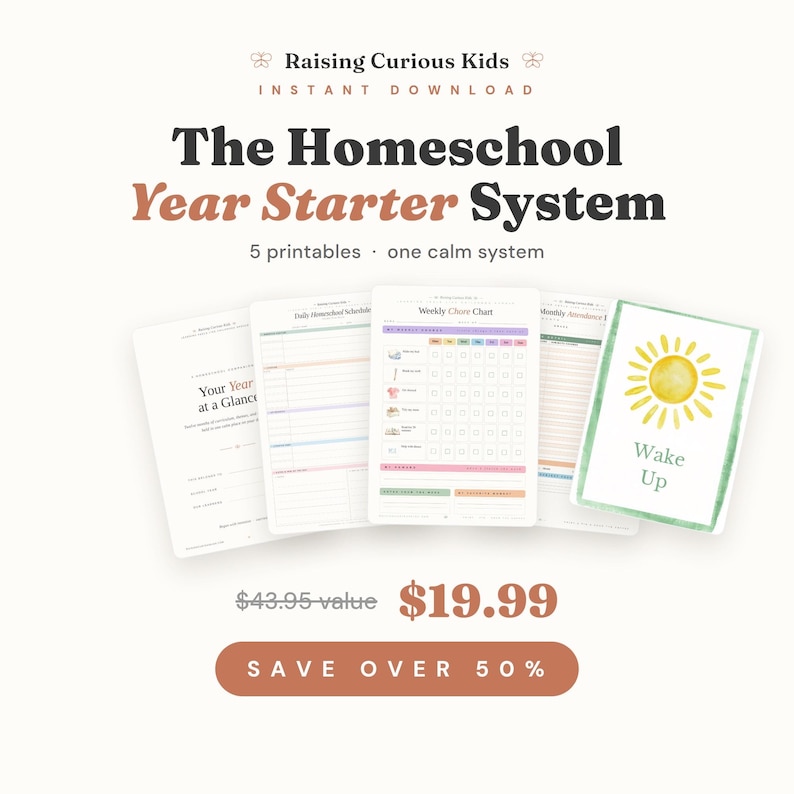
The Attendance Tracker is one of five printables in our Homeschool Year Starter System: Year at a Glance, Daily Schedule, Attendance Tracker, Chore Chart, and 80 Routine Cards. A clean, print-and-go record for the whole year, plus the tools to plan and run it. Secular, no spreadsheet required.
$19.99 $43.95
Get the Year Starter System on Etsy →SCAIHS or an Option 3 Association: How to Choose
This is the decision most new families actually wrestle with, so here is the short version. Both keep you legal, and both require a high school diploma or GED, 180 days, and the core subjects.
The differences are cost and testing. SCAIHS runs a few hundred dollars a year, keeps your records and transcripts, and requires standardized testing. An Option 3 association usually costs a fraction of that, leaves testing to you, and hands recordkeeping back to you.
If you want structure and records managed for you, SCAIHS earns its fee. If you want the lowest cost and the most freedom, an Option 3 association is why most of the state homeschools the way it does.
South Carolina Homeschool Law: Common Questions
Do I have to register with the state?
Not with the state directly. You join one of the three accountability options: your district, SCAIHS, or an Option 3 association. That membership is what makes your homeschool legal.
Does my child have to take a standardized test?
It depends on your option. Option 1 and SCAIHS require testing; most Option 3 associations do not. Many Option 3 families test voluntarily to benchmark progress, but it is a choice, not a rule.
Do I need a teaching degree?
No. You need at least a high school diploma or GED. South Carolina does not require a college degree or a teaching certificate.
Can my homeschooler play public school sports?
Yes. South Carolina’s equal-access law lets homeschooled students try out for public school teams on the same footing as enrolled students, once the eligibility requirements are met.
Other States and the Big Picture
South Carolina’s three-option system is one of the more distinctive in the country, but it is far from the strictest. Our overview of homeschool laws by state shows how sharply the rules change from one border to the next. Next door, North Carolina runs on a single state filing and one annual test, Georgia uses a declaration and monthly attendance model, and Tennessee offers its own set of three legal paths, including an umbrella option.
The Bottom Line for South Carolina Families
Pick your option, Option 3 for most, join before you withdraw, teach the core subjects across 180 days, and keep your plan book, portfolio, and progress reports current. Do that and you are fully compliant, with near-total freedom over how you teach.
Then get on with the good part. Start with planning your homeschool year, and grab the free weekly planner above to keep the daily rhythm calm.
Last reviewed: August 2026. Homeschool law changes, and the details above are a plain-language summary, not legal advice. Before you make decisions for your family, confirm the current rules with the official source: South Carolina Department of Education. The governing law is Title 59, Chapter 65 of the South Carolina Code, Sections 59-65-40, 59-65-45, and 59-65-47.