Everything you own for school is currently in three places: the dining table, a tote bag by the door, and a shelf in the hall closet that you have to move two coats to reach.
So every morning starts with a search. Ten minutes gone before anyone has written a word, and by the end of the day it has all migrated back to the table anyway.
This is not a room problem. It is a storage problem, and it has almost nothing to do with how much space you have. Here is where each thing goes, what to buy, and the rules that keep it from collapsing by October.
This post contains affiliate links. As an Amazon Associate I earn from qualifying purchases, at no extra cost to you.
Storage Is a Category Problem, Not a Container Problem
Most homeschool storage advice starts with bins. That is why most homeschool storage fails.
Buy the bins first and you end up with six containers holding a mix of everything, which is exactly what you had before, just in plastic. The pile did not go away. It got a lid.
Work the other direction. Decide the categories first, give each one a home, and then buy only the container that home needs. Five categories cover a whole homeschool, and most families already own half the containers.
The Five Things You Need to Store
1. Today’s work — keep it moving
The books and pages in use right now should never be filed. They need to be grabbable in one motion and gone in one motion.
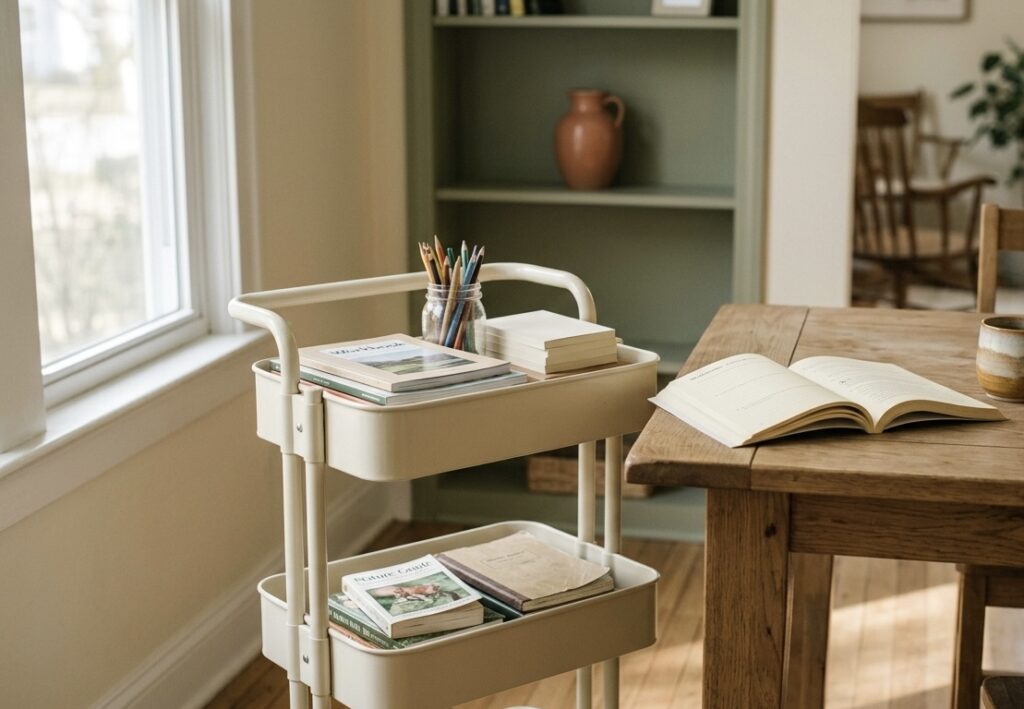
A rolling cart is the single best purchase here. It rolls to the table in the morning and rolls to a corner at four o’clock, and the table goes back to being a table.
If a cart is too much, a utility caddy with a handle does the same job for a fraction of the price, and it travels to the porch or the kitchen counter without a second thought.
2. This year’s curriculum — low and visible
Books you will use this year belong on an open shelf, spines out, low enough for a child to pull one down without asking.
A low bookshelf doubles as a boundary marker, which is why it works so well in a living room corner. Workbooks are the problem here, because they are too floppy to stand up and they slide into a pile within a week. A few magazine file holders hold them upright, one per subject, and the shelf stays readable.
Next year’s books do not go here. They go in a closet, in a box, out of sight.
3. Supplies — at their height or they do not exist
If a child has to move three things to reach the glue, the glue is gone. Not lost, just unused, which costs you the same.
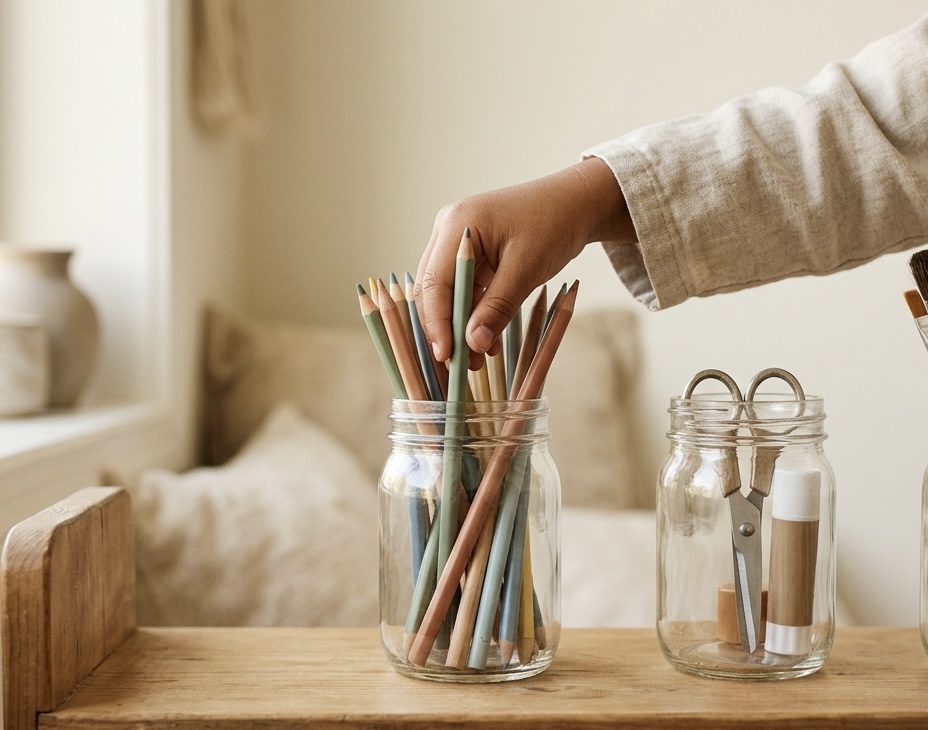
Wide-mouth mason jars or open cups, one per category, on a shelf at kid height. Writing tools in one, scissors and glue in another, art supplies in a third. Wide mouths matter more than they sound: a small hand should be able to drop something in without aiming.
Open containers beat lidded ones every time, because a lid is one step too many for a seven-year-old.
4. Paper — the one that always wins
Paper is what actually takes over your house. Finished work, worksheets in progress, the drawing nobody is allowed to throw away.
Give it two homes and it stops migrating. A hanging wall file holds in-progress pages off the table and within reach. A small corkboard gives finished work a place to be seen for a week before it goes. Keep a color-coded binder per kid for the pieces worth keeping, and let the rest go.
5. Everything else — one bin per kid, lid on
Manipulatives, half-finished projects, the thing that has no category. One lidded bin per child, and when school is over the lid goes on and the room is a room again.
Inside it, a zippered pouch per subject turns a lesson into one grab. The pouch is the classroom. Wherever it lands, school happens there.
One bin. Not two. When a second bin feels necessary, that is not a storage need, it is a purge you have been avoiding.
The Part That Makes Kids Put It Back
Storage only holds if the kids run it, and kids run pictures long before they run lists:
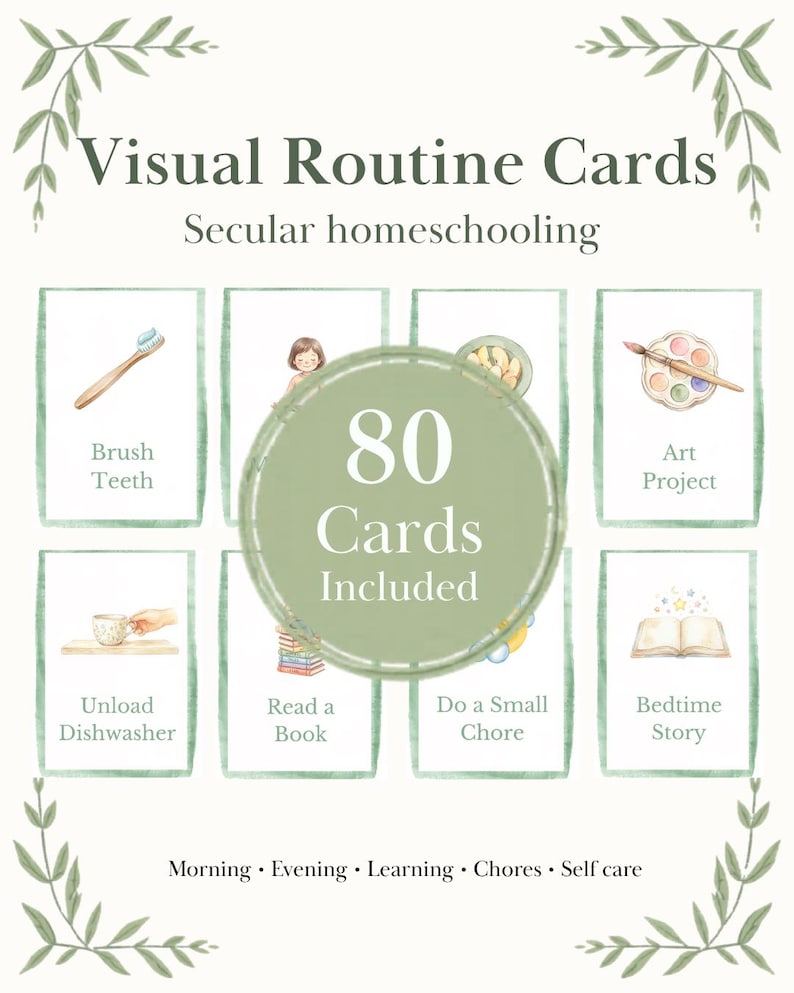
- Visual Routine Cards to make the put-it-away step part of the day, not a fight.
- Daily Schedule Bundle for a day your kids can see without asking you.
- Year at a Glance Planner for the big picture above the shelf.
Storage That Uses No Floor
When there is no room for storage, the answer is almost always vertical. Walls and doors are the square footage nobody is using.
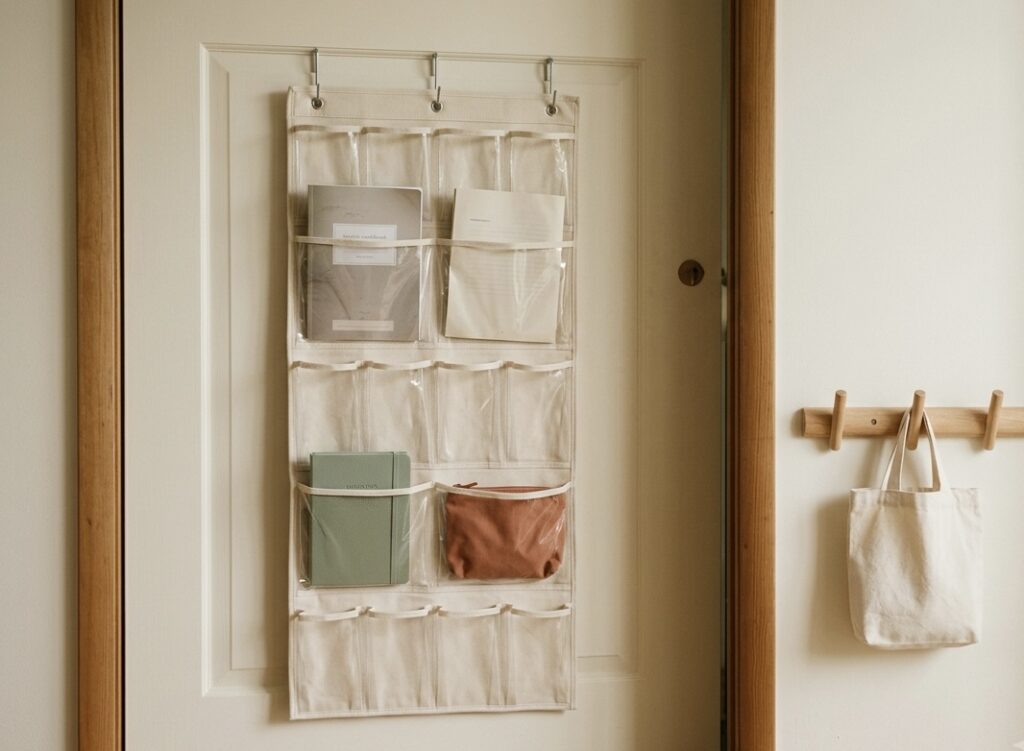
- The back of a door. An over-door organizer with clear pockets, one pocket per subject. Zero floor space, everything visible.
- A line of hooks at kid height. Wall hooks hold bags, headphones, and the pouch that otherwise lives on a chair.
- The fridge or a metal door. Free, magnetic, and already at the right height.
- Renting? Removable hanging strips put all of it up with no nails and no marks.
The wall is doing storage and teaching at the same time here. Our guide to homeschool wall ideas covers the three pieces worth hanging first.
The Under-$60 Version
Buy in this order and stop when the money runs out. Ranked by how much each one changes your morning.
- A caddy or a cart. Ends the search. Buy this even if you buy nothing else.
- Open jars for supplies, at kid height. A few dollars, and kids start serving themselves.
- One lidded bin per kid. The line between a homeschool and a mess.
- A pouch per subject. Turns any surface in the house into a desk.
- A wall file. Paper stops living on the counter.
- Hooks and a corkboard. The last things off the floor.
That is a full storage system for less than the cost of one curriculum. For the room around it, our homeschool room ideas on a budget guide covers the furniture, and the back to homeschool supply list covers what goes inside.
Storage is half of it. The rhythm you run it on is the other half — this free weekly planner is a calm place to start, with no setup required.
Four Rules That Keep It From Collapsing
Every storage system works in September. These are the four things that decide whether it survives to spring.
- One home per category. Not two. The moment pencils live in two places, they live in neither, and you are back to searching.
- Kid height, or it does not exist. Anything above their shoulder is your job forever. Put it where they can reach it and it becomes theirs.
- Label with pictures, not words. A photo of scissors taped to the jar means a five-year-old can put things away without reading. That is the whole game.
- Ten minutes at the end of the day, together. Everything back before anyone opens a screen. Set a visual timer where kids can see it and the clean-up stops being your voice and starts being the clock. Ten minutes now beats a Saturday later.
If it is the household paper that keeps winning rather than the school stuff, a family command center gives it one landing spot for everyone.
What Not to Buy
- Matching bins in a set of twelve. You will fill all twelve. That is not organization, that is storage for things you were going to throw out.
- Anything with a latch or a lid on daily-use supplies. Every extra step is a step kids skip.
- Opaque containers. If you cannot see it, you will buy a second one.
- A label maker. Tape and a marker work, and you will actually do it today.
The Bottom Line
Homeschool storage is not about having more room. It is about five categories, five homes, and a height a child can reach.
Decide the categories, buy the caddy, put the jars where small hands land, and let the ten-minute reset do the rest. The pile does not come back when everything has somewhere to go.
Grab the free weekly planner to set your rhythm, then put up the three-piece homeschool wall above it.
Frequently Asked Questions
How do you store homeschool supplies in a small space?
Go vertical and go mobile. A utility caddy holds today’s work and moves out of the way, an over-door organizer uses space you are not using, and open jars at kid height keep supplies reachable without a shelf.
Where do you keep homeschool books?
This year’s books go on a low open shelf, spines out, where kids can pull one down themselves. Magazine file holders keep floppy workbooks upright so the shelf stays readable. Next year’s books go in a closed box out of sight.
How do you organize homeschool papers?
Give paper two homes: a wall file for work in progress and a corkboard for finished work on display for a week. Keep one binder per child for the pieces worth saving and let the rest go.
What is the best homeschool storage on a budget?
A caddy, a few jars, one lidded bin per kid, and a pouch per subject. That runs well under sixty dollars and solves the search that costs you the first twenty minutes of every morning.
How do you get kids to put homeschool supplies away?
Make it a step they can see. Put a picture of what belongs there on the jar or the bin, keep everything at their height, and run the same ten-minute reset at the same time every day with a visual timer. Kids follow a visual they can read on their own long before they follow a rule you repeat.
Do you need a homeschool room to stay organized?
No. Every system on this page works on one shelf, one door, and one caddy that moves. Families with a dedicated room end up at the kitchen table anyway, which is why the categories matter more than the square footage.